 Dypressuregauge
How To Check If Pressure Gauge Is Working
To confirm whether your pressure gauge is still in “state”, the most direct way is to take three steps: first, “zero check” to see if the pointer is zero after complete pressure relief; The second is “tap test”, flicking the case under pressure to see if the pointer jumps (that is, what we often call “hysteresis”); Finally, if you need a firm conclusion, it is necessary to carry out a “comparative test” and compete with it on the same stage with a high-precision standard table. If the reading deviation exceeds its accuracy level (usually 2-3%), the gauge should be retired. In addition, the table is broken, the dial water or the interface leakage, these are obvious “retirement signal”.
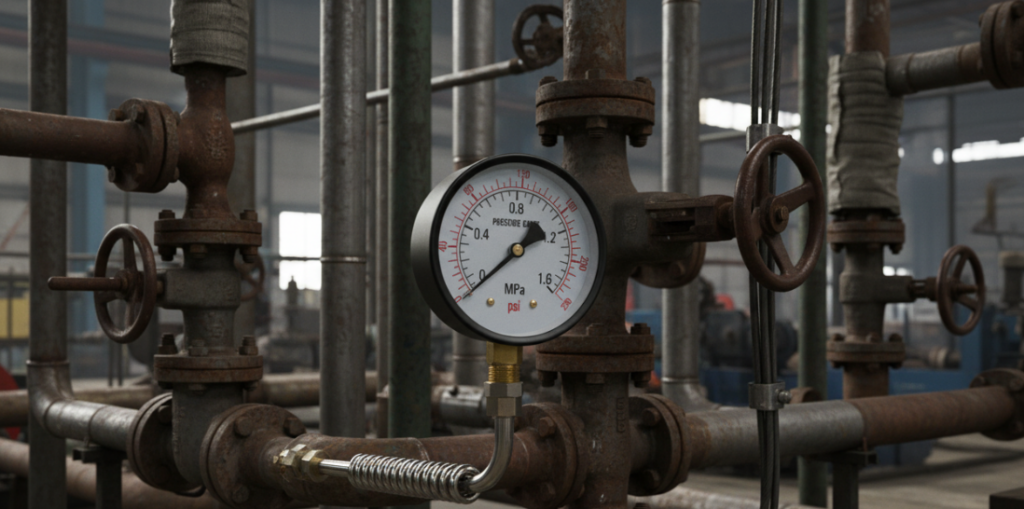
Zero Check: Assess the Status of the Bourdon Tube
To check whether the pressure gauge fails, the most basic step is to see its performance under no pressure. This is essentially checking whether the Bourdon tube, the core component of the pressure gauge, has produced permanent deformation.
How to operate: Ensure that the system has been completely relieved, and the system pressure must be reduced to atmospheric pressure.
Observation focus: the pointer must be tightly pointed at the zero scale line.
Professional judgment: If the pointer stops a little above the zero position, or it is firmly on the lower limit pin, it indicates that the internal Bourdon tube has undergone “permanent deformation”. This is usually caused by system overpressure. As long as the zero is crooked, all the readings behind are wrong, and there is no need to waste time calibrating it.
Tap Test: Identify Mechanical Friction
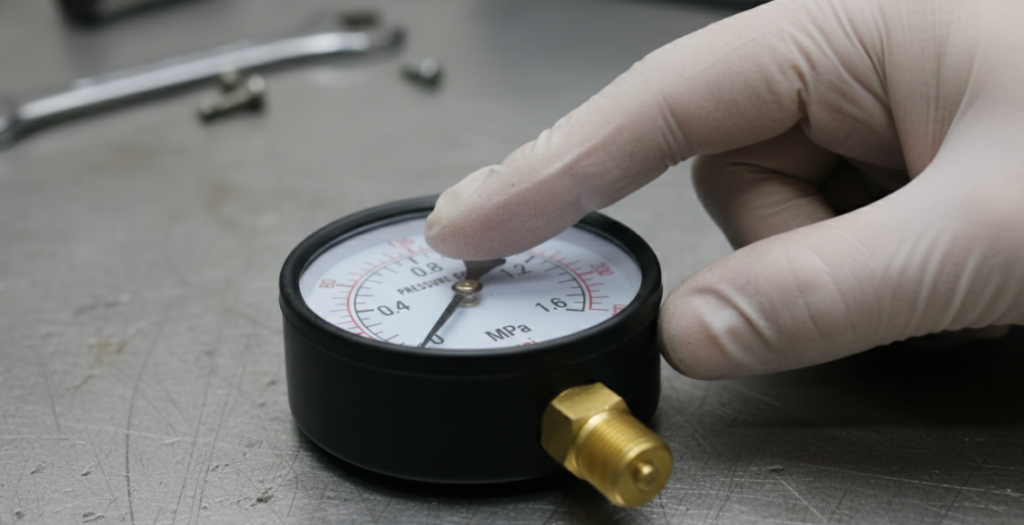
Although some pressure gauges can be reset to zero, the internal gears and hairspring may have been worn or rusted. At this time, I will do a simple “tap test” to diagnose this mechanical friction, which is also called “hysteresis” in the industry.
How to operate: When the system is under stable pressure, flick the gauge cover with the finger joints.
Observe the key point: the normal pressure gauge pointer should remain still, or only a very small vibration and quickly recover.
Professional judgment: If you tap and the pointer “jumps” to a completely different reading, it means that there is serious friction or jamming in the internal mechanism. This kind of meter is unresponsive to pressure fluctuations and often gives outdated readings. It is a time bomb for safety monitoring and must be replaced.
Comparative Testing: The Ultimate Verification Scheme
In key stations involving safety, we can’t rely on guessing. At this time, we need “comparative test”, which is what we often call bench test.
Method of operation: Use the three-way connector to install the pressure gauge to be tested and a “standard gauge (Master Gauge)” on the same pressure source. Standard tables are usually extremely accurate and are usually locked in the toolbox and not easily used.
Observation focus: compare the readings of the two tables at different pressure points.
Professional judgment: flip the dial of the pressure gauge to see its accuracy level (such as Grade B or 2-3%). If the difference between the two exceeds the rated accuracy range, then this gauge is a non-conforming product, which should be scrapped and submitted for inspection.
Appearance Inspection: Internal Failure at a Glance
Sometimes, you don’t need any standard gauge at all, and the naked eye can see that the gauge is useless. Physical degradation of the housing and internal components is the most visible manifestation of performance failure.
The table cover is broken or yellowed: The damaged table cover not only cannot see the reading clearly, but even more deadly is that it will allow pollutants in the environment to drill into the movement.
Internal water/fog: in the liquid pressure gauge, if there is condensation or turbidity, the sealing ring is broken. After the water enters, the interior will soon rust.
Joint leakage: If you find that there is a liquid or gas overflow at the connection point (table seat), the system pressure will not be able to fully act on the Bordon tube. This condition tends to result in low readings.
When Should I Change My Gauge?
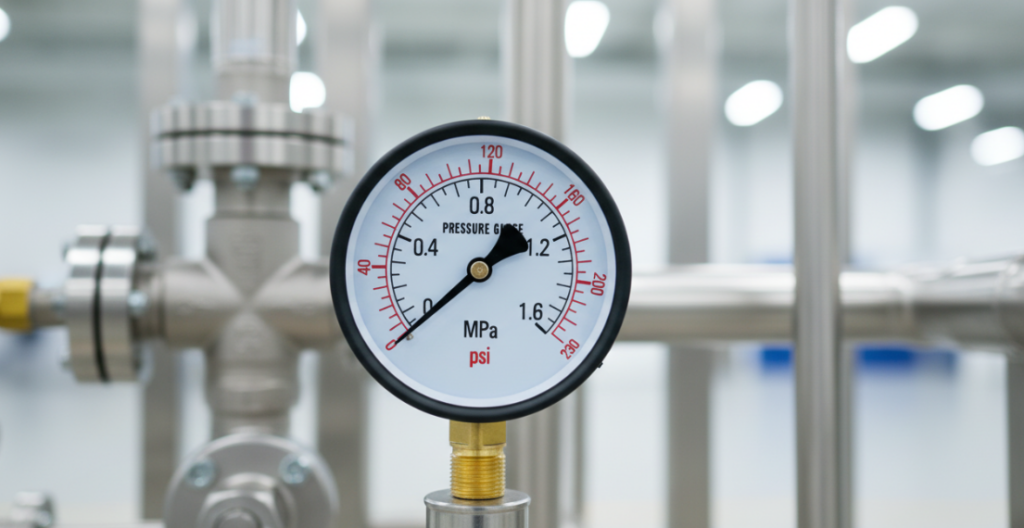
If your pressure gauge does not pass any of the tests mentioned above-whether it is a zero run, the pointer jumps after a knock, or there is obvious damage to the appearance-it is no longer a reliable safety tool.
For most industrial pressure gauges, the cost of maintenance is often more expensive than buying a new one. In order to ensure the life of the equipment and the personal safety of the operator, after the problem table is found, the most professional approach is to replace it directly, rather than trying to repair a tired movement.
Author: Robert Miller
“I’m a veteran industrial maintenance technician with over 12 years of hands-on experience in on-site troubleshooting. Throughout my career, I’ve seen how a single overlooked pressure gauge can lead to costly production shutdowns or safety hazards. I am passionate about sharing practical, field-tested advice—from simple tap tests to complex comparative verifications—to help operators and engineers keep their systems running safely and efficiently. My philosophy is simple: precision is the backbone of safety.”
The next: How To Calibrate A Digital Thermometer