 Dongyayibiao
Can You Have Negative Gauge Pressure
9Learn Why Negative Gauge Pressure Occurs In Vacuum And HVAC Systems And How To Interpret Your Gauge Readings.
View detailsWhile it is physically possible to connect an air pressure gauge to a water system if the NPT connection sizes match, it is generally not recommended for long-term use.
Air pressure gauges are designed for clean, dry and non-corrosive media. Once you connect it to the water system, those sensitive “pressure components” (such as Bunden tubes) will be directly exposed to moisture and impurities. This will not only lead to instrument corrosion, the internal structure of the scrap, the most terrible thing is that the reading will soon be inaccurate. For the stability of the system, what you need is a liquid filled pressure gauge or stainless steel gauge designed specifically for aqueous media.
It is undeniable that most barometer and water pressure gauge do use standard NPT threads (such as 1/4 “or 1/8” NPT). They bite perfectly and look tight and watertight when screwed on. However, we have to make it clear that if we can screw the watch up, it does not mean that the watch can withstand the medium inside. The compatibility of external connections is only an illusion, and the compatibility of internal materials is the core.
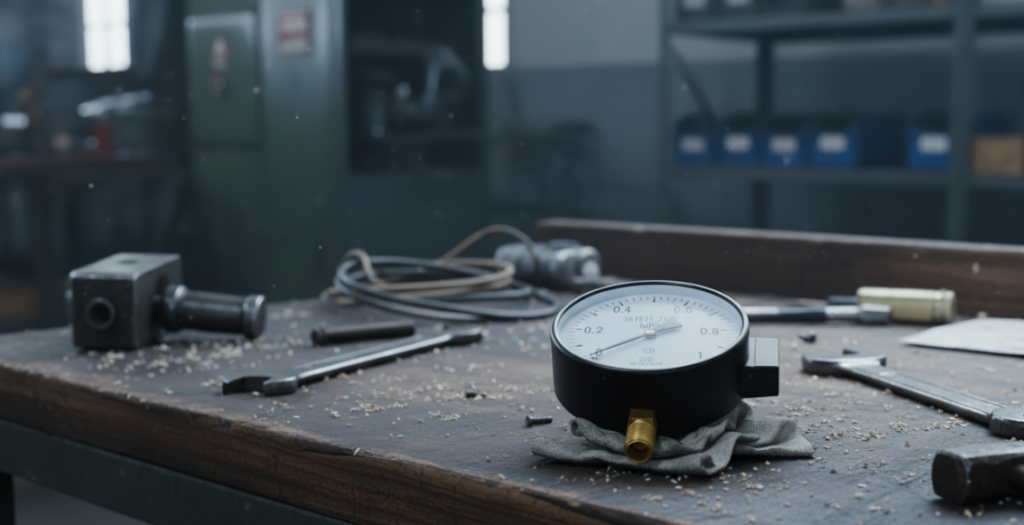
The barometer is prepared for the pneumatic system, and the environment is dry and clean. Water systems are another matter entirely. The water inevitably contains minerals, sediments and even chemical reagents used to treat the water. When these things enter the interior of the meter, because the barometer lacks special sealing protection and anti-corrosion materials, the internal parts will quickly have a “chain reaction” and directly shorten the service life.
At the heart of the pressure gauge is the Bourdon tube-the curved metal tube that changes with pressure and produces small deformations. In the barometer, it is usually made of brass or ordinary copper alloy, which is friendly to dry air. But hit the water:
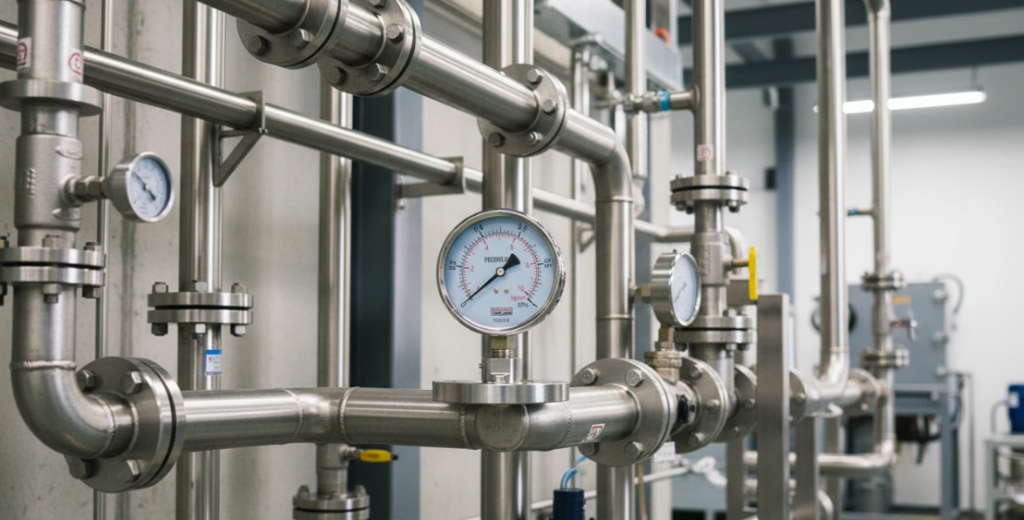
Air is compressible, it can buffer pressure fluctuations, but water is incompressible. In the waterway, frequent switch valve will produce serious “water hammer effect”. Since the internal structure of the barometer has not considered this instantaneous impact at all, the violent pressure wave will directly hit the gear, causing the pointer to break or the accuracy to collapse instantly.
If you want to worry or be responsible for system safety, please choose the right model:
To summarize: Don’t bet the difference of 100 or 200 dollars just because the interface is right. The air pressure gauge is installed on the waterway, and the end result is nothing more than water leakage, wrong reading or direct strike. For the accuracy and safety of your system, please go directly to the special liquid-filled stainless steel table, which is the choice of senior engineers.
Author: Mark Thompson
“Hi, I’m a senior mechanical engineer with over 10 years of experience in industrial fluid systems and instrumentation. Throughout my career, I’ve seen countless system failures caused by simple ‘make-do’ installations. My mission is to help technicians and DIY enthusiasts understand the critical nuances of equipment compatibility so they can build safer, more reliable systems without unnecessary downtime.”

Learn Why Negative Gauge Pressure Occurs In Vacuum And HVAC Systems And How To Interpret Your Gauge Readings.
View details
Learn Why Digital Manometers & Magnehelic Gauges Are Essential For Measuring Duct Pressure And Calculating HVAC ESP.
View details
Learn How To Set Pressure Gauge Calibration Cycles Based On ASME B40.100, Risk Assessment, And Environments.
View details
Learn How Bourdon Tube Pressure Gauges Work, Troubleshoot Common Failures, And Discover Expert Maintenance Tips.
View details
HelloPlease log in