 Dypressuregauge
Can You Have Negative Gauge Pressure
In industrial production and scientific experiments, the so-called “negative gauge pressure”—that is, we often say that the vacuum or partial vacuum state, the absolute pressure inside the system is lower than the current ambient atmospheric pressure. Since most pressure gauges on the market are calibrated with the local atmospheric pressure as the zero point reference, once the pressure in the system drops below the ambient pressure, the pointer will naturally point to the left of the zero scale line and the reading will become negative. This is not only normal but even necessary in many processes, such as vacuum distillation, the suction line of an HVAC system, or a pneumatic handling system. It is this pressure difference that drives the flow of fluid or gas.
Physical Mechanism Of Negative Gauge Pressure
To find out why the pressure gauge shows a negative value, you must first understand the working principle of pressure measurement. Ordinary pressure gauges are designed to set the “atmospheric pressure reference”. When the inlet of the pressure gauge is directly connected to the atmosphere, the internal sensing element (such as Bourdon tube) is subject to equal pressure inside and outside, and the pointer stops at zero.
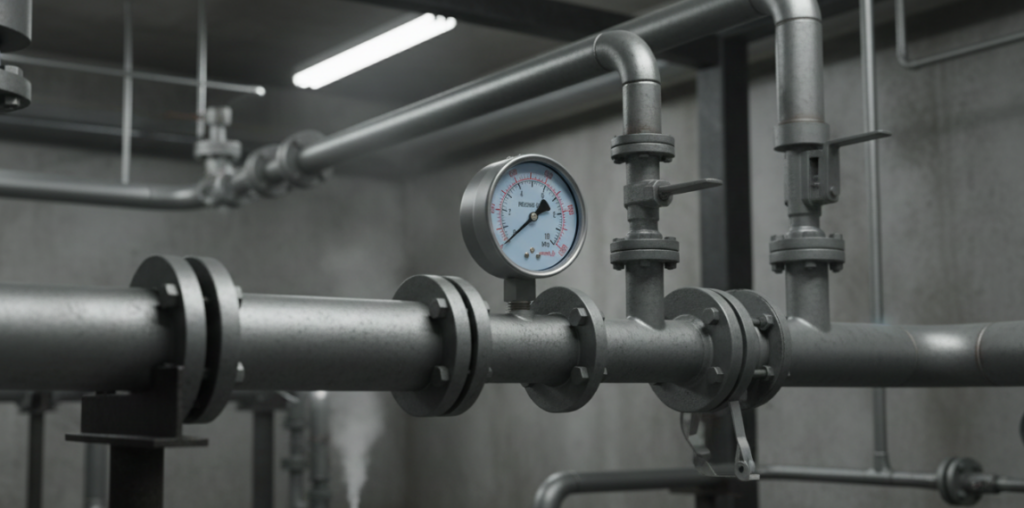
If you plug the pressure gauge into a closed system, and the absolute pressure in the system is lower than the ambient atmospheric pressure, things change. The external atmospheric pressure on the sensor is greater than the pressure inside the system, this physical imbalance force will force the pointer to deflect in the opposite direction. The reading is “negative”, which does not mean that the physical forces in the system have disappeared, but it tells us that there is a pressure “deficit” within the system compared to the atmospheric environment in which we live.
Why Is Negative Gauge Pressure Just Needed By Industry
In many industrial scenarios, negative pressure is created not to troubleshoot, but to achieve process goals.
- Vacuum distillation: In chemical and petroleum refining, the internal pressure is reduced to below atmospheric pressure, which allows the material to boil and distill at a lower temperature. This is a life-saving means for dealing with materials that are afraid of heat and are prone to deterioration at high temperatures.
- HVAC suction line: In HVAC systems, maintaining a stable pressure differential is the key to the refrigerant cycle. The “suction side” or low pressure side of the compressor relies on this negative gauge pressure to generate suction to pull the refrigerant vapor out of the evaporator to ensure that the entire refrigeration cycle runs smoothly.
- Pneumatic handling and vacuum suction cups: Many automatic production lines on the grab device to rely on vacuum suction cups to handle parts. These systems must maintain a constant negative gauge pressure in order to generate sufficient suction to hold the workpiece.

Understanding Of Differential Pressure
The concept of negative gauge pressure is essentially the description of differential pressure. When we usually talk about pressure, we are actually looking at the “difference” between the process environment and the surrounding atmosphere.
If the ambient atmospheric pressure is about 101.3 kPa and the absolute pressure inside the system is only 50 kPa, then the reading on the pressure gauge is about -51.3 kPa. This value is very intuitive for on-site operators, and it directly reflects how much “suction” or vacuum the system has. As long as we stare at these negative values, we can clearly judge whether the performance of the pump is up to standard and whether there is anything wrong with the system sealing.
Author: Alex Carter
I have specialized in the design and troubleshooting of high-precision pressure systems, from vacuum distillation units to complex pneumatic networks. My goal is to bridge the gap between theoretical physics and field-level reliability, helping engineers and operators master instrumentation to ensure both safety and operational efficiency.