 Dongyayibiao
How Does A Thermometer Work
5Learn How Industrial Thermometers Work. Compare Thermocouples, RTDs, And Liquid Thermometers To Optimize Your Maintenance.
View details
The answer is indeed possible, but in a complex industrial environment, if you do not understand the internal mechanical principles of the table casually cross over, the final loss is certainly the system security and data accuracy.
Why do we not recommend the standard under the interface pressure gauge cross-dress, the core reason lies in the internal Bourdon tube structure. When the standard pressure gauge is calibrated at the factory, the internal Bourdon tube and linkage mechanism are designed based on vertical force.
Once you turn the dial 90 degrees, gravity will act vertically on the path of the tube. This gravitational effect directly causes the so-called “zero shift. This is not an equipment failure at all, it is purely a physical reaction-because the internal tension has been changed, even if there is no pressure in the system, it is difficult for the pointer to stop at the zero scale line, either high or low.
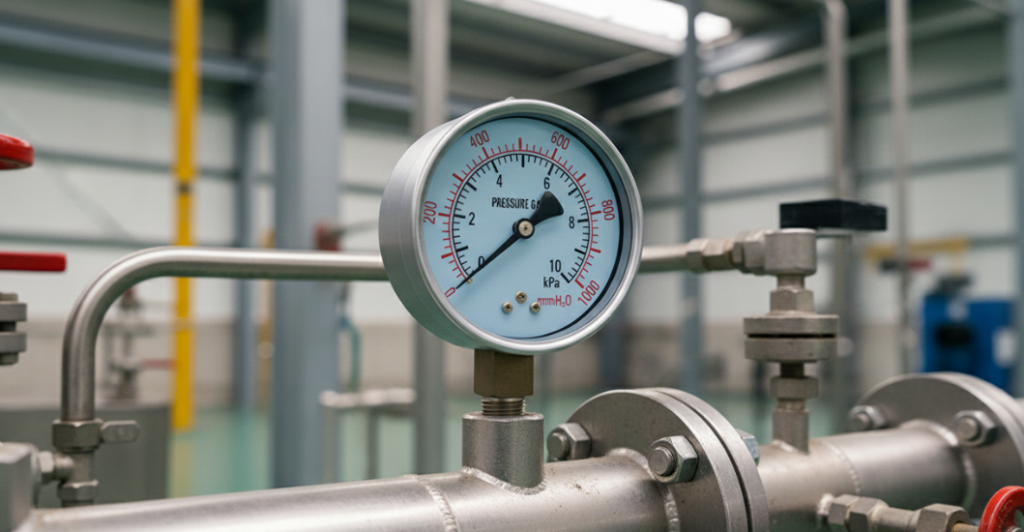
In industrial applications, accuracy is the lifeblood of the instrument, which is not negotiable. Usually, the standard pressure gauge is calibrated based on the “standing position.
After the table is flat, it usually causes a deviation of 1% to 5% of the full range. Let me give an example in actual combat: a meter with a 100 PSI full scale and an accuracy of 1%, if there is an additional 5% error due to the incorrect installation posture, the reading error can reach 5 PSI. In that kind of high-pressure system or on the site of extremely strict chemical process requirements, this error is enough to destroy the whole set of safety protocols, and even directly lead to a sharp drop in production efficiency.
As a field technician, you must have this spectrum of industry standards such as ASME B40.100 or ISO. The standard clearly stipulates that the installation angle of the pressure gauge must be controlled within a very small range.
If you take a vertically calibrated table and dress directly horizontally without any later compensation, it is technically called “illegal installation”. When the safety audit or quality sampling, people find that the actual performance of the instrument does not match the calibration certificate, this kind of trouble is usually difficult to explain clearly.
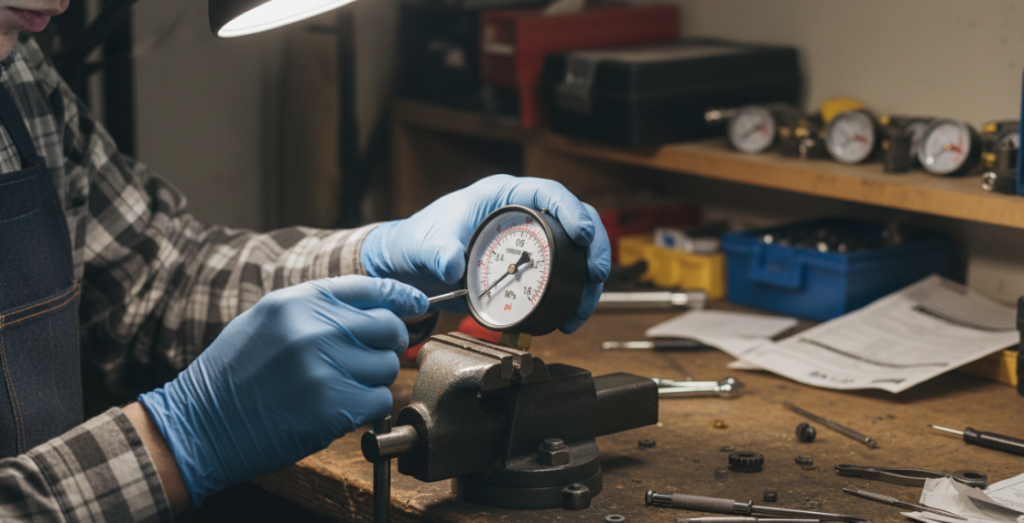
If there is really no way to lay out the pipelines on site, you must dress horizontally. You have three professional ways to go:
Scenario A: Back-mount design
This is the safest way to deal with horizontal pipelines. Choose a model with an interface on the back of the dial and screw it directly into the vertical panel or the side of a pipe. The dial is still perpendicular to the ground, and the internal mechanical structure is completely free from gravity interference.
Option B: Manual recalibration after in place
If you only have a ready-made lower interface pressure gauge in your hand, you must adjust it on site in a horizontal state after it is installed in place. You need to force the pointer to zero with a calibrator to offset the deviation caused by gravity. The subsequent measured pressure data is an accurate value based on the current position.
Option C: Select the model with zero Adjustment Screws
In order to ensure the flexibility of on-site processing, I recommend that high-quality instruments with external zeroing screws be preferred when purchasing. After installation, the technician only needs to fine-tune the screwdriver and align the pointer with the zero scale line. Although the operation is simple, it can compensate the position error very effectively and quickly restore the normal working performance of the instrument.
Author: Robert Harrison
II have commissioned and calibrated thousands of pressure monitoring systems across chemical plants, HVAC sectors, and high-precision laboratories. My focus is always on bridging the gap between theoretical engineering and practical field application. I am dedicated to helping technicians and engineers maintain system integrity by providing deeply technical yet actionable insights into instrument performance and industry compliance.

Learn How Industrial Thermometers Work. Compare Thermocouples, RTDs, And Liquid Thermometers To Optimize Your Maintenance.
View details
Learn Why Negative Gauge Pressure Occurs In Vacuum And HVAC Systems And How To Interpret Your Gauge Readings.
View details
Buy High-Precision Dual Needle Air Pressure Gauges From Imt Factory. Best Wholesale Prices For Air Brake Systems.
View details
Expert Guide For Calibrating Pressure Transmitters Using A Multimeter. Quickly Resolve Loop Issues.
View details Optimized by Seraphinite Accelerator
HelloPlease log in