 Dypressuregauge
Convert Gauge Pressure to Absolute: Simple Formula
Convert Gauge Pressure to Absolute: Simple Formula
Absolute pressure equals gauge pressure plus atmospheric pressure [P(abs) = P(gauge) + P(atm)]. To convert gauge pressure to absolute pressure, you simply read the value on your instrument and add the current local barometric pressure. Most engineers blindly plug standard sea-level pressure (14.7 psi or 101.325 kPa) into this formula. This lazy habit ruins thermodynamic calculations and causes industrial compressors to fail at higher altitudes. Let’s fix your conversion process with actual field mechanics.
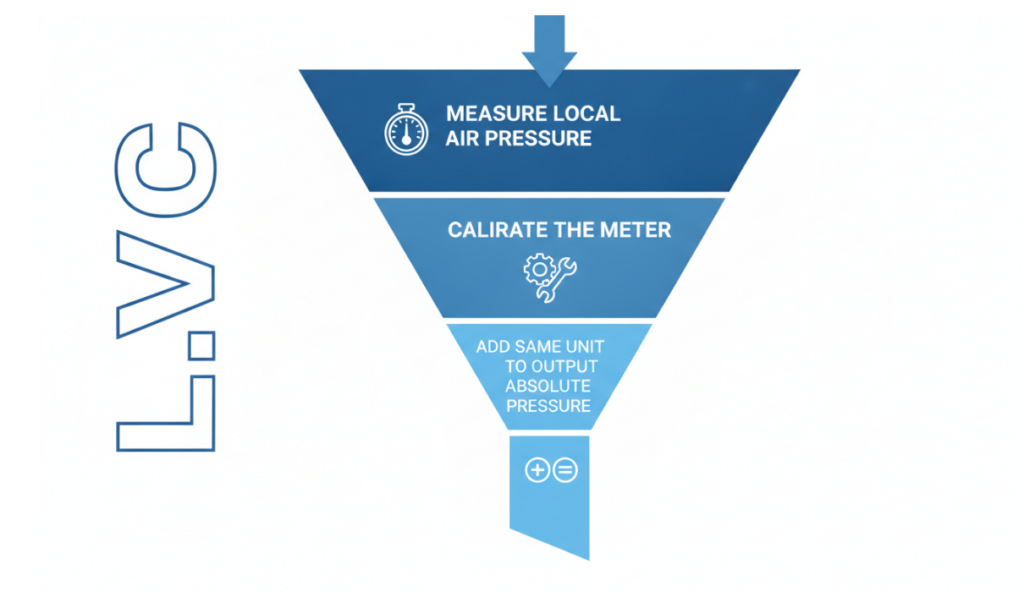
The L.V.C. Conversion Framework (A 3-Step Expert Model)
Thermodynamic calculations require extreme precision. I use the L.V.C. (Local-Verify-Calculate) framework to prevent data distortion before starting any fluid mechanics equations.
Step 1: Local Barometric Measurement (Bypassing the Sea-Level Trap)
Your atmospheric pressure variable must match your exact physical location. Standard atmospheric pressure (1 atm / 14.7 psi / 101.325 kPa) only exists at exactly sea level under specific weather conditions. A gauge in Denver, Colorado (elevation 5,280 ft) experiences an average atmospheric pressure of 12.1 psi. Adding 14.7 psi to a gauge reading in Denver introduces an immediate 2.6 psi error into your ideal gas law calculations. Use a digital barometer to get the actual local P(atm) value.
Step 2: Verify Gauge Zero-State Bias
Mechanical gauges drift over time due to vibration and temperature cycling. Disconnect the gauge from your system and expose it to the open room. The needle must rest exactly at zero. If the gauge reads 2 psi while disconnected, you have a mechanical bias. Subtract this bias from your final reading before converting to absolute pressure.
Step 3: Calculate with Strict Unit Alignment
You cannot add PSI to kPa. Engineers frequently ruin calculations by mixing imperial and metric units. Convert your local atmospheric pressure reading to match the exact unit displayed on your system gauge. If your gauge reads in PSIG (Pounds per Square Inch Gauge), your atmospheric pressure must be in PSI.
Engineering Case Study: The Altitude Effect on HVAC Charges
Using default pressure constants causes hardware failures. Last year, my team tested an industrial chiller system in a high-altitude facility in Nevada. The junior technician calculated the target absolute pressure for a nitrogen pressure test using the 14.7 psi constant.
The target absolute pressure was 150 psia. He calculated a required gauge pressure of 135.3 psig (150 – 14.7). The actual local atmospheric pressure was 13.2 psi. The system needed a gauge pressure of 136.8 psig (150 – 13.2). The 1.5 psi deviation caused a false positive during the system leak-decay test. The unit passed the pressure test but failed catastrophically during the vacuum dehydration phase. Always measure local barometric pressure.
Quick Unit Conversion Matrix (PSIG to PSIA, kPa to kPa abs)
Unit matching prevents mathematical errors. Use this matrix to select the correct standard atmospheric constant if you are operating exactly at sea level and lack a local barometer.
| Unit System | Gauge Pressure Variable | Sea-Level Atmospheric Constant | Formula |
| Imperial | PSIG | 14.7 psi | PSIA = PSIG + 14.7 |
| Metric | kPa (gauge) | 101.325 kPa | kPa (abs) = kPa (gauge) + 101.325 |
| Metric | bar (gauge) | 1.013 bar | bar (abs) = bar (gauge) + 1.013 |
How Modern MEMS Sensors Handle Absolute Pressure
Digital manifolds bypass manual conversion math. Smart HVAC tools from brands like Testo and Fieldpiece contain dual sensors. They use a standard piezoresistive transducer for gauge pressure and a secondary internal barometric MEMS (Micro-Electro-Mechanical Systems) sensor for ambient air pressure.
The internal processor executes the P(abs) = P(gauge) + P(atm) formula dynamically in real-time. When exporting raw CSV data from these manifolds for thermodynamic analysis, verify whether the column headers state “Pressure (Abs)” or “Pressure (Rel)”. Pushing absolute pressure data through a secondary manual conversion formula will double-count the atmospheric pressure.
FAQ
How do you convert gauge pressure to absolute pressure?
Add the local atmospheric pressure to your gauge pressure reading. The basic formula is P(abs) = P(gauge) + P(atm). Ensure both values use the same measurement unit (like PSI or kPa) before adding them together.
How to calculate absolute pressure from gauge pressure at high altitude?
Use a local barometer to measure the exact atmospheric pressure at your elevation. Do not use the 14.7 psi or 101.325 kPa sea-level standard. Add that local barometric reading to your gauge pressure.
What is the difference between PSIG and PSIA?
PSIG stands for Pounds per Square Inch Gauge, meaning the measurement ignores current atmospheric pressure (reads zero in an open room). PSIA stands for Pounds per Square Inch Absolute, which includes the atmospheric pressure.
Can gauge pressure be negative?
Yes. A negative gauge pressure indicates a vacuum condition. The pressure inside the system is lower than the surrounding atmospheric pressure. Absolute pressure, however, can never be negative.
Why do we need absolute pressure for the Ideal Gas Law?
Equations like PV = nRT rely on absolute zero as the baseline. Using gauge pressure in thermodynamic formulas creates massive calculation errors because gauge pressure ignores the massive baseline force of the Earth’s atmosphere already acting on the fluid.
How do I convert a vacuum reading to absolute pressure?
Subtract the vacuum reading (expressed as a positive number) from the local atmospheric pressure. If your atmospheric pressure is 14.7 psi and your gauge reads a 5 psi vacuum (or -5 psig), the absolute pressure is 9.7 psia.