 Dypressuregauge
How Do Pressure Gauges Work? An Expert-Level Visual Guide
The working principle of the pressure gauge is essentially to convert the physical force of the fluid or gas into mechanical movement. This is usually achieved by a bent hollow metal tube, which naturally straightens when the internal pressure increases. This tiny unfolding action, which is imperceptible to the naked eye, connects a set of gear segments and pinions, converting a slight straightening into a large rotation of the pointer across the dial.
Many engineers take the selection of meters as a basic job, but in fact, factory equipment managers have a headache every day for the premature failure of meters. Misunderstanding of the internal sensing elements can directly lead to system crashes and data errors. We can’t just stare at the dial, we have to delve into the core mechanical structure that determines the reliability of equipment in harsh industrial environments.
S-P-I Transformation Model
Mechanical instruments rely on a series of rigorous physical reactions to display accurate indicators. According to my habit, I usually use S-P-I transformation models to classify and disassemble this operation process.
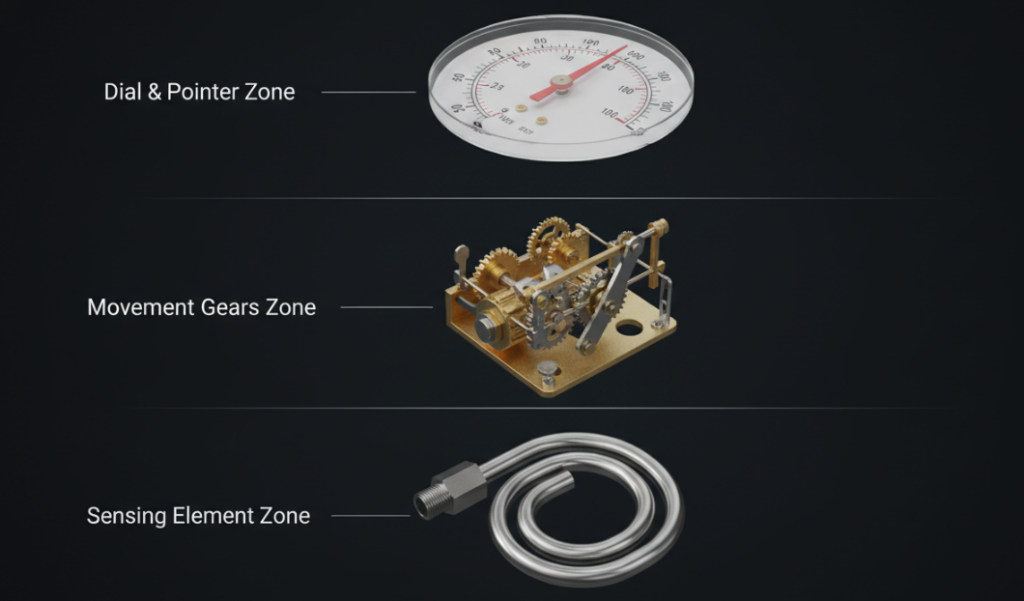
Sense: The elastic element receives the medium. To understand how the pressure gauge works, everything has to start with the interface. When a high-pressure medium enters a special part such as a Bunden tube or a diaphragm, it will immediately cause a physical deformation that can be calculated.
Process: mechanical linkage to amplify small movements. The sensing element actually only moves a few tenths of a millimeter. However, the tie rod connects this element with the rotating gear mechanism , multiplying this tiny displacement into a visually striking arc of rotation. When disassembling equipment at ordinary times, you can intuitively feel how precise the transmission system is.
Indicate: The pointer sweeps the scale. The last gear shaft drives the visible pointer across the precision printed dial, allowing on-site personnel to instantly read the current system status.
Bourdon Tube, Diaphragm Or Bellows
The wrong internal sensing element is selected, and the device is basically doomed to failure. Plant engineers must match specific elastic elements based on the fluid dynamics of the piping system.
Borden tubes: standard configuration for high-pressure applications
Bourdon tubes cover most industrial pressure measurement tasks from 15 psi to 100,000 psi. They are usually “C”-shaped or spiral-shaped and act like the kind of roll-paper whistle we used to blow when we were kids. The system medium fills the cavity, forcing the flattened cross section to be rounded. This rounding force straightens the tube, which in turn pulls the mechanical linkage attached to its closed end.
Diaphragm: shield against corrosive and viscous media
The diaphragm pressure gauge is not a tube, but a flexible corrugated circular plate. When pressure strikes its surface, the plate bulges upwards. When treating thick sludge, highly corrosive acids or wastewater, engineers will directly specify the use of diaphragm sheets. The diaphragm creates a physical barrier to keep the destructive fluids out of the fragile internal gear machinery.
Bellows: Accuracy in low-pressure environments
The bellows is like an accordion, and its expansion and contraction have extremely high sensitivity. People often ask how the pressure gauge works in ultra-low pressure environments, and the answer is bellows. Its huge surface area captures tiny pressure changes that are completely imperceptible to a hard Baudon tube.
| Sensor Type | Optimal Pressure Range | Media Tolerance | Primary Industrial Application |
| Piezoresistive | Low to Medium | Non-corrosive gases and liquids | Automotive, HVAC, Medical devices |
| Capacitive | Low to Medium | Corrosive media, gases, and liquids | Chemical processing, food & beverage |
| Thin-Film Strain | Medium to High | Gases and liquids, some corrosive media | Hydraulics, industrial machinery |
| Ceramic Thick-Film | Medium to High | Highly corrosive media, abrasive slurries | Wastewater treatment, oil & gas |
| Sapphire | High to Very High | Extremely corrosive media, high purity | Aerospace, nuclear, specialized chemicals |
Pulsation, Water Hammer And Fatigue Failure
The beautiful data in the laboratory is often vulnerable to the scene. There is no point in understanding the principle of a pressure gauge in a sterile test room if you ignore the rough physics of the running pipe.
The water hammer effect will destroy the Baudon tube instantaneously. The sudden closure of the valve creates a local pressure spike that propagates at the speed of sound. I’ve seen too many field accidents where this shock wave hits the Baudon tube so hard that it pushes it directly past its yield strength. Once the metal is permanently deformed, the reading of the instrument will be higher than zero instantly under normal pressure. At this time, there is no other way but to replace it immediately.
Shock requires that the case must be filled, but this also introduces a temperature risk. A surge in the pump can cause the needle to shake violently, which can destroy the pinion. Usually we fill the case with glycerin or silicone oil to dampen this vibration. But you have to monitor the ambient temperature at all times. Below 20 °F, glycerin turns into a thick syrup, making it extremely difficult for the pointer to move. Operators often misdiagnose this sluggish response as a drop in system pressure, which often results in catastrophic manual overpressurization.
Material Memory Loss In The Circulatory System
Metal has a memory limit. Frequent pressure spikes can cause fatigue, destroying the structural integrity of the alloy.
We recently conducted a field trace at a high-frequency hydraulic stamping plant and tested the performance of two types of pressure gauges under 10,000 extreme pressure cycles.
Standard Brass Bouton Tube: Due to the micro-yielding of the brass matrix, the zero calibration is lost after only 3,200 cycles.
316L stainless steel Bourdon tube: After more than 9,500 cycles, it still maintains ASME Class 1A accuracy.
Direct advice to the field is to honestly specify 316L stainless steel internal components to prevent metallurgical fatigue for any application that experiences rapid pressure cycling.
The Collision Of Digital And Machinery
Modern industrial operations cannot do without predictive maintenance data. Mechanical watches are indeed impeccable in terms of visual confirmation, but they cannot provide any remote data recording.
In the process of advancing the digital transformation of enterprises, the modern smart factory approach is to integrate MEMS (micro-electro-mechanical system) sensors directly behind the traditional Borden tube. This hybrid solution not only meets the needs of local readings in the field, but also pushes continuous PSI telemetry data to the cloud through LoRaWAN or HART protocols. You get both the reliability of a purely physical machine that can’t be hacked, and the digital threshold alarm.
FAQs
How does a pressure gauge work without power?
Mechanical tables operate entirely on fluid mechanics and metallurgy. The physical force of the liquid or gas bends the internal metal element from a physical level, driving the gear to turn the pointer, without requiring electricity throughout the process.
Why is there liquid in my pressure gauge?
This liquid is usually glycerin or silicone oil. It is used to absorb violent mechanical vibrations and pressure spikes, prevent fragile internal gears from chipping, and keep the needle steady for accurate readings.
How does a pressure gauge work when measuring negative pressure?
The vacuum gauge reverses the standard mechanical logic. Instead of pushing the Bourdon tube outward, the internal pressure draws the fluid out with a vacuum, causing the C-tube to curl inward more tightly. The linkage converts this inward curl into a counterclockwise movement of the pointer.
What is a Bourdon tube and how does a pressure gauge work with it?
A Bourdon tube is a flat metal tube that is sealed at one end. The pressure forces the flat tube into a perfectly round shape, which causes the curved tube to straighten. It pulls the lever at the closed end when straightened, turning the display gear.
How does a pressure gauge with a diaphragm seal work?
The diaphragm seal acts as an isolation meter. The system fluid presses against a flexible metal sheet. Behind this sheet, a specialized filling fluid transmits that precise force directly into the Bourdon tube of the pressure gauge.
Will the pressure gauge lose calibration over time?
Will. The continuous overpressure stretches the inner metal element beyond its elastic limit. The metal could not return to its original shape, causing the pointer to stop above zero even when not connected to the pipe.
How does a pressure gauge work to prevent a burst accident?
Safety type solid front pressure gauge has a solid metal wall between the Bourdon tube and the dial. If extreme overpressure causes the tube to burst, the explosive force is discharged from a special rear explosion plate, thus protecting the operator who is standing in