 Dongyayibiao
How Often Should Pressure Gauges Be Calibrated
10Learn How To Set Pressure Gauge Calibration Cycles Based On ASME B40.100, Risk Assessment, And Environments.
View detailsThe difference between the two is not whether they can measure pressure, but how they process data and what role they play in the overall control loop. The pressure gauge is a purely mechanical device, which relies on Bourdon tube or bellows to drive the pointer without receiving electricity, and is specially shown to on-site inspectors. The pressure transmitter is an electronic “advanced product”, which converts the pressure signal into 4-20mA current or HART and Modbus digital signals and transmits them to PLC or DCS system. The watch is for the eyes and the transmitter is for the “brain” of the system.
To fully understand the difference between the two, you have to look at their internal structure.
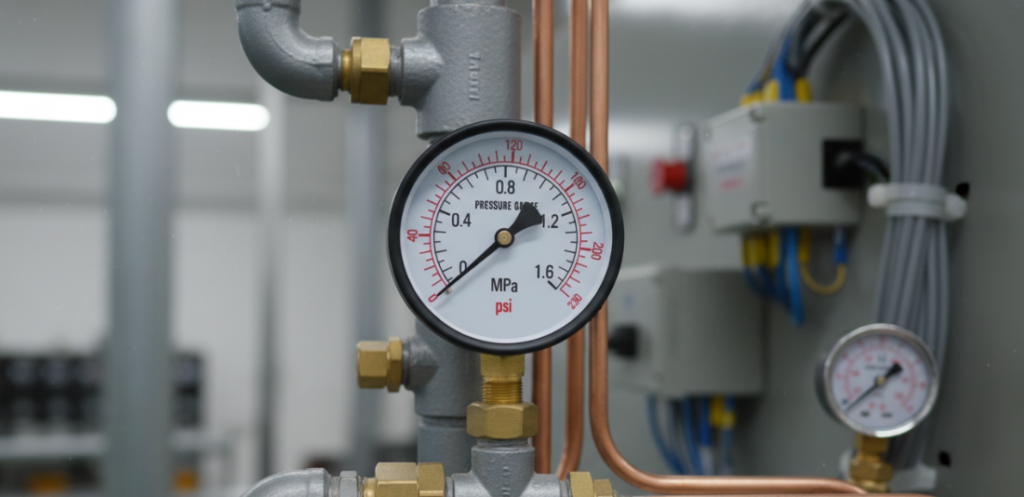
The operation of the pressure gauge completely follows the laws of physics. Most industrial pressure gauges use Bourdon tubes arc tubes that tend to straighten out under pressure. This displacement is converted into pointer rotation through a gear mechanism.
The core of a pressure transmitter is a pressure-sensing element, such as a piezoresistive sensor or a capacitive diaphragm. When pressure is applied, the sensor’s resistance or capacitance undergoes a slight change.
The biggest application difference between the two is “data flow”.
Pressure gauge (local indication): the data stays at the measuring point. Without the operator staring at the dial, this information is almost “non-existent” to the rest of the factory.
Pressure transmitter (remote integration): It feeds data back to the control room or PLC in real time. This enables many advanced functions:
| Features | Pressure Gauge | Pressure Transmitter |
| Main functions | on-site visual observation | remote monitoring and automatic control |
| Output form | physical pointer/dial | 4-20mA, HART, Modbus, etc |
| Power demand | No (mechanical) | requires external power supply (24V DC) |
| Automation Role | Passive (Observation Only) | Active (Participating in Control Loop) |
| Data logging | Manual logging (meter reading) | Automatic logging (database history) |
| Precision | Generally | high precision |
| Cost | Cheap, budget-friendly | high investment |
In a professional chemical plant or pumping station, the two are often “partners”, but the division of labor is clear.
In the following situations, choosing the pressure gauge:
However, the pressure transmitter must be used in the following scenarios:
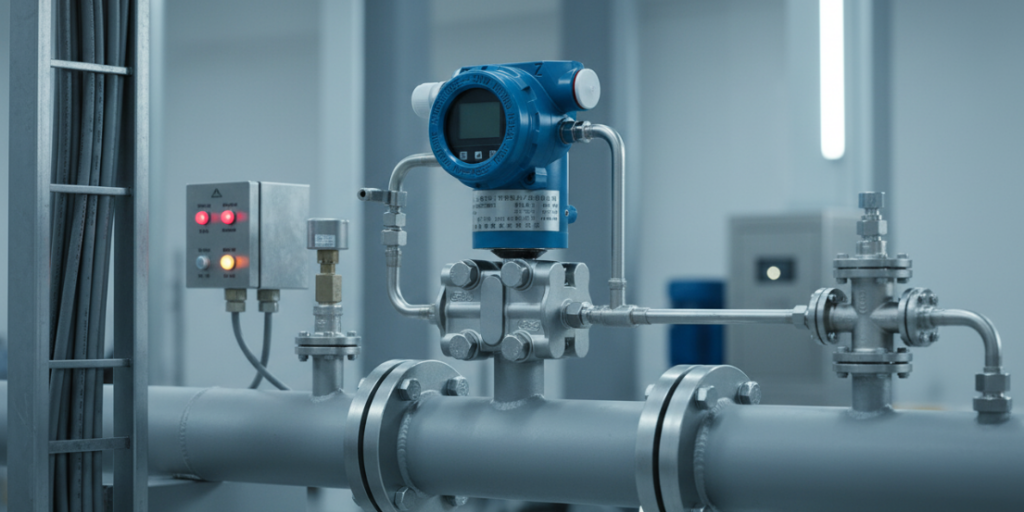
Although these two things measure the same physical quantity, the difference between the pressure gauge and the pressure transmitter is essentially the difference between “manual observation” and “automation intelligence”. The pressure gauge is your “eye” on the spot, which is stable and reliable. The pressure transmitter is the “nervous system” of the factory, which is responsible for feeding key data to the “brain” of PLC or DCS “. Transmitters are essential to any modern industrial facility seeking efficiency and safety.
Author: David Sterling
“I am an instrumentation and control engineer with over 12 years of hands-on experience in industrial automation and process safety. I am passionate about bridging the gap between rugged field hardware and intelligent system architecture, helping technicians and engineers build safer, more efficient industrial environments through practical technical insights.”
Learn How To Set Pressure Gauge Calibration Cycles Based On ASME B40.100, Risk Assessment, And Environments.
View details
Learn How Digital Pressure Gauges Work Through Sensors, ADCs, And Microprocessors For High-Accuracy Measurement.
View details
Learn Why Negative Gauge Pressure Occurs In Vacuum And HVAC Systems And How To Interpret Your Gauge Readings.
View details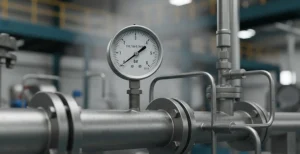
Learn How Bourdon Tube Pressure Gauges Work, Troubleshoot Common Failures, And Discover Expert Maintenance Tips.
View details
HelloPlease log in