 Dongyayibiao
Can I Use Air Pressure Gauge For Water
10Thinking Of Using An Air Pressure Gauge On Water Pipes? Learn Why This Leads To Failure, Corrosion, And Dangerous Water Hammer.
View detailsThe core of the pressure gauge is a set of energy conversion logic: the pressure of the fluid or gas is converted into mechanical movement, and finally the pointer is driven to point to a specific value on the dial.
The vast majority of industrial pressure gauges on the market use Bourdon tube. This thing is a C- shaped, flat, hollow metal tube. When the pressurized medium (whether liquid or gas) enters the tube, the pressure will force the tube to “straighten”-professionally we call this elastic deformation. This subtle movement is transmitted to the pointer through a set of linkages and gears.
If you find that the meter reading at hand jumps, or is simply stuck, the problem usually lies in the 3 place: the inlet is blocked, the overpressure causes permanent deformation of the Bourdon tube, or the gear falls into the gear and causes friction. In fact, as long as the connection point is checked and the pressure sensing element is not blocked, most of the reading errors can be solved, and there is no need to replace it with a new one at any time.
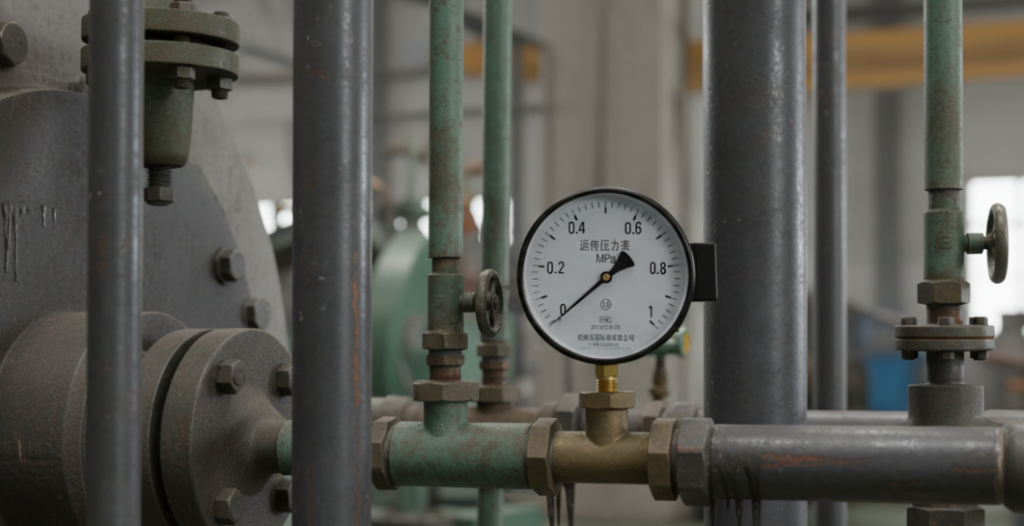
If you want to understand the working principle of the pressure gauge, you have to stare at the Bourdon tube. The reason why it can become the industry standard is because it is simple and reliable enough. This “C-shaped” design is the soul, because the tube is flat and hollow, it is like a metal spring.
Pressure sensing element: As the system pressure increases, the medium will directly squeeze the inner wall of the metal tube.
Elastic deformation: The physical logic here is purely elastic. The tube is designed to spring back to its original shape when the pressure is released. If you don’t play it back, the watch will be useless.
The displacement of the Baudon tube is actually very small, sometimes only a few millimeters. In order to let the naked eye can see, pressure gauge must rely on a set of mechanical linkage system to “enlarge” action:
Sector gear and pinion: The end of the Bourdon tube is connected to a connecting rod. The connecting rod pulls the sector gear, which in turn drives the pinion on the pointer.
Amplification effect: This gear mechanism is essentially an amplifier. Even if the tube is only opened a little bit, it is reflected on the dial by a large sweep of the pointer. This is why you can read high precision values.

When the pressure gauge is not on time, it is rarely because of any complex system collapse, usually some low-level mechanical interference.
The pressure inlet is blocked: if the meter reading is zero or the response is slow, look at the pressure inlet first. Especially running high viscosity fluid or impurity system, dirt is easy to seal the mouth.
Overpressure and pipeline deformation: If the table has been subjected to severe impact, the pressure exceeds the range, the Baudon tube will undergo “plastic deformation”. The damage is irreversible and the tube will never bounce back. I have seen many gauges whose pointer does not return to zero after pressure is relieved, basically the pipe has been abandoned.
Gear friction and debris: sometimes the pointer jitters or gets stuck while moving.. This is usually dust, grit or oxide that gets into the gear set. Because these gears are precise, even micron-sized debris can create a huge amount of friction.
Before deciding to throw it in the trash, you can try to restore its function through simple maintenance:
Check the connection: poke into the pressure opening. Most of the time, simple flushing can solve the problem that the medium cannot enter.
Verify the calibration: If the mechanical structure is not broken but the reading is off, see if the connecting rod is loose due to excessive vibration.

Preventive measures: this is what I want to emphasize most. If your system often has pressure surges (water hammer, etc.), be sure to install dampers. This thing can protect the Bourdon tube from instantaneous impact, which is the secret to prolong the life of the pressure gauge.
After figuring out these internal logic, and then facing those broken watches, you can more accurately judge whether it should be repaired or replaced. After all, in the industrial field, accurate diagnosis is always more effective than blind replacement.
Author: Robert Miller
I am a senior industrial maintenance engineer with over 11 years of experience in on-site commissioning and equipment repair. Throughout my career, I’ve specialized in the ‘nervous systems’ of industrial machinery, with a particular focus on precision instruments. I believe that a deep understanding of mechanical logic is the key to efficient diagnosis.

Thinking Of Using An Air Pressure Gauge On Water Pipes? Learn Why This Leads To Failure, Corrosion, And Dangerous Water Hammer.
View details
Discover Why The Bourdon Tube Gauge Is The Industry Standard. An Expert Engineer Explains Its Reliability, Benefits, And How To Choose The Right One.
View details
Learn How To Read Pressure Gauges Accurately. Master Units, Zeroing, And Safety To Prevent Dangerous Errors.
View details
Learn How Differential Pressure Transmitters Work, From Sensor Mechanisms To Industrial Signal Conversion And Applications.
View details
HelloPlease log in