 Dongyayibiao
Can You Have Negative Gauge Pressure
9Learn Why Negative Gauge Pressure Occurs In Vacuum And HVAC Systems And How To Interpret Your Gauge Readings.
View detailsThe pressure gauge should be calibrated at least once every 12 months. This is the rule to maintain accuracy levels and ensure compliance with NIST traceability. It must be based on a rigorous risk assessment, in particular with reference to ASME B40.100. If your equipment is in a harsh environment, severe vibration or frequent overpressure all day long, even if it is to avoid the safety hazards caused by measurement drift, I strongly recommend shortening the cycle to 3 to 6 months. If it is a stable environment of the laboratory, as long as you have historical data to prove that its long-term stability meets the requirements of ISO/IEC 17025, it is not impossible to extend it to 24 months. We’re balancing operational costs with the risk of a catastrophic failure or audit breach.
Although many manufacturers will give a general recommendation, it makes sense that 12 months has become the industry benchmark. Annual calibration ensures that the pressure gauge is always within the accuracy class defined by ASME B40.100. This cycle is just right in line with most companies annual audits and quality management systems(QMS).
In the annual inspection, maintaining the traceability of NIST is the core. It can provide you with complete record documents to prove that your measurements are consistent with national standards. In the industrial sector, this is not only a technical requirement, but also a hard document to deal with legal and security compliance checks.
In many high-pressure industrial scenarios, sticking to a 12-month calibration cycle is actually very risky behavior. Some conditions can significantly accelerate “measurement drift”-the gradual loss of accuracy over time. If your pressure gauge encounters the following situations, I suggest directly increasing the calibration frequency to once every 3 to 6 months:
Mechanical vibration and pulsation: Continuous vibration can wear the internal linkage of the mechanical watch, which can lead to serious systematic errors in readings.
Frequent overpressure events: If the pressure gauge is often pushed beyond the upper limit of the measuring range, the pressure sensing element may produce permanent plastic deformation, which will instantly invalidate the previous calibration record.
Harsh environmental conditions: corrosive atmospheres, extreme temperature fluctuations or high humidity environments can destroy the integrity of the pressure gauge faster than you might expect.
Increasing the frequency of calibration in this scenario is essentially proactively reducing safety risks and avoiding unplanned downtime that is ridiculously expensive.
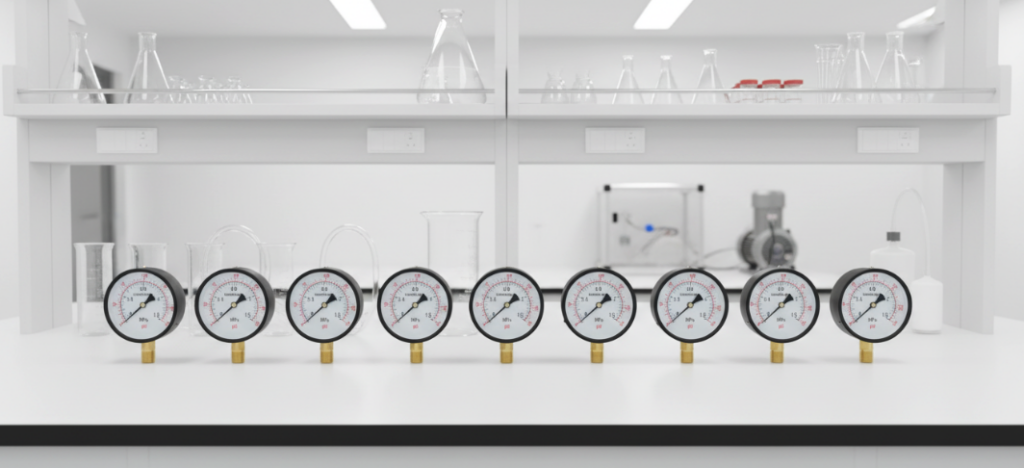
Not every gauge needs this kind of high-intensity supervision. For some non-critical applications, or gauges used in a controlled laboratory environment, a 24-month cycle is reasonable. I have to remind you that this extension must be based on the following premises:
Controlled environment: The pressure gauge must be in a constant temperature and humidity, no vibration, no corrosion environment.
Historical data analysis: You must have at least two to 3 years of calibration records in your hand, proving that the watch has never exceeded the specified tolerance range.
ISO/IEC 17025 compliance: Your calibration process must follow the standard strictly so that the data is convincing when you explain why you are extending the cycle in front of the auditor.
Determining the calibration frequency of a pressure gauge is a strategic decision. The 12-month rule is a safe starting point, but the final schedule must be determined by your actual operating environment-whether it’s on the muddy ground of a chemical plant or on a clean test bench in a precision laboratory.
By weighing the operational cost of calibration against the potential risk of audit violations or equipment failures, you can truly protect personnel and ensure the accuracy of the production process.
Author: Marcus Steve
“Hi, I’m a senior compliance consultant specializing in industrial instrumentation, I have spent over 12 years helping facilities navigate the complexities of ASME B40.100 and ISO/IEC 17025 standards. My expertise lies in bridging the gap between technical precision and operational efficiency. I am passionate about helping teams move beyond ‘one-size-fits-all’ schedules to develop rigorous, risk-based calibration strategies that protect both their personnel and their bottom line. When I’m not auditing quality management systems, I’m dedicated to sharing technical insights that ensure industrial safety and NIST traceability.”

Learn Why Negative Gauge Pressure Occurs In Vacuum And HVAC Systems And How To Interpret Your Gauge Readings.
View details
Learn Why Digital Manometers & Magnehelic Gauges Are Essential For Measuring Duct Pressure And Calculating HVAC ESP.
View details
Learn How Bourdon Tube Pressure Gauges Work, Troubleshoot Common Failures, And Discover Expert Maintenance Tips.
View details
Learn How Industrial Thermometers Work. Compare Thermocouples, RTDs, And Liquid Thermometers To Optimize Your Maintenance.
View details
HelloPlease log in