 Dongyayibiao
What Is The Most Common Type Of Pressure Gauge
7Discover Why The Bourdon Tube Gauge Is The Industry Standard. An Expert Engineer Explains Its Reliability, Benefits, And How To Choose The Right One.
View detailsTo accurately calibrate a thermometer in a non-laboratory environment, the Ice Point Method is the most reliable solution I have ever worked. This method is very effective in ensuring food safety and measurement accuracy, and does not require you to prepare any expensive professional equipment.
Understanding the logic behind calibration is critical. Unlike the boiling point of water—which fluctuates wildly with the altitude and pressure of your location—the melting temperature of pure water ice is stable at 0°C under almost all environmental conditions.
For industrial or laboratory applications, this consistency is the cornerstone of the traceability and reliability of measurement results. If this is not taken seriously, even one degree of deviation in food processing or equipment monitoring can be extremely costly.
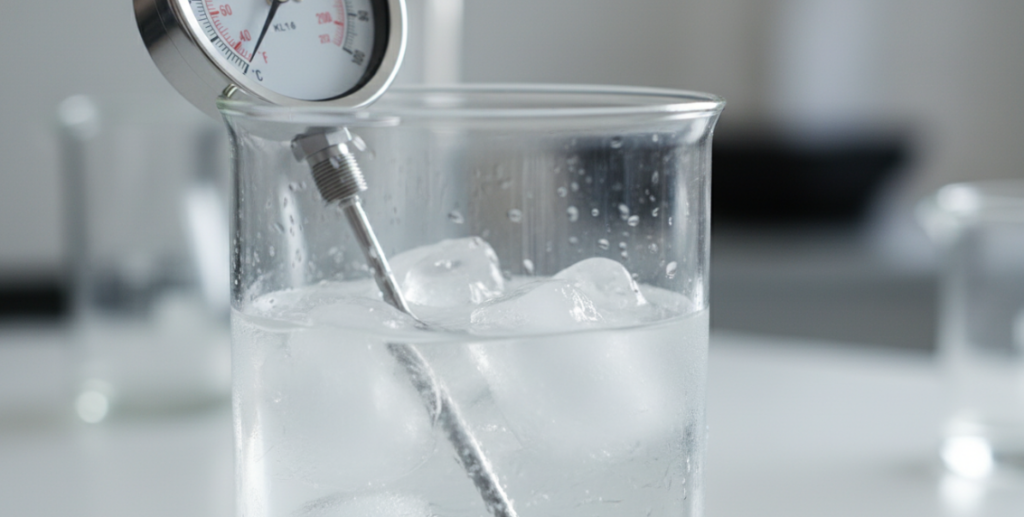
The success or failure of calibration depends on the quality of your glass of ice-water mixture. In order to ensure that the thermometer sensor is completely immersed in a constant temperature environment, you need to pay attention to the following details:
After the reading is stable, if the display is not exactly 32 °F, you will have to “align” the physical constants.
Many of today’s digital thermometers have a “CAL” calibration key. When the probe is stable in ice water, press and hold this button and the device will automatically synchronize to 32 °F. If your equipment is relatively simple and does not have this function, then you have to manually record the deviation value (offset) and add and subtract it in future measurements.
This kind of scene is very common in heavy industry. Adjusting it requires a physical operation: find the adjustment nut on the back of the dial. With the probe submerged, slowly turn the nut with a small wrench until the needle is exactly on the 32 °F scale.
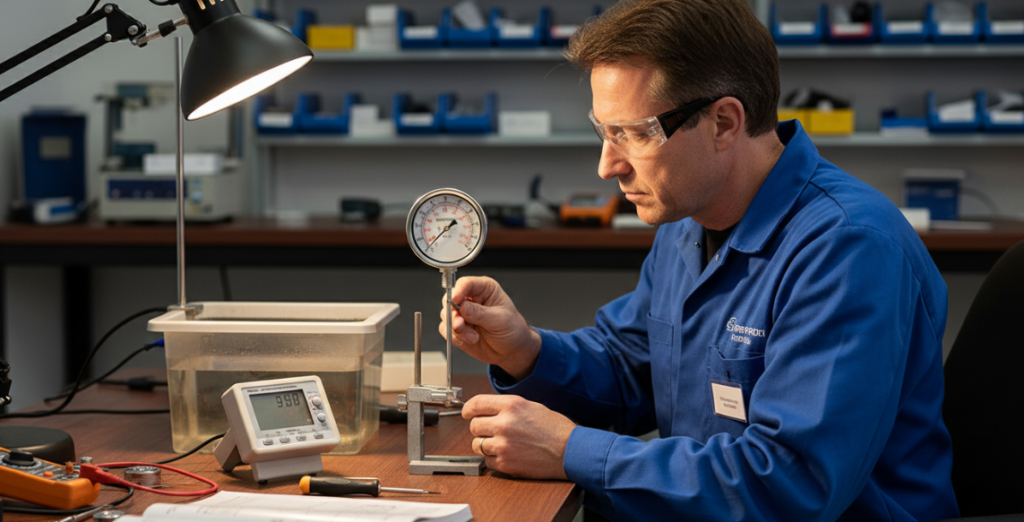
Many people are used to the boiling point method, but in the pursuit of high-precision professionals, this method is a lot of pit. At high altitudes, reduced atmospheric pressure can cause water to boil well below 100°C. In Denver, for example, the water starts at about 202 °F.
If you switch to the freezing point method, you can completely kill these variables. Whether you’re in a factory at sea level or a laboratory on a plateau, the freezing point is a fixed physical constant. This is the hard truth that makes the instrument meet the strict standards of the profession.
In order to ensure data rigor and operational security, I strongly recommend calibration at the following nodes:
We always believe that “precision is the backbone of operation”. Ensuring that your thermometer is properly calibrated is the first step in maintaining a high operating environment.
Author: David Young
“Hi, I’m an instrumentation specialist with years of hands-on experience in precision measurement and field calibration. As a member of the team, I have always advocated that ‘precision is the backbone of operation.’ My mission is to provide professionals with practical, reliable calibration insights to ensure safety and accuracy in even the most demanding industrial and laboratory environments.”
Discover Why The Bourdon Tube Gauge Is The Industry Standard. An Expert Engineer Explains Its Reliability, Benefits, And How To Choose The Right One.
View details
Learn Why Negative Gauge Pressure Occurs In Vacuum And HVAC Systems And How To Interpret Your Gauge Readings.
View details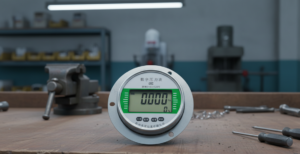
Learn How Digital Pressure Gauges Work Through Sensors, ADCs, And Microprocessors For High-Accuracy Measurement.
View details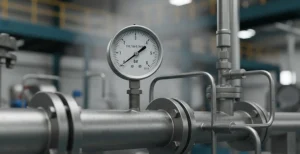
Learn How Bourdon Tube Pressure Gauges Work, Troubleshoot Common Failures, And Discover Expert Maintenance Tips.
View details
HelloPlease log in