

pressure gauge bsp thread

Check the thread and seal your BSP port requires, then compare a standard Y-60, a liquid-filled YN-100, and the Ordinary Pressure Gauge series for your application.

Match the BSP thread and seal

BSP stands for British Standard Pipe. Read the full thread designation on the equipment drawing or port marking. A size alone, such as 1/4 in., leaves the thread form and sealing method unresolved.

ConnectionWhere it sealsWhat to check on the port
BSPP (G)
Parallel thread, ISO 228-1
At the specified sealing surface outside the threads, using a seal such as a washer or O-ring.Check the mating G thread and the face or seat that the seal bears against.
BSPT (R)
Tapered male thread, ISO 7-1
At the mating threads, using the sealing material specified for the joint.Check the specified female thread. ISO 7-1 uses Rc for tapered female threads and Rp for parallel female threads.

For an unmarked replacement, isolate and fully depressurize the equipment before removing the gauge. Check the outside diameter and taper of the male thread with calipers, then check the pitch with a thread gauge. Compare those measurements and the sealing surface with the port drawing or a thread reference. BSP sizes are nominal, so the measured diameter will differ from the size in the designation.

For a drawing that specifies G 3/8 or R 3/8, see the 3/8 BSP pressure gauge connection guide for dimensions and fit checks.

Choose the gauge for the service conditions

For steady service with a process fluid that does not corrode steel or copper alloys, start with the Ordinary Pressure Gauge series. When the fluid calls for stainless steel wetted parts, check the listed material options for the Standard Pressure Gauge Y-60 against the fluid and its temperature.

For equipment subject to mechanical vibration or pressure pulsation, consider the liquid-filled YN-100. The fill damps pointer movement so operators can read the dial more easily. Report pressure spikes separately when specifying the range, since the gauge still needs to withstand the pressure at the connection.

Choose a scale that makes normal operating pressure easy to read and accommodates the expected operating range. For a replacement, check whether the line enters below the dial or behind it, and measure the available clearance for the case and a wrench.

Compare three pressure gauge options

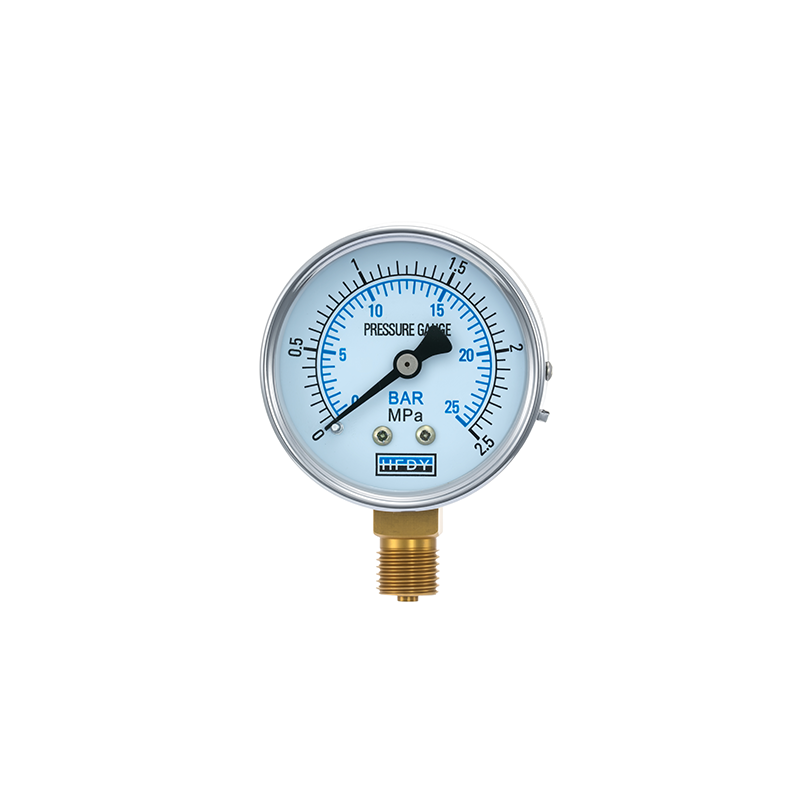
Silver-rimmed gauge with a pale blue dial and a threaded stem below the case

Y-60 shown with a bottom connection and a bar/MPa dial.

Standard Pressure Gauge Y-60

The Y-60 is designed for gases and liquids that flow freely and do not crystallize.

  • Wetted materialsThe Bourdon tube and connection are listed in 304 or 316 stainless steel.
  • ConnectionThe 63 mm version lists M14 × 1.5 or a special connection. Specify the exact BSP thread you need when requesting a special connection.

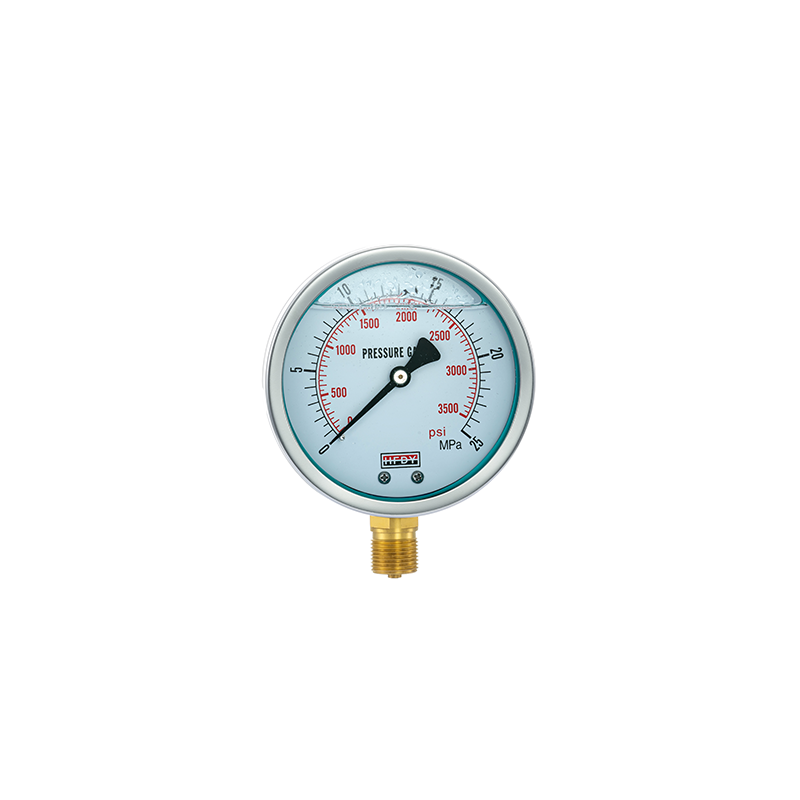
Pressure gauge with a visible fill line, psi and MPa scales, and a bottom stem

YN-100 shown with a liquid-filled case and a psi/MPa dial.

Vibration-Resistant Pressure Gauge YN-100

This liquid-filled, bottom-entry model is intended for systems with vibration or pressure pulsation where brass wetted parts suit the process fluid.

  • Dial and fill3.94 in. (100 mm) dial, with glycerin or silicone oil listed as fill options.
  • ConnectionBSP is listed as a thread option. For the 100 mm dial, listed connection sizes include 1/4 in. and 1/2 in. Confirm the size, G or R designation, and seal together for the quoted configuration.
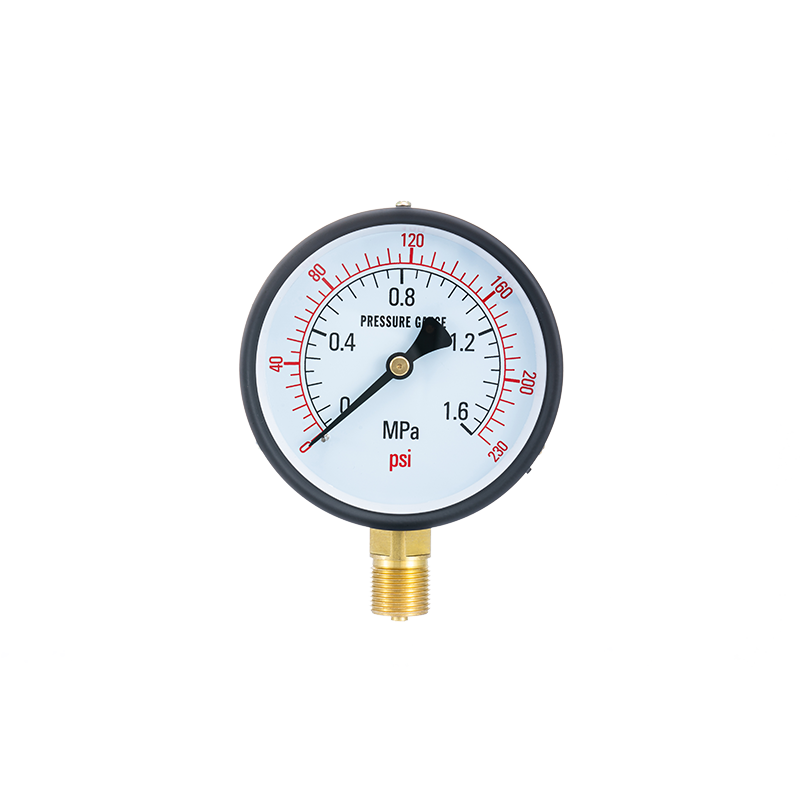
Black-rimmed pressure gauge with red psi markings and a male thread below the dial

Ordinary Pressure Gauge shown with a black case and a psi/MPa dial.

Ordinary Pressure Gauge

This general-purpose series offers several dial sizes for local readings in steady service.

  • Listed dial sizes60, 100, 150, 200, and 250 mm (approximately 2.36 to 9.84 in.).
  • ConnectionThe series lists M14 × 1.5 or M10 × 1 for Y-60 and M20 × 1.5 for the larger models. Check BSP availability for the specific model you plan to order.

Verify fit before ordering

If the installation calls for an adapter, check the thread and seal on both sides, the adapter’s pressure and temperature ratings, and the extra clearance it needs.

For a repeat order, use the approved connection drawing or quote reference. For a new connection going into a batch order, ask about checking a sample for fit, seal, and dial orientation before placing the full order.

Request a BSP pressure gauge quote

Send Hangzhou Dongya Instrument Co., Ltd. your equipment port designation, gauge requirements, and quantity for a quote.

  • Phone: 008618968133688
  • Email: [email protected]
  • WhatsApp: 008618968133688
  • Address: Hangzhou Dongya Instrument New Plant Area, Zhougongwu, Yinhu Street, Fuyang District, Hangzhou City, Zhejiang Province (North side of National Highway 320)

For an unmarked port, email the equipment drawing or close-up photos of the thread and sealing surface along with your inquiry.

WhatsApp QR Code WhatsApp Chat
+86-18968133688