 Dypressuregauge
What Is The Function Of Pressure Transmitter
The core task of a pressure transmitter is to measure the physical pressure of a liquid or gas acting on a sensor element and then convert this mechanical displacement into a standardized linear electrical signal ——that is, the 4-20 mA current loop, which is our most commonly used industrial standard. Many people who have just entered the industry are prone to confusing it with basic sensors, but the key value of a transmitter is that it is an automated system “communication bridge”: it can not only detect pressure changes, but also amplify and adjust the signal without losing accuracy and enable long-distance transmission. The PLC or DCS in the control room accurately read the data and then handle real-time process control, safety interlocking and continuous monitoring of the system. It is with this stable and precise output that the automation system can truly “perceive” the true state inside the pipeline and container, ensuring that the entire working condition always runs in a safe and efficient range.
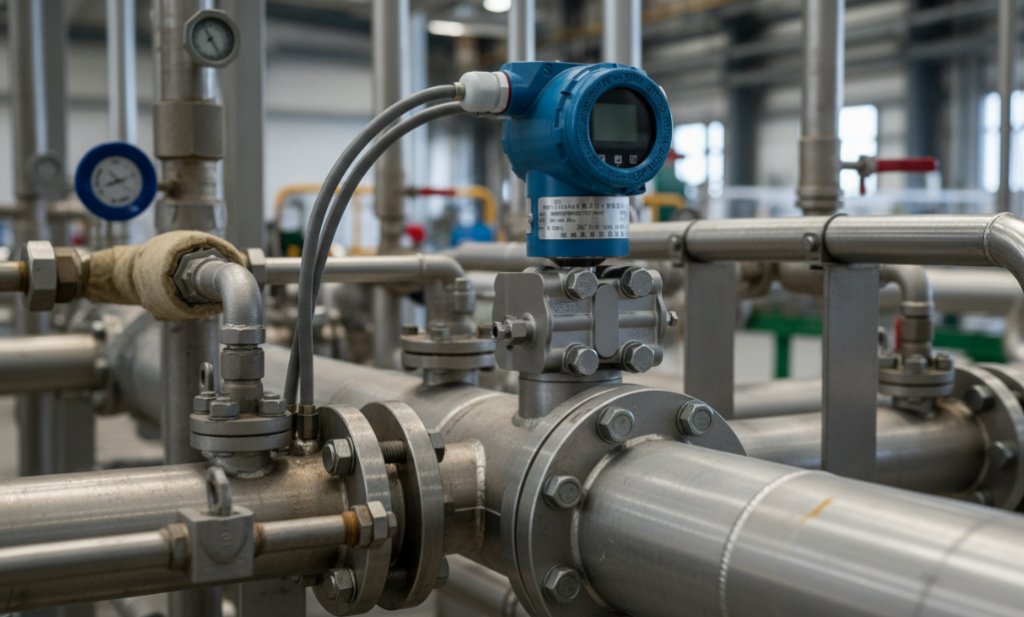
From Mechanical Forces To Electronic Data
The starting point of all this is on that diaphragm. When the process medium applies pressure, this sensitive element will produce extremely small physical displacements. A sensor inside the transmitter captures this movement ——usually by a change in capacitance or resistance—— and turns it into a raw millivolt-level signal.
This part of the circuit in the transmitter “sending” is the most valuable: it is responsible for linearizing the messy raw data and ensuring that the final electrical signal output is exactly proportional to the input pressure value. This high standard of precision is what gives our engineers the confidence to trust the data ——if you see a 12 mA current signal in the background, you can 100% conclude that the pressure is now exactly 50% of the scale.
Ensure The Integrity Of Signal Transmission Over Long Distances
In those factories with huge areas, it is common for the measuring point to be a few hundred meters away from the control room. If only the weak signal of an ordinary sensor is used, the voltage drop caused by electromagnetic interference or cable impedance at such a long transmission distance will already be tortured to an end. The function of a pressure transmitter is to “condition” the signal into a strong 4-20 mA current loop. This standard is naturally immune to noise and can ensure that the high-precision data collected on the pipeline will remain authentic when transmitted to the controller.
Bridge To Industrial Automation
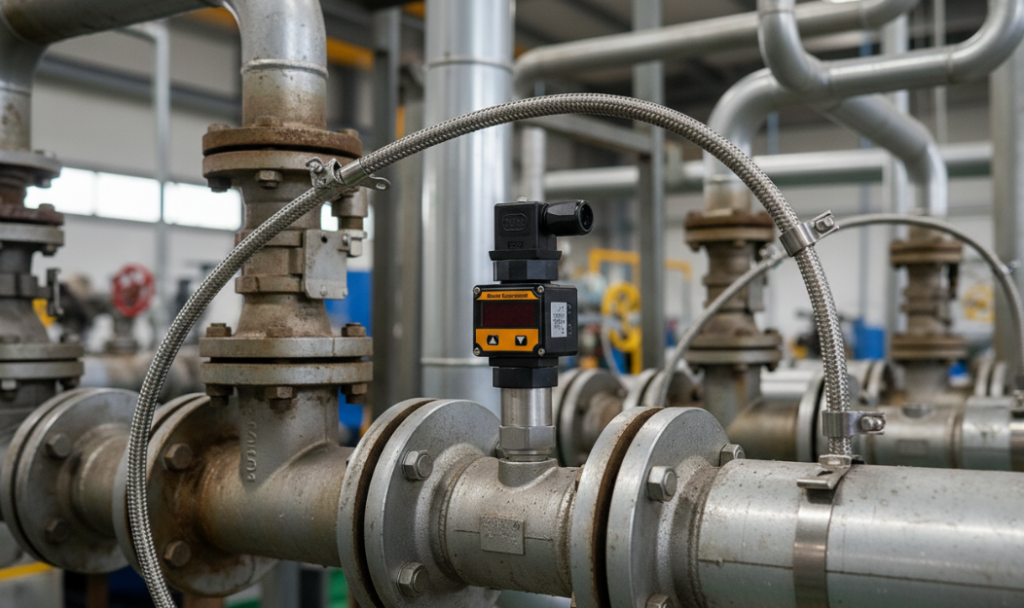
I often compare pressure transmitters to PLC or DCS systems “eyes and ears”. Without this communication link, the central control system would be completely blind to the process status on site and would not be able to manage it at all.
By continuously delivering data streams, transmitters make the following key operations a reality:
- Real-time process control: such as automatically adjusting the valve opening based on pressure feedback, or controlling the pump speed.
- Data interpretation: Convert abstract current signals into units that operators can understand, such as PSI, Bar or Pascal.
Ensure Production Safety And System Efficiency
In addition to daily numerical measurements, the transmitter’s function and safety interlock are also tightly bound together. In high-pressure environments, it acts like a sentinel on duty around the clock. Once the pressure exceeds the preset safety limit, the transmitter will instantaneously notify the DCS to trigger an emergency stop or force open the pressure relief valve.
Allowing the system to effectively “feel” the internal pressure state of the container and piping is the only way to prevent fatigue damage to the equipment or even catastrophic accidents. This ensures that the complete set is not just operating, but operating within the extremely stringent and safe parameters required by modern manufacturing.
Author: Alex Rivera
I’ve spent my career installing, calibrating, and troubleshooting thousands of field instruments in complex industrial environments. My mission is to bridge the gap between theoretical engineering and real-world application, helping the next generation of technicians and engineers master the ‘eyes and ears’ of automation systems.