 Dypressuregauge
Differential Pressure Gauge Working Principle Explained
The core lies in its isolation design: The differential pressure gauge completely separates two different pressure source, the high-pressure end and the low-pressure end through a flexible sensing element. Once a pressure difference appears on both sides, the high-pressure side will push the sensing element to move toward the low-pressure side. This mechanical displacement is then accurately translated into the runout of the dial hands through a sophisticated mechanical linkage or magnetic coupling system. The biggest difference between it and ordinary pressure gauges is that the differential pressure gauge automatically “filters” out the background static pressure and only looks at the unbalanced combined force. That’s why we can use it to accurately monitor filter status, seal tank fluid levels, or pipeline flow.
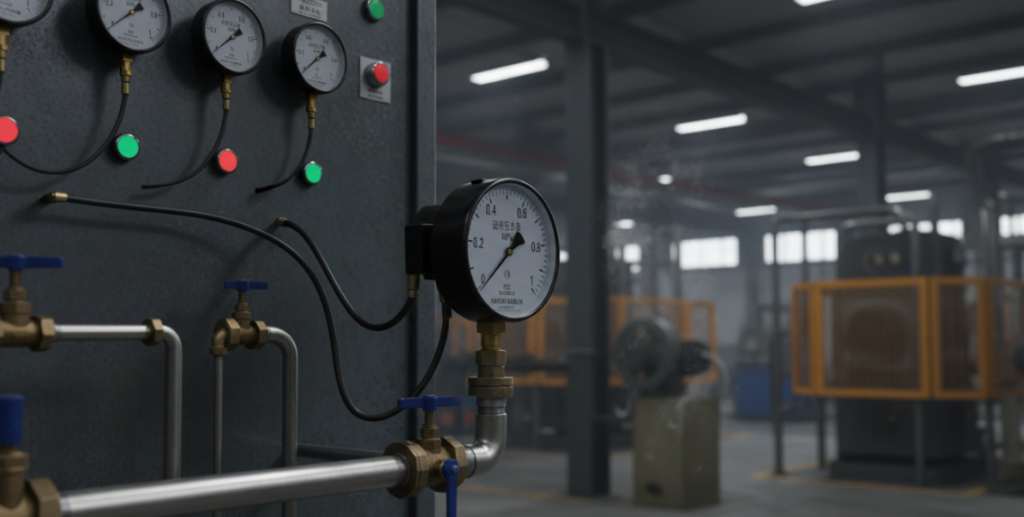
Structural Logic Of HP And LP Interface
The basis of the working principle of the differential pressure gauge actually lies in its double chamber structure. Unlike a normal pressure gauge with only one air inlet, a differential pressure gauge has two very clear interfaces:
High Pressure (HP) Interface: Connects to an area upstream of the system or with higher pressure.
Low Pressure (LP) Interface: Connects to an area downstream of the system or with lower pressure.
What these two interfaces lead to inside are two chambers that are isolated from each other. This design guarantees that the process media from both sources will never mix, but they will act simultaneously on two opposite faces of the internal sensing element.
Mechanical Structure Of Sensing Elements
The sensing element is the “engine” of this instrument, and its displacement is the physical manifestation of ΔP. Depending on different industrial needs, we usually use these components:
Diaphragms: These flexible diaphragms are very sensitive and can sense even small pressure fluctuations. When the pressure on the HP side exceeds that on the LP side, the diaphragm bends toward the LP chamber.
Bellows: Like an accordion, they stretch or compress according to pressure differences. I usually recommend this when a mechanical transmission requires more physical travel.
Pistons: Common in high-pressure hydraulic systems, they use pressure differences to push the piston to compress the calibration spring.
Transmission Of Displacement
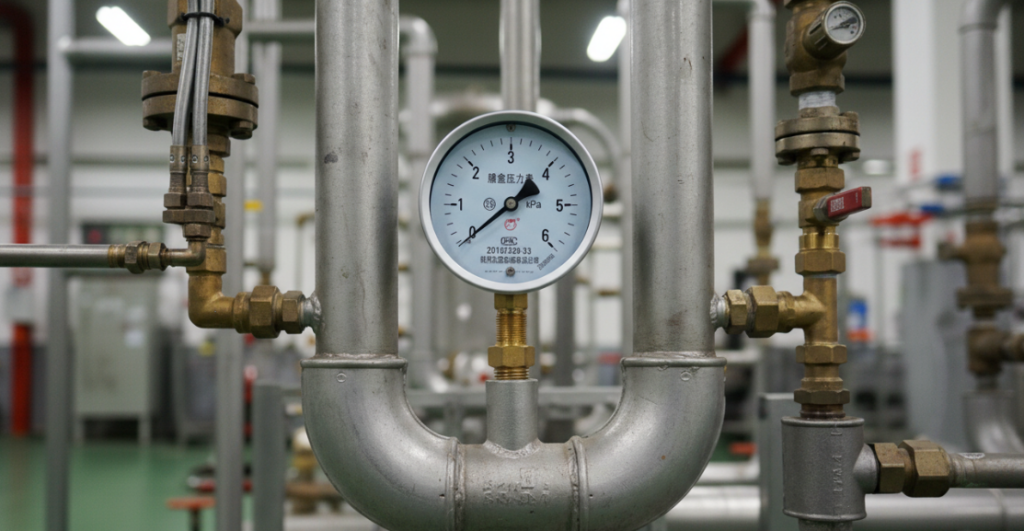
Mechanical linkage: In many traditional designs, a set of precision gears and fulcrums will connect the sensing element directly to the pointer shaft. This ensures a linear relationship between ΔP and the pointer on the dial.
Magnetic coupling: For those systems that absolutely cannot leak and require the process medium to be completely isolated from the dial, magnetic coupling is a lifesaver. The sensing element moves the magnet, which in turn “attaches” the pointer on the other side of the partition to rotate. This is standard on high quality industrial differential pressure gauges, which are extremely durable in harsh environments.
Understanding The Difference Between Static Pressure And Differential Pressure
The most powerful thing about the differential pressure gauge is that it can “ignore” static pressure. Assuming a system pressure of 1000 PSI, if HP and LP are connected at the same time, the pointer will not move because the sensing element is in the median. The table will only show 5 PSI if one side is 1005 PSI and the other side is 1000 PSI. This ability to isolate background pressure allows engineers to capture extremely subtle changes in extremely high system pressures.
Field Practical Applications
Filter status monitoring: Measure ΔP before and after the filter to know the exact “pressure drop”. The more clogged the filter, the greater the difference between the two sides, which is a reminder that it is time to clean or replace it.
Sealed tank level: In a pressure vessel, a differential pressure gauge compares the total bottom pressure and the top gas pressure. The difference directly represents the height of the liquid column and is very accurate.
Flow measurement: A local pressure drop occurs when fluid flows through a throttling device such as an orifice plate. The differential pressure gauge measures this pressure drop, and the flow rate can be calculated based on the mathematical ratio.
Author: David Miller
Having navigated complex process control challenges in sectors ranging from petrochemicals to water treatment, I focus on bridging the gap between theoretical mechanics and practical field reliability. I specialize in helping engineers and technicians optimize system performance through precise pressure measurement and diagnostic solutions.