 Dypressuregauge
0 60 psi pressure gauge: Range, Uses and Selection Guide
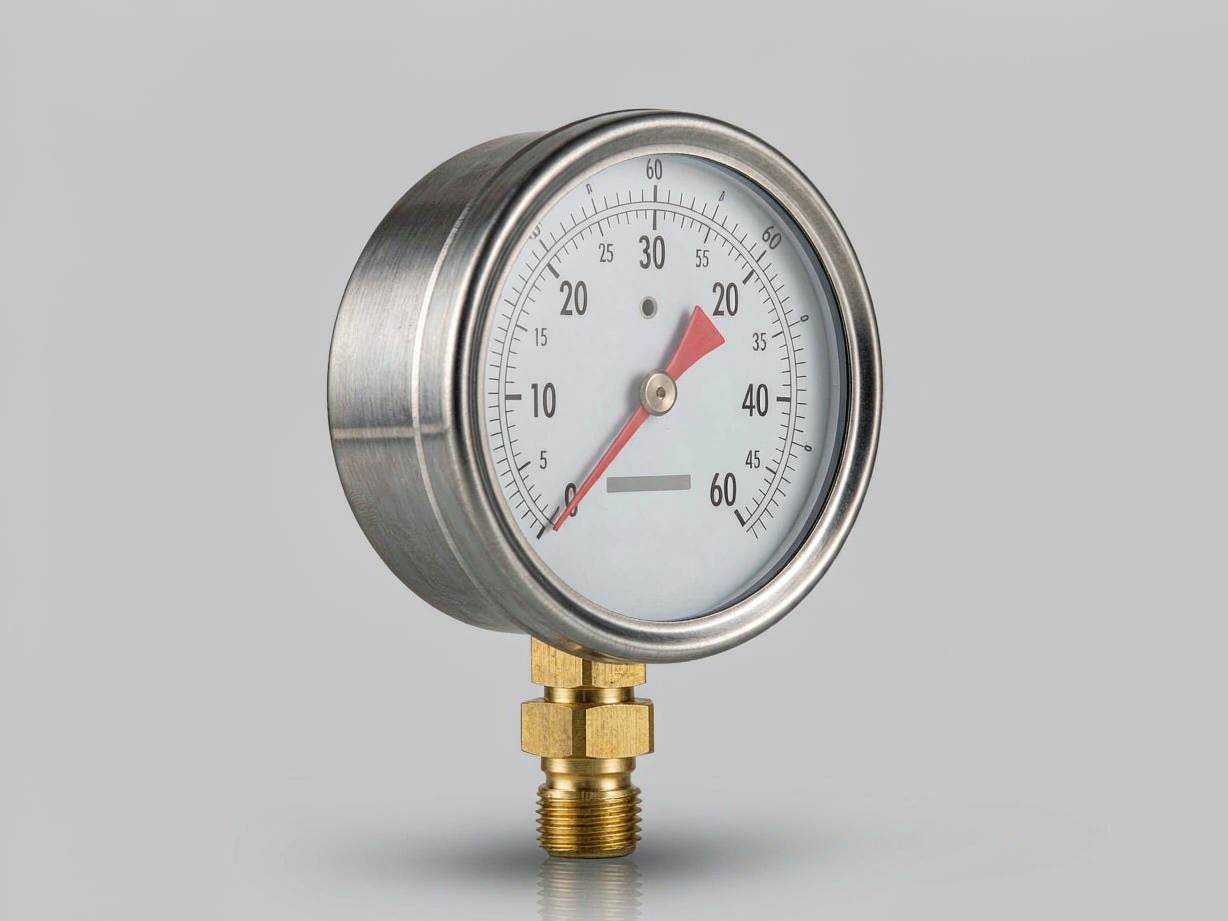
What pressure is read at 0 60 psi
A meter labeled 0 60 psi pressure gauge reads gauge pressure, with a range from zero all the way to 60 psi. Zero is the lower limit, and 60 psi is the upper limit. These two numbers describe the span of the dial scale and are neither equal to the allowable error nor indicate that the device must operate at 60 psi for a long time. psi is short for pounds per square inch, which is how many pounds of force are carried per square inch. Converted to metric, 1 psi is approximately equal to 6.895 kPa, or 0.069 bar, so 60 psi is approximately equivalent to 4.14 bar, or about 0.41 MPa. Those who are used to using megapascals can roughly understand it as a table of 0 to 0.4 MPa.
The range should be consistent with the actual pressure
When many people choose a pressure gauge, they subconsciously regard the number at the top of the dial as the grade, but in fact it is just the end of the scale. It is also a psi table, 0 30 psi pressure gauge, 0 60 psi pressure gauge or 0 300 psi pressure gauge. The difference is not good or bad, but whether the range can cover your real working conditions. If the range is set to a smaller size, the pointer will be pushed to the head or even over-traveled at the moment of startup or as soon as the pressure spike occurs, and the life of the spring tube will be significantly shortened. The range is set, and your normal operating pressure only falls in a small arc near zero, making the readings difficult to read when squeezed together. Moreover, the accuracy of mechanical watches is usually marked as a percentage of full scale. The larger the scale, the greater the absolute error corresponding to the same accuracy level. Therefore, the principle of selecting the range is: normal pressure, start-up fluctuations, pulsations, and foreseeable abnormal pressures must all be covered, while ensuring sufficient readability of the critical working interval.
What scenarios do commonly used psi ranges correspond to
It’s easier to find its location by putting the 0 60 psi pressure gauge into the entire psi series. Very low gas pressures, such as in certain pneumatic tests or micro-pressure situations, are more suitable for 0.5 psi pressure gauge or 0.15 psi pressure gauge. For general compressed air lines, small pneumatic tools, and civilian water supply, 0 30 psi pressure gauge and 0 60 psi pressure gauge are the most common settings. Further up, 0 100 psi pressure gauge, 0 160 psi pressure gauge, 0 200 psi pressure gauge, and 0 300 psi pressure gauge cover the higher sections for compressed air and general industrial use. When it comes to hydraulic systems, the scale is completely different. 3000 psi pressure gauge and 5000 psi pressure gauge are the norm. Interfaces, pressure measuring elements and safety structures must be equipped according to this pressure level.
A few reminders about writing style
It’s worth keeping an eye on when buying a watch: the same range can often be written in several ways. 0 60 psi pressure gauge and 0-60 psi pressure gauge refer to the same table, the difference is just a hyphen; 0 to 30 psi pressure gauge and 0-30 psi pressure gauge are the same, 0-15 psi pressure gauge, 0-160 psi pressure gauge, 0-200 psi pressure gauge, 0-300 psi pressure gauge These hyphenated names, Essentially, they are all upper limited routes. Many people simply omit the initial zero and write it as 15 psi pressure gauge, 30 psi pressure gauge, 100 psi pressure gauge, 200 psi pressure gauge, 300 psi pressure gauge, or even use 100 psi air pressure gauge to emphasize that this is a barometer. These abbreviations usually start from zero. As long as the context is clear, they all refer to the same type of psi table calculated from zero. Don’t be fooled by spelling differences when comparing quotes.
Interfaces, materials, and precision are just as important
The range is only the first step in selection. A 0.60 psi pressure gauge also requires confirmation of the process interface. Common medium and low pressure psi gauges use 1/4 NPT threads, but metric threads or G threads are also used. Before placing an order, you must clearly see the thread standard, nominal size, internal and external threads, and sealing method. You cannot screw based solely on the approximate diameter. The liquid receiving material must be compatible with the medium. Ordinary compressed air or water can be used with copper alloy liquid receiving. If it encounters corrosive media, stainless steel or a diaphragm seal must be replaced. The diameter of the dial determines how far you can see clearly. Tables of 40, 50, and 63 mm are suitable for close-range equipment, while tables over 100 mm are more suitable for far-range reading. If there is obvious vibration on site or pressure pulsation, the needle will shake violently. In this case, you can select a liquid filling meter, use glycerin or silicone oil for damping, or add throttling buffer to stabilize the reading.
A few reminders about installation and routine maintenance
When installing the watch, the wrench must fall on the wrench surface of the pressure interface. You cannot screw the watch case directly, otherwise it will easily damage the movement and the interface. The installation location should be as far away from strong vibrations as possible, and it is also easy to observe. During daily checks, the pointer should return to near zero in the unpressurized state, but returning to zero only means that the zero bit is normal, not that the entire range is accurate. Regular checks are still necessary. If you find that the pointer is always at the top of the range, wobbles rapidly, or the reading is obviously low, you should check whether it is overvoltage, pulsation or interface blockage based on the working conditions, rather than rushing to replace a table with the same specifications.