 Dypressuregauge
What should I pay attention to when choosing a pressure gauge with a 0-30 psi and a 1/4 NPT rating?
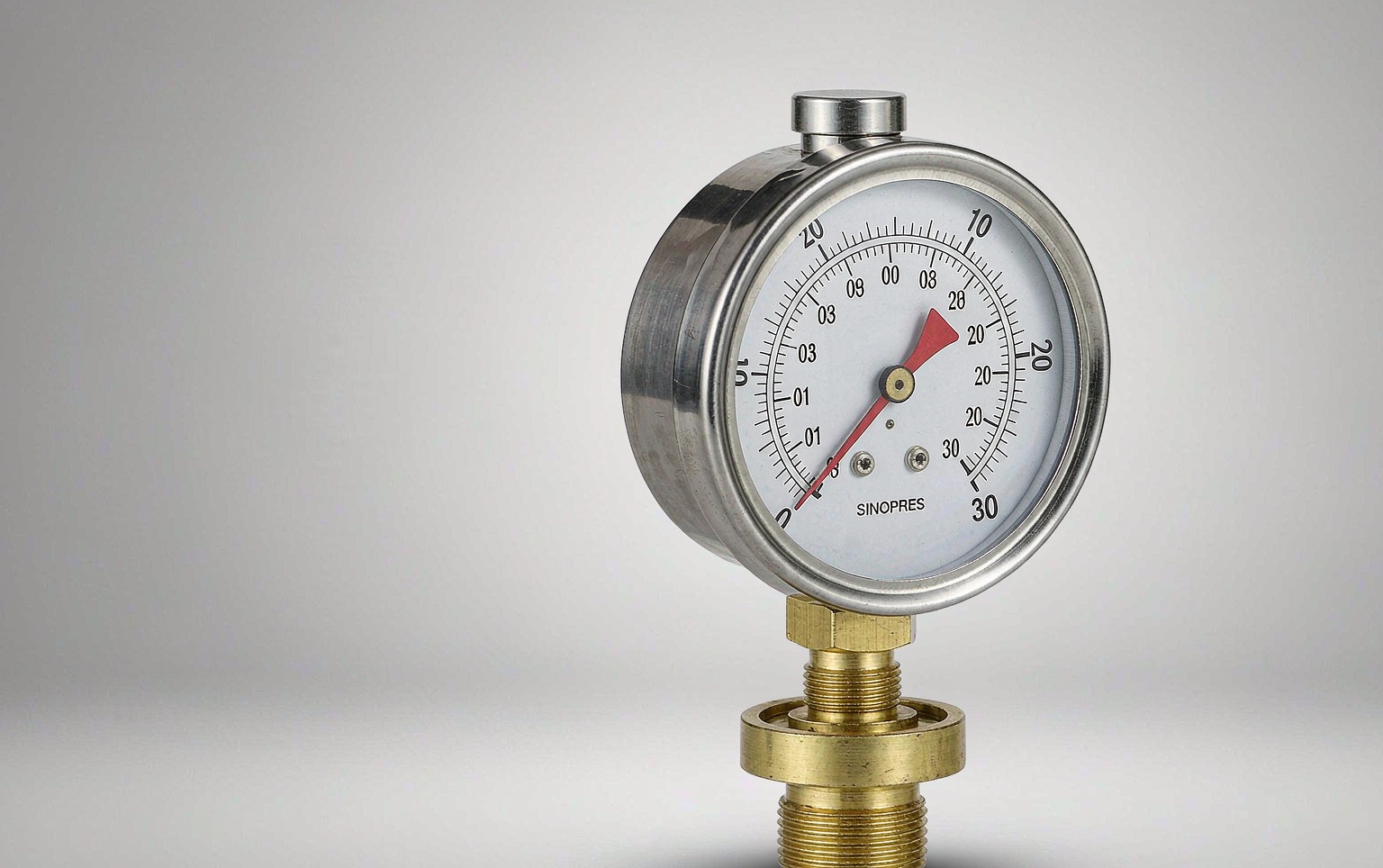
Most of the people who checked the English string “0 30 psi pressure gauge 1 4 npt” had a device in imperial units and were in a hurry to find a mechanical watch with a range between 0 and 30 psi and a 1/4 NPT interface to replace it. The principle of this watch is actually very simple. It has a spring tube inside. When the pressure comes on, the tube deforms, and with the gear and connecting rod, the pointer rotates in a circle, and a reading is taken on the dial.
However, you need to be clear before buying: the pressure measured by this gauge is called “gauge pressure” (that is, the pressure relative to the outside atmospheric pressure). If your system requires “absolute pressure” or “differential pressure”, be sure to just say it and don’t buy it, put it back in, and find out the readings are all wrong.
There is a big pit to avoid regarding the 1/4 NPT interface
NPT is American Standard “tapered pipe thread”, and as the name suggests, it has a taper that gets tighter the tighter you tighten it. When installing, you have to wrap raw material tape (sealant is also acceptable) to plug the leak. This is completely different from the flat threads we usually see that can be sealed with a gasket. A 1/4 NPT refers to a thread with an outer diameter of 1/4 inch, which is what many small “bottom fitting (radial)” pressure gauges use.
A special reminder here: NPT, G thread (imperial non-sealed), R thread and metric thread, no matter how similar they look, they cannot be hardened! Hard tightening will not only destroy the threads, but it will also definitely leak air. If you really want to transfer, just buy a genuine adapter. In addition, when installing the watch, use a wrench to tighten the flat part at the bottom of the joint. Do not hold the watch case with both hands and force it to turn. Once the case twists and deforms, the movement inside will fall apart if it is not properly manufactured. Also pay attention when wrapping the raw material belt to prevent debris from falling into the hole and blocking the pipe.
Why does the range have to be 0–30 psi?
0-30 psi is considered a low range. Other similar series on the market include 0-15, 0-60, 0-100 psi, etc. There is a real trick to choosing a range: the pressure when your equipment is normally running should ideally fall just in the middle of the dial, which is the most intuitive to look at. At the same time, fluctuations when the equipment is first started, or occasional pressure peaks, must also be taken into account.
If you choose a smaller range, it will burst the meter “if you hold your breath”; if you choose a larger range, the needle will only move slightly at the bottom, and you will not be able to see the reading clearly. Moreover, the larger the range, the larger the absolute error. So don’t always have the illusion of “buying a big bit of pressure resistance”. If your system has a water pump, compressor, or valves that open and close very quickly and there are frequent shocks in the pipes, you will need to choose a high-range one (such as the 100 psi version) and add additional cushioning and shock absorption devices.
Dial size and connector size, don’t confuse them
Many people get confused when buying watches, confusing the dial diameter with the thread size under the dial. Also a 1/4 NPT connector, the dial above can be 1 inch, 1.5 inches, 2.5 inches or even larger. For example, if you search for “2.5 in dial”, it comes with a two-and-a-half-inch plate, while “1 in” is a mini plate.
By the way, I would like to complain about the habit of foreigners writing sizes: 1.5 inches they like to write as 1 1/2, 2.5 inches as 2 1 2, and 0.75 inches is 3/4. There’s also that extra-pocket 1/8-inch connector (1 8 npt) that’s a circle thinner than 1/4. There are also some precautions when reading. The small dial has dense scales, which makes it very easy to see the switches if the light is bad or you look at it with your eyes tilted. If you require high reading accuracy, simply use a large dial or simply change the dial display.
Is it vibrating loudly and causing corrosion? Have some means
If your device vibrates violently, or the pressure fluctuates, it is strongly recommended to apply the “fill gauge”. That is, the kind with the case filled with glycerin or silicone oil. The oil can shock the hands and is not easy to shake. But this oil is not a panacea. If the needle is still jumping wildly after adding oil, you should wonder whether you need to add a buffer tube, or simply move the watch further away to install it. You can’t just rely on the watch to carry it by itself.
Also, what kind of medium is running in your tube? If the liquid or gas is corrosive, you need to check the material of the pipes and connectors inside the meter. At this time, it usually needs to be made entirely of stainless steel. Regardless of whether you choose brass or stainless steel, you have to follow your medium, temperature, and pressure.
Install the Life-Saving Code
Try to pick a location where it’s not too jarring and doesn’t require you to pout your butt to take a reading. When opening the valve to apply pressure, be slow and let the pressure rise slowly. Don’t pull the valve open suddenly, the instantaneous impact force can dry out the movement and destroy it.
By the way, some regulations mention a “30 psi safety limit” (such as the compressed air requirements for workshop dust guns). These are the rules for people’s safe operation. They are completely different from the 30 psi range we choose for pressure gauges. Don’t confuse them, let alone use them to randomly adjust system settings or tire pressure. Also, before changing the meter, you must make sure that the equipment has been completely pressure-relieved and the valve is locked, otherwise it is no joke that high-pressure medium will spray out as soon as you unscrew the meter.
When buying a watch from a manufacturer, what parameters should I specify?
To summarize, if you take “0 30 psi pressure gauge 1 4 npt” and go to the manufacturer to buy a watch, don’t just talk about it “give me a better industrial watch”. You have to report all these “code”:
Gauge pressure or absolute pressure? What is the range (0-30 psi)? How big is the connector (1/4 NPT, bottom or back)? Should the part that comes into contact with the liquid be copper or stainless steel? How big should the dial be? What is the operating temperature? Is shockproof required?
The larger the dial, the more accurate the scale, but this depends on whether there is room on your device. If you feel that 30 psi is not enough, you can also replace the interface with a 0-60 psi one. To put it bluntly, buying a pressure gauge is like a puzzle. You have all the core parameters such as interface, range, material, and size in place, so that the gauge you buy can be used seamlessly.