 Dypressuregauge

Abs pressure to gauge pressure: How to convert it
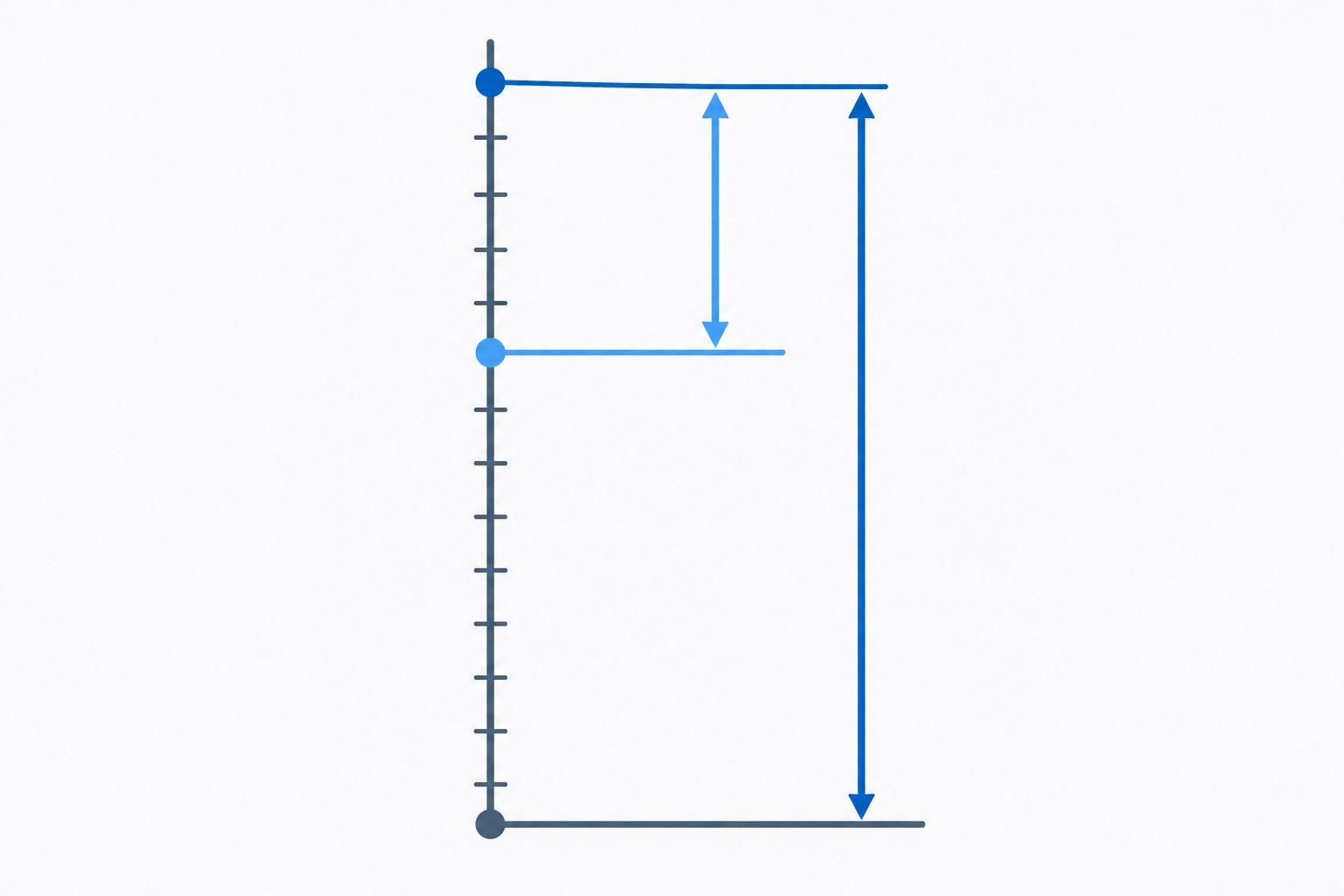
Converting absolute pressure to gauge pressure is not simply a unit change. Both readings may use kPa or psi, but their zero references differ: absolute pressure starts at ideal vacuum, while gauge pressure starts at the atmospheric pressure around the measurement point. The conversion therefore depends on the atmospheric pressure that matches the process measurement.
The formula: subtract absolute atmospheric pressure
The relationship is p_abs = p_gauge + p_atm, so the conversion is p_gauge = p_abs - p_atm. Here, p_abs is absolute pressure, p_gauge is gauge pressure, and p_atm is absolute atmospheric pressure.
Use the same unit for both values before subtracting. For example, if the absolute reading is in kPa, express the atmospheric pressure in kPa as well. The reference matters too: p_atm must be absolute atmospheric pressure, not another gauge-pressure reading. After subtraction, label the result as gauge pressure, such as kPa(g), rather than kPa(abs).
Match the atmospheric pressure to the measurement
p_atm is not one fixed value for every place and time. It should correspond to the location and time of the process measurement. Elevation and weather change atmospheric pressure, so the same absolute-pressure reading can convert to different gauge-pressure values under different atmospheric conditions. Because the formula subtracts p_atm, an atmospheric-pressure input that is too high makes the calculated gauge pressure too low by the same amount.
The fixed value of 101.325 kPa can be used only as an approximation under clearly stated conditions; it should not automatically be treated as the actual atmospheric pressure at the measurement site. If only elevation or standard atmospheric pressure is available, the conversion is an estimate. For high-accuracy work, do not substitute a fixed standard value without checking that it represents the relevant conditions.
Keep the pressure basis visible
psia denotes absolute pressure; psig denotes gauge pressure. Both use psi, but their numbers are not directly comparable just because the unit matches. A specification that lists only psi, bar, or Pa does not identify the pressure basis. If a source gives no absolute or gauge reference, the number alone is not enough to determine which conversion applies.
When interpreting a reading, keep its value, unit, pressure basis, and measurement point together. Time and operating conditions can also help explain changes in the reading.
Read a negative gauge result correctly
If process absolute pressure equals local atmospheric pressure, the calculated gauge pressure is zero. If it is higher, gauge pressure is positive; if it is lower, gauge pressure is negative. A gauge instrument open to the atmosphere with no process pressure should read close to zero, while an absolute-pressure instrument in the same state should read close to local absolute atmospheric pressure.
A negative gauge value describes pressure below local atmospheric pressure. It does not mean that absolute pressure is negative: absolute pressure uses ideal vacuum as its zero and cannot fall below that reference.
Do not interchange vacuum expressions
Vacuum may be expressed as absolute pressure, negative gauge pressure, or a positive vacuum value. Expressions such as -x kPa(g), x kPa vacuum, and x kPa(abs) are not interchangeable based on the number alone. Before comparing them, align the pressure basis, sign convention, and unit.