 Dypressuregauge
Absolute and Gauge Pressure Difference: Abs vs Gauge
The absolute and gauge pressure difference fundamentally relies on the zero-reference point: absolute pressure measures strictly against a perfect vacuum (zero reference), while gauge pressure measures against the local, fluctuating ambient atmospheric pressure. Confusing these two metrics during instrument procurement or fluid dynamics calculations instantly causes PID control loops to fail, damages vacuum pumps, and leads to catastrophic pipe over-pressurization. A minor atmospheric shift of 0.5 PSI from a passing weather front will ruin a chemical batch if a factory installs a gauge pressure transmitter where an absolute sensor was structurally required. We will break down exactly how to specify the correct sensor for high-altitude installations, diagnose vapor pressure calculation errors, and apply the Z.R.O. engineering framework to your next system design.
The Mathematical Core: Abs vs Gauge Pressure
Engineers convert between these two metrics using a rigid formula heavily dependent on the exact barometric conditions at the installation site. The standard equation is Pabs=Pgauge+Patm. You cannot simply add a flat 14.7 psi (101.325 kPa) to your gauge reading and assume the absolute pressure is correct. You must measure the actual local atmospheric pressure (Patm) on that specific day to perform a precise thermodynamic conversion.
| Metric Type | Zero Reference | Common Units (PSIA vs PSIG) | Typical Industrial Applications | Susceptibility to Weather |
| Absolute Pressure | Perfect vacuum (strict zero reference) | PSIA | Vacuum pumps, high-altitude installations, vapor pressure calculations, precise thermodynamic conversions | None; completely independent of local barometric conditions and passing weather fronts. |
| Gauge Pressure | Local, fluctuating ambient atmospheric pressure (PatmPatm) | PSIG | General fluid dynamics, pipe pressure monitoring, standard non-critical chemical batching | Highly susceptible; a minor atmospheric shift (e.g., 0.5 PSI from a weather front) directly alters the reading. |
The “Z.R.O.” Sensor Selection Framework
Procurement teams and junior engineers waste millions of dollars annually specifying the wrong transducers for fluid systems. You eliminate this specification error completely by running every design through the Z.R.O. Framework: Zero-Isolation, Reference-Shift Vulnerability, and Operational-Venting.
Zero-Isolation (Absolute Requirement)
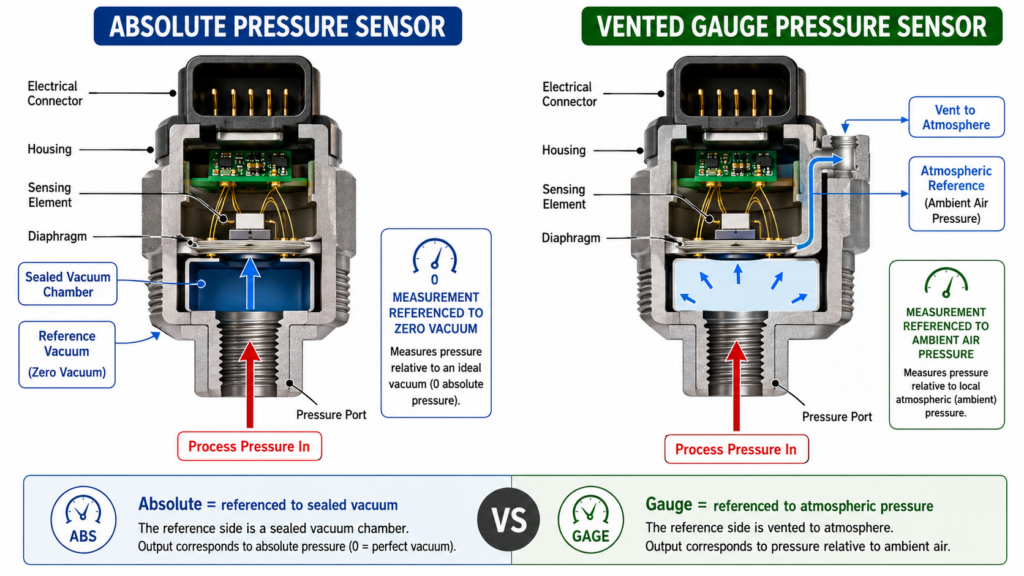
You must specify an absolute pressure sensor (Abs) whenever your fluid calculation requires tracking thermodynamic properties, such as vapor pressure or gas density. Absolute sensors feature a completely sealed internal vacuum chamber positioned right behind the sensing diaphragm. This design isolates the silicon die from all external weather variations. Aeronautical altimeters, weather stations, and vacuum packaging machines mandate zero-isolation to function correctly.
Reference-Shift Vulnerability (Gauge Flaw)
Gauge pressure sensors actively betray your data if your process requires high-precision stability across different weather fronts. A gauge sensor features a tiny vent hole (usually in the electrical connector) that lets ambient air sit behind the sensing diaphragm. When a low-pressure storm rolls over your chemical plant, the local atmospheric pressure drops. Your gauge sensor will falsely output a higher pressure reading for your internal pipe, even if the actual pipe pressure never changed.
Operational-Venting (Gauge Advantage)
You select gauge pressure (Gauge) exclusively when the internal system pressure must interact safely with the immediate outside environment. Hydrostatic tank level measurement requires gauge sensors because liquid levels rise and fall based on the pressure of the ambient air pushing down on the open tank surface. Venting the sensor guarantees the measurement only reflects the liquid’s weight, entirely ignoring atmospheric fluctuations.
Engineering Pitfalls: The High-Altitude Trap
Installing standard gauge pressure transmitters in high-altitude mining or pumping facilities guarantees system failure. An engineering firm recently installed 50 standard gauge sensors in an Andes mountain lithium facility at 13,000 feet (4,000 meters). The local atmospheric pressure at that altitude is only 8.9 psi, not the 14.7 psi sea-level standard programmed into their PLCs. The SCADA system read the gauge data, applied sea-level assumptions, and subsequently over-pressurized the entire filtration network, blowing out thousands of dollars in flange gaskets.
What is Absolute Gauge Pressure? (Sealed Gauge)
The term “absolute gauge pressure” technically represents an engineering misnomer, referring instead to “Sealed Gauge” (SG) sensors. A sealed gauge transducer locks in a specific atmospheric pressure (usually 14.7 psi) behind the diaphragm during the factory manufacturing process. It behaves like an absolute sensor because it lacks a vent hole and ignores local weather changes. Engineers deploy sealed gauge units in heavy washdown environments (like food processing) where a traditional vented gauge sensor would suck water into its electronics through the breather tube.
Industry Trends: MEMS Sensors in HVAC/R
Strict environmental regulations regarding low-GWP (Global Warming Potential) refrigerants are forcing HVAC/R manufacturers to abandon traditional gauge manifolds for digital MEMS absolute pressure sensors. Modern refrigerants like R-290 operate under tighter vapor-compression thresholds. Evacuating a chiller system now requires technicians to pull a vacuum down to 500 microns (absolute pressure). A traditional mechanical gauge cannot detect micron-level vacuum leaks. Piezoresistive absolute MEMS chips measure the deflection of a silicon diaphragm at a microscopic level, instantly alerting technicians to moisture boiling off inside the copper lines.
People Also Ask (FAQ)
What is the difference between PSIG and PSIA?
PSIG (Pounds per Square Inch Gauge) measures pressure relative to the surrounding atmospheric air. PSIA (Pounds per Square Inch Absolute) measures pressure relative to a perfect, zero-pressure vacuum.
Can gauge pressure be negative?
Yes. Gauge pressure reads negative when the pressure inside a system is lower than the surrounding atmospheric pressure. Engineers refer to this specific condition as vacuum pressure or draft pressure.
Why do we use absolute pressure in thermodynamics?
Thermodynamic laws, like the Ideal Gas Law (PV=nRT), mandate absolute pressure because gas behavior depends on the total kinetic energy of molecules. Gauge pressure ignores the atmospheric molecules already exerting force on the system, making the math invalid.
How do you convert gauge pressure to absolute pressure?
You measure the exact local atmospheric pressure using a barometer, then add that specific value to your gauge pressure reading. Using a generic 14.7 psi standard introduces calculation errors if you are not at sea level.
What happens if you use a gauge pressure sensor in a vacuum?
The sensor will output a negative value until it reaches its maximum negative calibration limit (typically around -14.7 PSIG at sea level). For precise deep vacuum monitoring (microns or Torr), you must use an absolute sensor.
Does atmospheric pressure affect absolute pressure readings?
No. Absolute pressure sensors rely on an internal, factory-sealed vacuum chamber as their permanent reference. External weather changes or altitude shifts have zero impact on the diaphragm’s deflection regarding the internal fluid.
The prev: 60mm Industrial Stainless Steel Pressure GaugeThe next: 0 200 PSI Pressure Gauge