 Dypressuregauge
Bellow Pressure Gauge vs Bourdon Tube: Which Is Better?
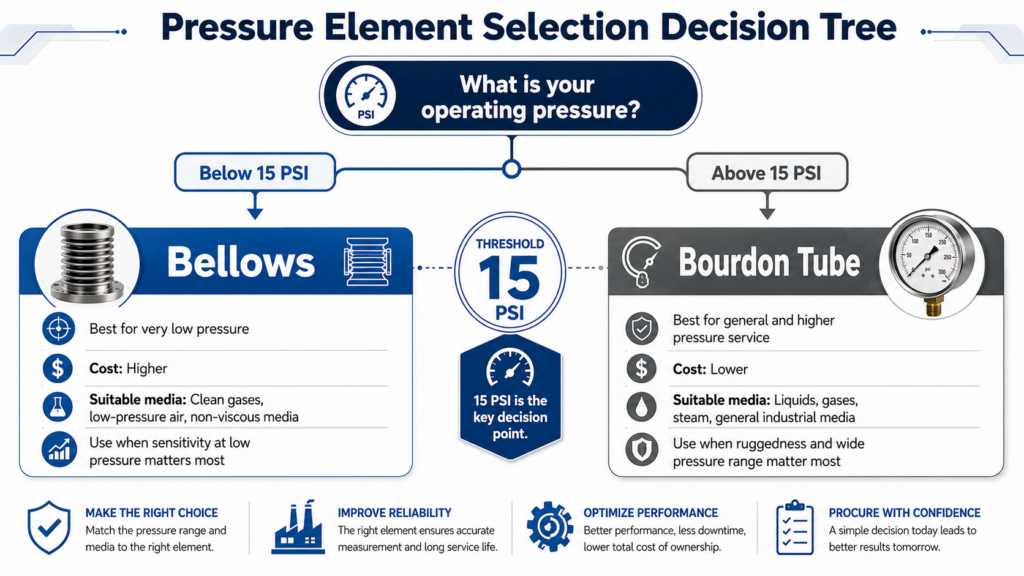
There is no absolute difference between the advantages and disadvantages of these two designs. Which one to choose depends entirely on your actual work pressure. At very low pressure (less than 15 PSI or micro water column), the bellows pressure gauge (k800) is the absolute king, because of its large surface area, can easily capture even the slightest pressure change. In a high-pressure environment (15 PSI or even 100,000 PSI), the Bourdon tube (I .e. spring tube) becomes the main force, and its thick and hard metal tube wall can withstand great hydraulic impact.
If you install the bellows on the hydraulic pipe, it will burst 100% on the spot. On the other hand, if the Bourdon tube is installed on the low-pressure heating, ventilation and air conditioning (HVAC) pipe in order to save the budget, the pointer will be as dead and motionless. Today, let’s pick 1 pick the mechanical limits and cost differences of these two things, as well as the selection matrix that senior engineers strictly abide by in order not to waste the project budget.
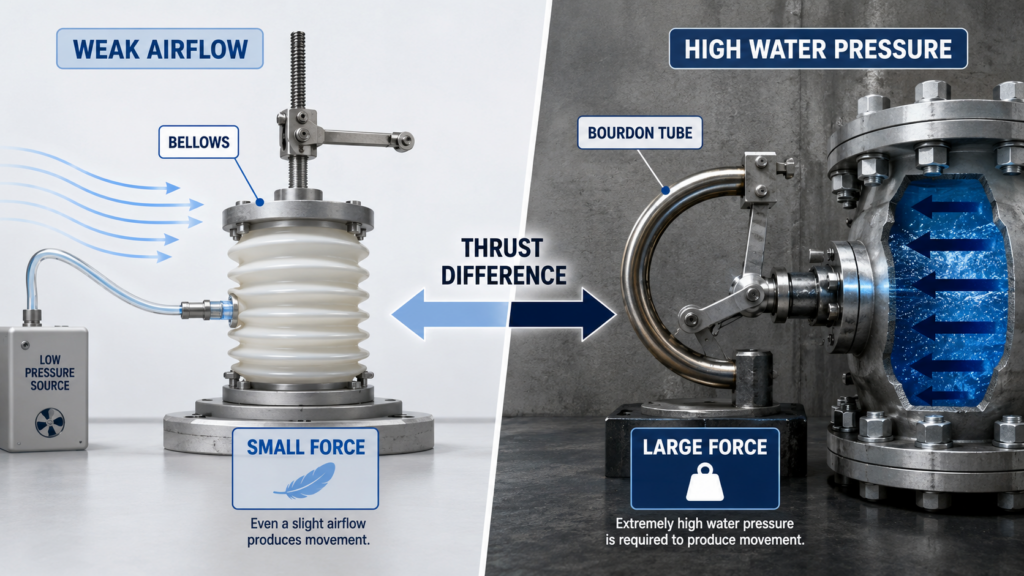
15 PSI Watershed: Blind Spot of Bourdon Tube
Want to use Bourdon tube to measure the micro-pressure of a few tenths of PSI? Save it, it’s not accurate at all. In the engineering world, everyone has a clear red line: 15 PSI (about 1 Bar). This is the watershed that distinguishes the two technologies.
Bellows Pressure Gauge: Win In Surface Area
The reason why the bellows pressure gauge (K535) is cattle is that the huge surface area inside it can amplify the extremely weak pressure change into a huge mechanical force. Its accordion-like metal walls, not even a few microounces of gas pressure. The huge surface area multiplies the mechanical thrust, which can easily drive the transmission gear. Like the micro-negative pressure in the clean room, the gas inlet of the burner, or the artificial ventilator, where the pressure is so small that even a hard pipe cannot be bent, you must use this kind of watch.
Bourdon Tube: The Overlord Of High Pressure Field
In contrast, the Bourdon tube itself is too hard, and it requires considerable kinetic energy to overcome its own rigidity. Its core load cell is 1 thick and flat metal tube. The poor thrust of low-pressure air (such as a pipe leak with only 2 PSI) cannot hold this hard pipe open at all. However, precisely because it is hard enough, when encountering 5,000 PSI pumps, offshore drilling platforms and high-pressure steam boilers, Bourdon tubes are the only safe and reliable choice.
“P.S.I.” Selection Matrix for Engineers
In order to prevent buying the wrong equipment, the project manager will take the “P.S. I. matrix” (I. e. pressure Pressure, sensitivity Sensitivity, isolation Isolation) to check before confirming the purchase order. If you don’t understand these 3 parameters, don’t rush to sign.
1. Pressure Limit: Micro Pressure Vs Heavy Hydraulic
The load cell must match the absolute peak pressure of the system. If the operating pressure of your pneumatic line, gas bus or vacuum system is much lower than 30 PSI, choose bellows pressure gauge (k772) honestly. But as long as the system (whether liquid or gas) pressure is over 30 PSI, directly on the Bourdon tube. If the bellows is forced to carry the over-limit pressure, this thing will instantly undergo permanent plastic deformation and the whole watch will be scrapped directly.
2. Sensitivity: Against Gear Friction
This depends on how much you tolerate the “dead zone (Deadband). The dead zone means that the dial pointer will not really start to move until the pressure has changed. The sensitivity of the bellows is extremely high, as long as the pressure has 0.1 PSI fluctuations, the pointer will be able to react immediately. However, the Boughen tube is in the low range section, the mechanical friction is relatively large, and the reaction is a bit slow. Therefore, if the project hard requirements in the near zero pressure interval for precision monitoring, bellows is your only choice.
3. Isolation: To Prevent The Risk Of Explosion Table
Don’t forget to evaluate the water hammer effect and pulse risk of the system. Bourdon tube is naturally resistant to construction, and it is not empty when encountering pressure spikes, and you can also pour glycerin into the watch case to absorb the shock wave. But the bellows pressure gauge (k744) is much more delicate, especially afraid of sudden pressure shock. If you have to use bellows on the pipeline with quick opening/quick closing valves, you must install a pressure limiting valve on the outside to isolate the fragile bellows from the shock wave.
| Specification | Bellows Gauge | Bourdon Tube |
| Optimal Range | < 30 PSI (Precision monitoring near zero) | > 30 PSI |
| Media Type | Pneumatic lines, gas manifolds, and vacuum systems | Any liquid or gas system |
| Overpressure Tolerance | Extremely Low: Permanent plastic deformation if max rated pressure is exceeded; highly susceptible to sudden spikes (requires external pressure-limiting valve). | High: Naturally resists pressure spikes and water hammer; casings can be filled with glycerin to dampen shockwaves. |
| Sensitivity | Exceptional: Instantly translates a 0.1 PSI change into visible needle movement. | Lower: Suffers from higher mechanical friction at the low end of the scale (larger deadband). |
| Cost | N/A (Not specified in the provided text) | N/A (Not specified in the provided text) |
New wind direction of 2026 industry: clean room and hydrogen fuel cell
By 2026, the manufacturing industry began a large-scale transformation to ultra-pure hydrogen fuel cells and ISO level 3 clean rooms, which directly pushed the bellows pressure gauge to the “industry standard” throne of low-range gas monitoring.
Today’s proton exchange membrane (PEM) hydrogen electrolyzers require extremely accurate micro-pressure monitoring, and even a slight error can lead to explosive gas mixing. The traditional low-range Bunden tube simply does not have such a high physical resolution, and even the tiny voltage drop of 0.5 PSI cannot be measured. In order to meet the stringent safety compliance standards in 2026, the procurement team of the new energy industry has now forced the use of stainless steel bellows pressure gauges on all low-pressure gas skids, eliminating those cheap bourdon tube substitutes.
The case of stepping on the pit on the spot: the procurement accident of “saving small money and losing big money”
Last year there was a commercial HVAC chiller project in Chicago, and a buyer engaged in a budget review casually changed the meters, resulting in serious equipment damage. Originally, the engineer’s drawing clearly stated that a $130 bellows pressure gauge was used to monitor the vital 3 PSI pressure difference on the supplementary fan unit.
The result? The auditor thought the bellows was too expensive, so he gave it up and bought a common Bourdon tube pressure gauge with the same range of 0-15 PSI and only $35, thinking that the two functions were the same. At the commissioning stage, the weak wind pressure of 3 PSI could not push the stiff Bourdon tube mechanical structure at all, and the dial was pointing to zero. The automatic control system 1 looked at the “reading zero”, thinking that the fans were completely on strike, and immediately forced the main fan to continue to spin at 100 per cent of the load. In less than 48 hours, the fan motor burned down directly, and finally had to pay $3500 to replace the motor. Under this circumstance, the purchasing team has a long memory: bellows must be used for micro-pressure measurement, which is a rigid mechanical requirement and is definitely not an optional “advanced matching”.
Cost and Life: A Pit-Avoidance Guide for Budget Personnel
It’s true that you have to pay a lot of money to buy bellows, but it can help you avoid those deadly control system failures under certain low-pressure conditions.
On the market, the price of the bellows pressure gauge is generally 3 to 4 times that of the ordinary Bourdon tube. No way, the manufacturing process of this thing is much more complicated, not only to weld multi-layer thin-walled metal folds, but also to calibrate precision against the force measuring spring. But it’s money well spent, especially when measuring pressure below 15 PSI. If you install a cheap Baudon tube in a place with only 5 PSI in order to save the budget, this watch will be inaccurate for the rest of your life. Good steel is used on the blade: leave the budget for the bellows on the low-pressure pipeline. As for other high-pressure places in the factory, just use cheap ordinary Bourdon tubes.
Industry Frequently Asked Questions (FAQ)
Bellows Pressure Gauge And Bourdon Tube Pressure Gauge, Which Is Better?
There is no comparison. The mechanical principles of the two are different. Measuring low pressure and vacuum (below 15 PSI) requires high precision, using bellows; Measuring liquid and gas with medium pressure to extreme ultra-high pressure, using Bourdon tube.
Bellows Pressure Gauge Can Be Used To Measure High Pressure?
Absolutely not. The inside of the corrugated pipe is a thin metal fold, which is directly exploded by a high pressure or permanently deformed by stretching. Most bellows have a limit of 30 to 50 PSI, while Boulden tubes can withstand 100,000 PSI.
Why Is The Bellows Pressure Gauge More Expensive Than The Bourdon Tube?
expensive in the process. To make the kind of thin and flexible metal corrugations requires extremely precise welding technology, and the internal must be equipped with a complex spring system to ensure the accuracy of linear expansion. The Bourdon tube, to put it bluntly, is 1 a flattened, bent tube, and the cost of mass production is extremely low.
Under What Circumstances Must The Engineer Specify A Bellows Pressure Gauge?
Clean room air flow pressure difference, burner air supply, low vacuum system, and level measurement of the kind of extremely shallow open water tank. The hydrostatic pressure in these scenarios is too weak to push ordinary Bourdon tubes.
Does The Bellows Pressure Gauge Need To Be Filled With Liquid (Such As Glycerin)?
generally not needed. The bellows mainly measures low-pressure gas, which can hardly be touched by heavy hydraulic vibration that requires glycerin to absorb shock. In addition, the bellows is already very sensitive, if the micro-pressure meter filled with liquid, but will slow down the reaction speed of the pointer, self-defeating.