 Dypressuregauge
Capsule Pressure Gauge Working Principle
Why does a regular bourdon tube not work when measuring micropressure? In fact, the answer lies entirely in the working principle of the capsule pressure gauge.
This pressure gauge is designed for small pressure measurements of gaseous media. At its core is a precision element called a capsule—which, is formed by gas-tight welding of two circular, corrugated metal diaphragms at the edges “the power source”. As pressure enters the interior of the membrane cartridge through the interface, the membrane expands. This extremely small displacement is then amplified by the highly accurate movement and converted into the circular motion of the hands on the dial.
The key to the irreplaceable use of capsule pressure gauges in the low-pressure field is the huge pressure area brought by welded membranes. This gives it extremely high sensitivity and a linear relationship between pressure and pointer deflection. In the low-pressure range of 0-600 mbar, where ordinary bourdon tubes cannot jump at all, it can still maintain excellent long-term stability.
Core Structure Of The Gauge
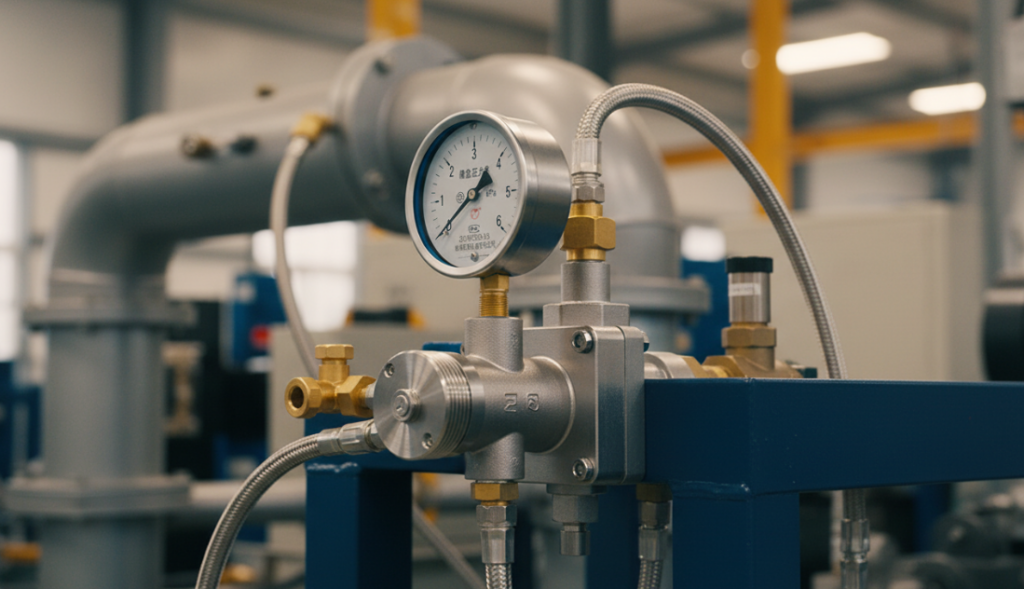
To fully understand the logic of its work, you have to first look at the internal structure of this thing. Among the precision instruments, long-life design relies on the following core components:
- The Capsule Element: This is the heart of the instrument. Those two corrugated diaphragms are the key. The corrugations not only increase the effective pressure sensing area, but also ensure linear elasticity.
- Cconnector: The gateway into which the gaseous medium enters.
- Linkage Mechanism: A high-precision amplification system. This part is very challenging for the process. It must accurately convert the expansion of the capsule by a few microns into visual data.
- Hands and dial: Calibrated for specific micro-pressure ranges (such as mbar, Pa or mmH2O).
From Physical Deformation To Precise Reading
From the pressure input to the dial display, there is a rigorous mechanical relay in between:
- Pressure sensing and elastic deformation
When the gas enters the pressure chamber, it fills the interior space of the welded diaphragm. Because the edges are sealed, the pressure forces the two membrane sheets to expand outward. - Linear displacement
One thing I personally really appreciate about the capsule pressure gauge principle is its “linear” nature. Many sensing elements will appear weak under low-voltage signals, but the huge surface area of the capsule pressure gauge ensures that even if the pressure only moves a little, it can still produce measurable displacement. - Amplified by movement
Since the physical displacement of the capsule pressure gauge is usually only a few millimeters, a complex linkage system must be relied upon. This mechanism multiplies the displacement, driving the hands across the dial in high resolution.
Why Use The Gauge
Whilebourdon tube gauges are the industrial standard in the high pressure world, they are indeed too “dull” in the face of micro pressure. The advantages of capsule pressure gauges are mainly reflected in:
- Extreme sensitivity: The range can even be as low as 0-6 mbar.
- Stronger stability: The dual diaphragm design provides better long-term zero-point stability.
- Medium Match: It is specifically optimized for dry gaseous media, where oil-filled or heavy-duty spring-loaded tube gauges often do not respond at all.
- Technical Notes: In applications in the 0-600 mbar range, capsule pressure gauges are the industry benchmark for maintaining system safety and efficiency.
Typical Application Scenarios

Based on its unique working principle, this type of pressure gauge is crucial in industries where “small changes are big propositions”:
- Medical technologies: such as ventilator monitoring and cleanroom pressure monitoring.
- HVAC: Filter condition monitoring and fan suction control.
- Gas Distribution: Monitor low-pressure gas lines and burners.
Choose Your Pressure Gauge
Figuring out how it works is only the first step, and more importantly, how to choose the right tools for your system. Whether you are measuring boiler furnace pressure or laboratory vacuum, reliability will always come from that well-designed, precision-welded capsule pressure gauge.
A good meter is not just a moving pointer, it is the guarantee of the accuracy of your project. If you’re facing the challenge of micropressure measurement, a capsule pressure gauge is usually the standard answer.
Author: Alex Chen
I’m a Senior Instrumentation Engineer with hands-on experience in industrial pressure measurement. From HVAC systems to medical device calibration, I’ve dedicated my career to mastering the mechanics of precision instruments. My passion is breaking down complex technical concepts into practical, actionable insights for professionals working in the field.
The prev: Shockproof Pressure GaugeThe next: Diaphragm Seal Pressure Transmitter