 Dypressuregauge
Difference Between Pressure Transmitter And Pressure Sensor
Ultimately, their core difference lies in the quality of the output signal and whether signal conditioning circuits are integrated.
That “Fragile” Original Signal Line
A so-called pressure sensor is essentially a physical quantity detection element. If you use this equipment, you have to be prepared “to serve” it.
- Output Signal: It outputs an extremely raw low-voltage millivolt (mV) signal. Not only is this signal nonlinear, but it also undergoes no internal processing and is almost impossible to use directly in automated control systems.
- Poor Interference Immunity: The environment on industrial sites is quite complex, with frequency converters, high-power motors, and dense power lines, and electromagnetic interference everywhere. Since the mV signal of the pressure sensor is too weak, it is easily drowned out by this noise, resulting in serious distortion of the reading.
- Limited Transmission Distance: Because of weak anti-interference ability, the signal decays very quickly, and you don’t dare to stretch the cable at all. Once the line is long, the data is useless.
- Must Be Amplified Externally: You have to additionally install external signal conditioning and amplification equipment, which invisibly increases the complexity of the system and potential points of failure.
Industrial Control Site “Conservative”
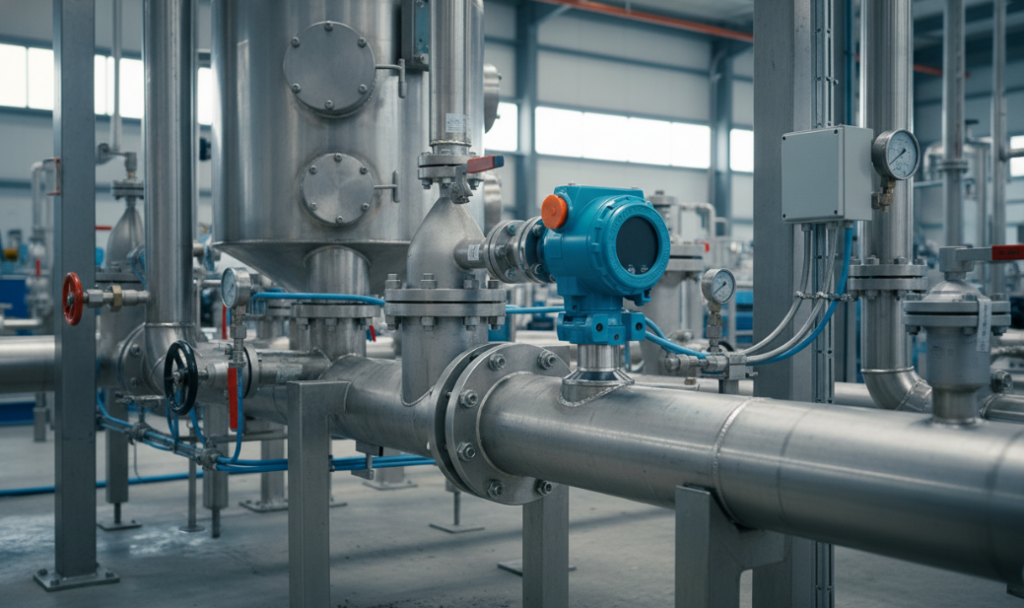
In contrast, pressure transmitters are the equipment we can really “and use with confidence” in the field of automation. It integrates a complete set of electronic processing circuits based on the sensing elements. This is not just adding a shell, but a qualitative change in signal quality.
- Built-in Signal Processing: The PCB circuit board built into the transmitter directly amplifies and linearizes the nonlinear, weak millivolt signals generated by the sensing elements.
- Standardized Output: The transmitter outputs a standardized industrial signal, such as the most classic 4-20mA current loop, or 0-10V DC, or even the now popular HART digital protocol. This means you don’t need any intermediate conversion equipment and the signal is directly recognized by the automated system.
- Noise Immunity and Long-Distance Transmission: For example, a 4-20mA current loop, this output method is extremely immune to electromagnetic interference and will not produce a significant voltage drop with distance extension like voltage signals. In large chemical plants or workshops, even if a few hundred meters are transmitted, the data remains stable as before.
Why Do Engineers Prefer Transmitters?
When designing self-controlled system architectures, system integration is often key to our evaluation. Here we can see the huge gap between pressure transmitters and sensors in engineering applications.
When you are designing a PLC or DCS architecture, the “plug and play” nature of the transmitter is simply a boon. The output terminal is directly connected to the analog input card (AI) of DCS, the signal is clean and stable, and real-time monitoring is completed in one go.
In contrast to the pressure sensor, in order to plug it into a modern DCS system, you have to introduce an additional signal isolator or amplifier. This not only increases material costs, but also adds a lot of wiring points and intermediate links ——when maintaining, these “extra links” are often the first places to break down.
Which One Should You Choose?
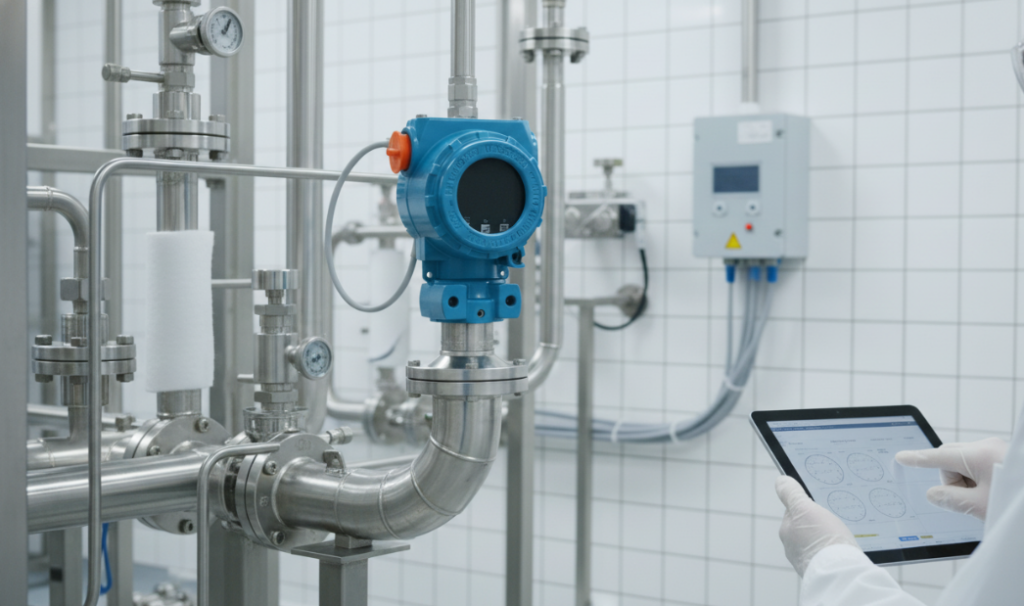
When evaluating these two technologies, it is recommended to follow one principle: look at the environment and look at the system.
If your project requires long-distance signal transmission, the field environment is full of various electromagnetic interferences, and you must directly dock with PLC or DCS for automated control, then a pressure transmitter is the only option.
Pressure sensors are not without merit. They are usually only suitable for specific scenarios: such as embedded OEM devices, laboratory environments, or when your system design stage has reserved sufficient signal conditioning space and the transmission distance is extremely short. If these conditions are not met, don’t choose the sensor just to save a little cost, otherwise the subsequent operation and maintenance troubles will make you regret it.
Author: Alex Sterling
Hi, I’m a Senior Automation Engineer with over 11 years of experience in industrial instrumentation and control system design. Throughout my career, I have managed numerous large-scale plant upgrades and complex automation projects, where selecting the right hardware is often the difference between a seamless system and a maintenance nightmare. I am passionate about simplifying complex technical concepts to help fellow engineers avoid costly mistakes and improve their system reliability.