 Dypressuregauge
Different Pressure Gauges Compared: Maximize Safety
When selecting various types of pressure gauges, the safety directors of the factory must keep their eyes on 3 indicators: the rupture limit, chemical compatibility, and the discharge path of explosive energy. For example, if you dare to install an ordinary brass Borden tube (Bourdon tube) on a corrosive ammonia gas pipeline, it is definitely a time bomb for toxic material leakage buried in the factory.
The only way to ensure the safety of industrial pipelines is to find out the mechanical failure modes of various pressure gauges and make them accurately match the specific process hazards on your site. Imagine, if the internal sensing element is shattered by hydraulic shock, what is the meaning of the dial you usually struggle with, is the thread type right? Next, let’s take the S.A.F.E. isolation frame to the bottom, talk about the “oxygen-oil burning trap” that can kill people, and then show you how to evaluate the mechanical limits of those hard cores to ensure that you buy the right watch while protecting the safety of personnel.
S.A.F.E. Pressure Gauge Isolation Review Framework
Procurement and HSE (Health, Safety and Environment) teams rely on the S.A.F.E. framework to avoid those fatal hardware mismatches. Listen, every spare instrument you choose must pass these four steps:
Solid-Front: Transfer Explosion Energy
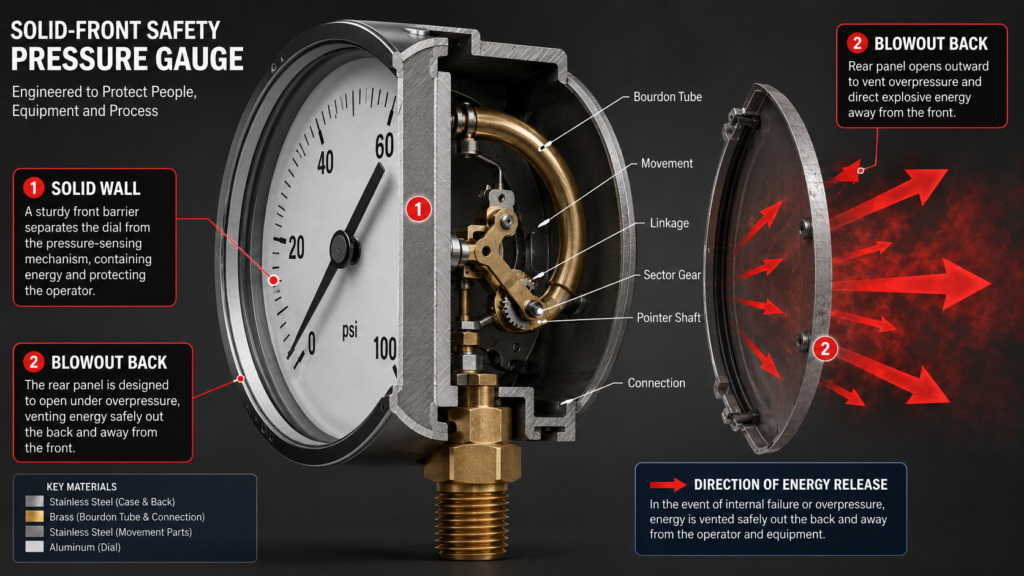
As long as the gas process pressure exceeds 300 PSI, the safety design of the “solid front plate” must be firmly grasped. This kind of table has a 1 thick cast metal wall welded directly between the internal measuring element and the front glass panel. In the event of a sudden spike in pressure causing the internal metal pipe to burst, this solid metal wall will be able to withstand the shock wave and the metal shards flying around, protecting the operator standing in front of the dial.
Application Limits (Application Limits): Protection Against Metal Fatigue
Experienced engineers will stick the normal working pressure in the middle 50% of the maximum range of the pressure gauge, which can effectively prevent metal fatigue failure without warning. No matter what type of pressure gauge (such as k480), if you have to let it die at 90% of the full scale all year round, the internal metal will be permanently stretched. This plastic deformation will completely destroy the “elastic memory” of the sensor, resulting in a low value displayed by the instrument. The most frightening thing is that when it comes to the critical juncture of overpressure, this kind of false data will deceive the automatic safety valves and keep them closed, causing catastrophe.
Fluid Compatibility (Fluid Compatibility): Hydrogen Threat In 2026
With the large-scale expansion of the green hydrogen pipeline in 2026, a huge chemical compatibility blind spot in routine procurement has been completely exposed. Under high pressure, hydrogen molecules can easily drill through the grain boundaries of standard 316L stainless steel. This kind of penetration will cause “hydrogen embrittlement”, which will turn 1 steel Bouton tubes with full toughness into 1 broken glass, often suddenly burst in daily operation. Designers engaged in hydrogen engineering must specify the use of special diaphragm pressure gauges with gold-plated diaphragms to physically keep hydrogen molecules out.
Explosive Drainage (Explosion Routing): Allowing Space For Pressure Relief Rear Cap
You have to make sure there is enough physical space behind the pressure gauge case, otherwise the safety function of “back cover pressure relief” is a decoration. The solid front plate pressure gauge is pushed out by a layer of rubber membrane on the back of the case. If the plumber wants to save trouble and install the watch on the concrete wall or steel plate, the rubber film on the back will not open at all. The explosive energy held inside will bypass the solid front plate and directly shatter the glass in front, and the glass ballast will shoot into the aisle like a bullet.
Mechanical Failure Modes of Various Pressure Gauges 1 Grilled
Safety engineers will use specific sensing technologies to suppress specific process hazards. If you want to protect your factory, you have to find out how these internal mechanical structures collapse under extreme pressure.
Bourdon Tube Pressure Gauge: Risk Of High Pressure Fragment
The Bouldon tube does work well when dealing with clean, high-pressure fluids, but 1 it encounters high-frequency pump pulsations, it will die ugly. When subjected to untreated hydraulic shock (water hammer effect), the bent hollow metal pipe will break directly at the welding socket. Remember, as long as the Baudon tube is mounted on a positive displacement pump, a mechanical buffer (flow restriction hole) must be installed upstream of it to kill it before the kinetic energy tears the tube.
Diaphragm Seal Pressure Gauge: Dead Knock Highly Toxic Sludge
To deal with highly toxic, highly corrosive or viscous fluids, the diaphragm table is the last line of defense. Bunden tube will let dangerous fluid run into the meter body, but the diaphragm table is not the same, it in the pipe joint to build a flat, indestructible physical sealing layer. Even if the mechanical structure of the instrument itself is broken by external forces, the heavy diaphragm can lock toxic chemicals in the pipeline. It is the treatment of raw sewage, sulfuric acid and crystallization medium.
Bellows Pressure Gauge: Overpressure Is Extremely Fragile
Bellows pressure gauges are extremely sensitive when measuring dangerous micro-pressures (such as low vacuum hazardous gas extraction), but their tolerance for overpressure peaks is absolutely zero. If the downstream valve slammed to death, the thin accordion-like metal bellows would burst instantly. You must install a special pressure limiting valve (PLV) in front of any bellows pressure gauge to physically stop the sudden pressure surge and don’t let it tear the fragile metal folds.
| Gauge Type | Primary Safety Threat | Required Safety Accessory | Best Fit Application |
| Bourdon Tube | High-frequency pump pulsations / Hydraulic shock (water hammer) causing the tube to snap | Mechanical snubber (restrictor orifice) | Clean, high-pressure fluids |
| Diaphragm Seal | External physical damage / Toxic chemical leakage into gauge body | Inherent heavy-duty diaphragm (acts as a flat, impenetrable physical seal) | Highly toxic, corrosive, or viscous fluids (raw sewage, sulfuric acid, crystallizing media) |
| Bellows | Sudden overpressure spikes (downstream valve slamming shut) causing metal folds to rupture | Dedicated pressure-limiting valve (PLV) | Dangerous micro-pressures (low-vacuum hazardous gas extraction) |
A painful lesson from the scene: the $1.4 million ammonia blowout caused by the wrong meter.
Because they didn’t understand the limits of fluid compatibility, an Illinois refrigeration plant paid $1.4 million at the end of 2024 for the 1 catastrophic gas leak. At that time, an inexperienced junior buyer bought a batch of standard brass Bourdon tube pressure gauges to monitor high-pressure anhydrous ammonia lines.
You know, ammonia attacks wildly and dissolves copper alloys like brass. This corrosive process fluid took less than 45 days to get the brass Blanden tube from the inside. During a conventional compressor stop-start cycle, the corroded and thinned metal pipe in the main instrument bursts. The watch case blows up and the pressurized liquid ammonia is sprayed directly to the machine room. The gas cloud that formed immediately forced the entire plant to evacuate. The two operators went directly to the hospital and attracted a sky-high fine from the Environmental Protection Agency (EPA). If it was clearly required to use a stainless steel diaphragm sealed pressure gauge at that time, the ammonia gas could be completely isolated from the inside of the instrument, and the disaster could be completely avoided.
The deadly “oxygen-oil” burning trap
If you use the conventional calibration process to get the pressure gauge on the oxygen line, it is an explosion that will kill the 1 field in an instant.
On-site technicians often place industrial pressure gauges on static weight testers filled with hydraulic oil for verification. If any technician connected the meter originally used on the oxygen line to a test bench filled with oil, tiny droplets of hydrocarbon oil would stick to the inside of the meter. When he put the watch back into the pure oxygen pipeline, the high-pressure oxygen would react violently with the remaining oil. Adiabatic compression will cause the oil to ignite instantly, and this pressure gauge will immediately become a 1 local bomb, which will not only completely destroy the dashboard, but also cause fatal fragmentation. Therefore, you must purchase specially cleaned “Oxygen Service Only” pressure gauges and strictly abide by the rules: only oil-free dry nitrogen or distilled water equipment can be used to verify them.
A few hard core questions (FAQ)
How Is High Pressure Gas Pressure Gauge Safe?
A safe high-pressure gas meter must have a “solid front plate, back cover pressure relief” case design. This structure has a 1 thick metal wall between the pressure element and the dial. In case the internal pipe bursts, the explosion energy can be forced out of the back of the meter.
Why Can’t Bourdon Tube Pressure Gauge Be Used For Thick Mud?
Because thick mud, sludge and easily crystallized chemicals are very easy to drill into the narrow opening of the Bunden tube and then solidify in it. This 1 the blockage, the pressure is trapped inside, the meter will give a false “safe” reading, and the actual pressure in the pipeline may have soared to the critical point of explosion. This kind of situation old and practical flush diaphragm pressure gauge bar.
What Happens If The Pressure Gauge Fails In Chemical Compatibility?
The process fluid will completely corrode the internal sensing elements from the inside out. This will directly lead to sudden mechanical fracture, and a good watch will become an open water leakage point, spraying pressurized dangerous chemicals into the surrounding work area.
Why Do Some Pressure Gauges Have Glycerin In Them?
Glycerin or silicone oil is used to dampen severe mechanical vibrations and fluid pulsations. If you don’t fill this liquid, the brass gear inside will shatter within a few times, and the pointer will either fall off or get stuck. At this time, the operator is blindfolded and ignorant of the dangerous pressure changes.
Oxygen Line Can Casually Use What Pressure Gauge?
Absolutely not. You must use those tables that have been specially degreased and have the “Oxygen Only” certification. Standard pressure gauges are more or less equipped with some oil left over from manufacturing or calibration. Once these oils meet high-pressure pure oxygen, they will spontaneously ignite and cause a big explosion.