 Dypressuregauge
Different Types of Pressure Gauges: Which Fits Best?
Want to avoid sudden equipment bursts and costly downtime? The secret is to match the most suitable pressure gauge mechanical design for different fluid characteristics. Whether you are a purchasing team or a factory engineer, when facing Bourdon tubes, diaphragm tables, bellows and digital solid-state sensors, you must make decisions strictly based on the viscosity of the medium, mechanical vibration and peak working pressure. To give the simplest example, if you install the wrong pressure gauge on a viscous mud pipe, there is no doubt that the interior will be blocked instantly, giving you the illusion of “zero pressure” that kills people.
In this article, let’s skip the boring textbook definitions and hard core analyze the mechanical limits of various pressure gauges, the digital industrial internet of things (IIoT) trend in 2026, and the “M.A.P.S.” golden matrix that senior engineers will definitely use when selecting models.
M.A.P.S. Selection Rules Exclusive to Plant Engineer
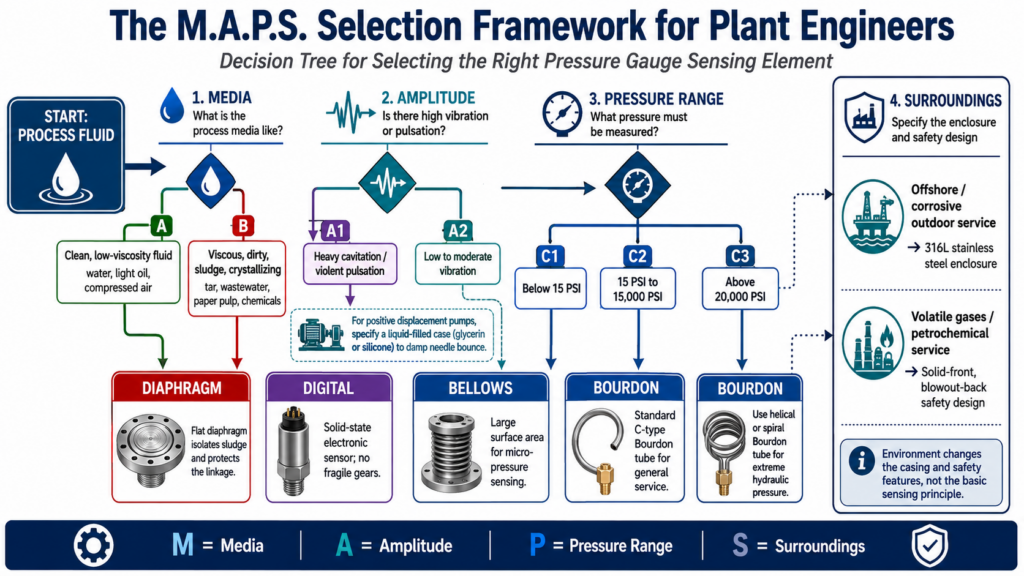
In order to eliminate procurement errors from the source, experienced factory managers will let each order pass the test of the M.A.P.S.(medium, amplitude, pressure range, environment) framework. Before finalizing the internal sensing elements, you must understand the actual situation of these four sites.
M-Media: Isolation Of Corrosive And High-Viscosity Fluids
The nature of the fluid directly determines the internal geometry of the pressure gauge. Clean, low-viscosity media like water, light oil and compressed air run very smoothly in the hollow Bouton tube. But if it is replaced by high viscosity fluid (such as tar, waste water, pulp) or easy to crystallize chemicals, it must be on the flat film pressure gauge. The diaphragm will form a physical barrier at the joint, keeping the sludge out and preventing them from drilling into the instrument and blocking the fragile linkage mechanism.
A- Amplitude (Amplitude): Get Vibration And Cavitation
The high-frequency mechanical vibration and fluid pulse can be called the “meat grinder” of traditional brass gears. If you want to put the table directly on the positive displacement pump, don’t forget to specify the liquid-filled shell (usually glycerin or silicone oil), which can not only lubricate the gear, but also greatly slow down the violent beating of the pointer. If the system cavitation is very serious, it is recommended to directly abandon the mechanical gear and upgrade to a solid-state digital pressure gauge that relies on electronic piezoresistive sensors.
P-Pressure Range (Pressure Range): Mechanical Limit
The sensitivity of different metal components to physical forces is very different. Bellows pressure gauges are definitely the king of measuring very small pressures (less than 15 PSI or boiler air ducts), because they have a huge surface area like accordions, and even a little force can produce obvious displacement. Conventional C- type Borden tubes dominate the mainstream range of 15 PSI to 15,000 PSI. As for the extreme hydraulic environment of more than 20,000 PSI, honestly choose the spiral or coil spring type Bunden tube, otherwise the metal tube is very prone to fracture.
S-Environment (Surroundings): Survive In Harsh External Environments
The environment around the instrument determines its shell material and safety configuration. Outdoor offshore rigs must be equipped with a 316L stainless steel enclosure to resist corrosion from seawater. Petrochemical plants that deal with flammable and explosive gases have strict safety requirements-they must use a “safe (strong front, pressure relief)” design. The ingenuity of this design is that in case the internal measuring tube bursts, the explosion-proof wall will guide the explosion debris to spray out from the back of the meter, thus saving the life of the operator in front.
Four core pressure gauge technology hard core dismantling
In the field of industrial pipeline monitoring, engineers mainly rely on 4 different sensing technologies. The mechanical advantages of these designs are perfectly matched with the actual working conditions in your factory, which is the fundamental guarantee for the reliable operation of the system.
Bourdon Tube Pressure Gauge (Bourdon Tube): The “Old Cattle” In The Field Of High Pressure”
In 90% of pure fluid applications, Bourdon tubes provide reliable accuracy at a very high cost performance. The principle of this device is very intuitive: 1 bent, flat metal tube will try to “straighten” when subjected to internal pressure. This straightening action pulls the link, which in turn drives the dial hands. You can use it in large quantities in ordinary compressed air, chilled water cycles and pure hydraulic circuits. But remember, don’t use it in mud or food hygiene processing, because the hollow tube is a natural “dead corner”, once bacteria and solid impurities go in, they can’t get out completely.
Diaphragm Pressure Gauge (Diaphragm): Iron Wall To Deal With Sludge And Chemicals
Instead of a hollow tube, the diaphragm is replaced by a flexible corrugated metal disc. The process pressure directly presses on this flat film, transmitting the force to the pointer mechanism above. This design is simply for the harsh chemical environment. If you want to deal with the strong hydrochloric acid that can instantly dissolve ordinary stainless steel Bourdon tubes, you only need to coat the liquid surface of the diaphragm with a layer of PTFE (Teflon), Hastelloy or Monel alloy, and the problem is solved.
Bellows Pressure Gauge (Bellows): Expert In The Field Of Micro Pressure
When the pressure or vacuum is so weak that the Bourdon tube cannot be pushed at all, it is the bellows’s turn to play. Its sensing element looks like a thin-walled metal accordion. The huge surface area can catch even a glimmer of gas pressure and push the pointer through longitudinal expansion. Heating, ventilation and air conditioning (HVAC) engineers often use it to keep an eye on the positive pressure gradient of the clean room and the gas pressure of the burner.
Solid-State Digital Pressure Gauge (Solid-State Digital): Standard For 2026 IIoT
Modern facilities are eliminating mechanical watches at a rate visible to the naked eye and replacing them with digital pressure transmitters with LED displays. There are no moving parts in the solid-state sensor. People play with measuring the tiny deformation of the silicon chip under pressure. Because of this, it is completely immune to gear wear, hysteresis and vibration damage that can destroy analog instruments. It is worth mentioning that the new model in 2026 basically has Bluetooth and Hart protocols built in. The maintenance team can directly read the pressure drop data of the pipeline without even patrolling the line in person and taking out a smart phone.
| Gauge Type | Best For | Fatal Weakness | Cost Tier | Average Lifespan |
| Bourdon Tube (Standard) | Standard pressure measurement | Instantly dissolves in aggressive acids; lacks the sensitivity to measure ultra-low pressures | Low ($) | Short to Moderate (Vulnerable to mechanical wear and vibration damage) |
| Diaphragm | Sludge, harsh chemical processing, and aggressive acids (e.g., hydrochloric acid) | Still relies on a mechanical pointer mechanism (susceptible to gear wear and hysteresis over time) | Medium-High (−−$) (Due to PTFE, Hastelloy, or Monel coatings) | Moderate to Long (Excellent chemical resistance but mechanical limits) |
| Bellows | Ultra-low pressures, vacuums, cleanroom positive pressure, HVAC burner gas drafts | Thin-walled metallic accordion design cannot withstand raw physical force or high-pressure applications | Medium ( | Moderate (Subject to mechanical fatigue of the thin-walled accordion) |
| Solid-State Digital | 2026 IIoT integration, high-vibration environments, remote smartphone data logging | Requires an electrical power source; higher initial upfront investment | Premium ( | Longest (Zero moving parts; immune to gear wear, hysteresis, and vibration) |
Procurement Pit Avoidance Guide: Hydrogen Embrittlement Failure Trap in 2026
The explosive growth of the green hydrogen industry in 2026 has exposed a fatal blind spot in the procurement of conventional instruments. When buying pressure gauges for high-pressure hydrogen pipelines, many purchasers still habitually choose standard 316L stainless steel Bourdon tubes, assuming that “stainless steel can prevent corrosion”.
The facts are very face-hitting. Hydrogen molecules are so small that they can easily penetrate the grain boundaries of standard 316L stainless steel under pressure. Within a few weeks, the absorption of this gas will cause the so-called “hydrogen embrittlement”. Originally full of toughness, the Bouton tube will become as brittle as glass and burst suddenly during a regular pressure cycle, discharging explosive hydrogen directly into the workshop. Therefore, engineers who come into contact with hydrogen must specify special diaphragm seal pressure gauges equipped with “gold-plated diaphragm. This layer of gold barrier can 100 percent block the penetration of hydrogen molecules, protect the internal measuring elements, and kill the catastrophic factory explosion in the cradle.
The tragic case of the scene: the 40,000-dollar water pump scrapping accident caused by internal blockage
How expensive is it to misunderstand the specific application of the pressure gauge (K480)? Last October, a municipal sewage treatment plant paid a painful price of $40000 for this. At that time, in order to cut the budget, the purchasing team bought a batch of cheap standard Bourdon tube pressure gauges for $20 to monitor the outlet pressure of a heavy-duty sludge pump.
The result? After only 3 days, the untreated sewage filled the tiny opening of the Bunden tube to death. The sludge dried and crunked inside, completely sealing the whole tube, causing the dial pointer to “freeze” at 45 PSI forever. Half a month later, a downstream valve accidentally stuck in the closed state. The water pump is still frantically pressing the sludge into the blocked pipeline, and the actual pressure of the pipeline soars instantly, breaking through the 150 PSI. However, the blocked pressure gauge still showed a safe value of 45 PSI in a “quiet time” and did not trigger the automatic shutdown protection at all. In the end, the extreme overpressure directly shattered the mechanical seal of the pump and exploded the pump casing, which not only caused serious large-scale biological pollution leakage, but also brought direct equipment replacement costs of US $40000.
Imagine that if it had cost $150 to upgrade to a flat diaphragm pressure gauge, it could have kept the sludge out and accurately reported the pressure spike, and the pump would have been able to get out.
Frequently Asked Questions (FAQ)
What Are Some Common Pressure Gauges In Industry?
These 4 are mainly used in the industry: Bourdon tube pressure gauges for pure high-pressure fluids; Diaphragm pressure gauges specially designed to deal with corrosive chemicals and thick sludge; Bellows pressure gauges with extremely low micro-pressure; and solid digital pressure gauges that are like fish in water in high vibration and industrial Internet of Things (IIoT) automation environments.
When Should I Choose A Diaphragm Instead Of A Bourdon Tube?
When you pump high viscosity liquid, thick mud, easy to crystallize fluid or strong corrosive acid, must be on the diaphragm table. The flat diaphragm not only prevents internal blockage, but also covers it with a protective anti-corrosion coating (such as Teflon). If it had been replaced by a Bourdon tube, the interior would have been blocked or corroded.
Why Is There Liquid In The Dial Glass Of Some Pressure Gauges?
This is because the manufacturer has injected glycerin or silicone oil into the shell, which is mainly used to deal with the violent beating of the pointer caused by the vibration of the machine or the pulse of the water pump. These fluids effectively lubricate the internal brass gears and prevent them from chipping under constant mechanical shock.
Can Bourdon Tube Measure Low Pressure Or Vacuum?
Extremely not recommended. Bourdon tubes perform quite poorly at very low pressures (less than 15 PSI), because hard metal tubes require a lot of force to be stretched apart. To accurately measure vacuum or trace gas pressure, you ‘d better specify a bellows pressure gauge or a highly sensitive diaphragm gauge.
What Is A “Solid-Front” Pressure Gauge?
This instrument is characterized by a thick metal explosion-proof wall directly poured between the internal piezometer and the front dial. In the event that the piezometer tube bursts due to extreme overpressure, this solid wall will block the shock wave and guide the explosion force and glass fragments to spray out along the pressure relief cover on the back of the meter, thereby protecting the safety of the operator to the greatest extent.