 Dypressuregauge
Atmospheric Pressure vs Gauge Pressure: Can It Be Zero?
The answer is yes. When the internal pressure of the system is exactly the same as the ambient atmospheric pressure around the sensor, the gauge pressure reading will be accurately zero. This phenomenon can be seen everywhere in daily work. For example, when we open a valve and let an unpressurized tank communicate directly with the outside air, the instrument panel will display zero. This is because the gauge pressure deliberately excluded the atmospheric pressure at the beginning of the design, and it directly used the local indoor air pressure as the baseline. However, once the local air pressure fluctuates due to the movement of the weather front or the sudden drop in altitude, this baseline will follow the shift, resulting in calibration errors for instruments that are not equipped with vents. Many novice technicians directly messed up the high-precision process because they only calibrated the sensor at sea level, but completely ignored the 1 of air pressure changes when they brought the equipment to high altitude areas. Next, let’s take a closer look at the mechanics behind zero drift and see how field engineers compensate for it.
“Pyramid Model” Of Pressure Baseline”
Engineers often rely on fixed reference points to avoid catastrophic calculation errors. You can think of the pressure measurement as a three-tiered pyramid.
The base of the pyramid is “absolute zero” (that is, absolute vacuum). It represents a perfect state without any molecular collisions at all. All absolute pressure measurements start from this impenetrable bedrock.
The intermediate layer is “atmospheric pressure”. This floor is like a floor that can float up and down. At sea level, it is maintained at about 14.7 psi(101.3 kPa), but will continue to rise and fall depending on the local weather system and altitude.
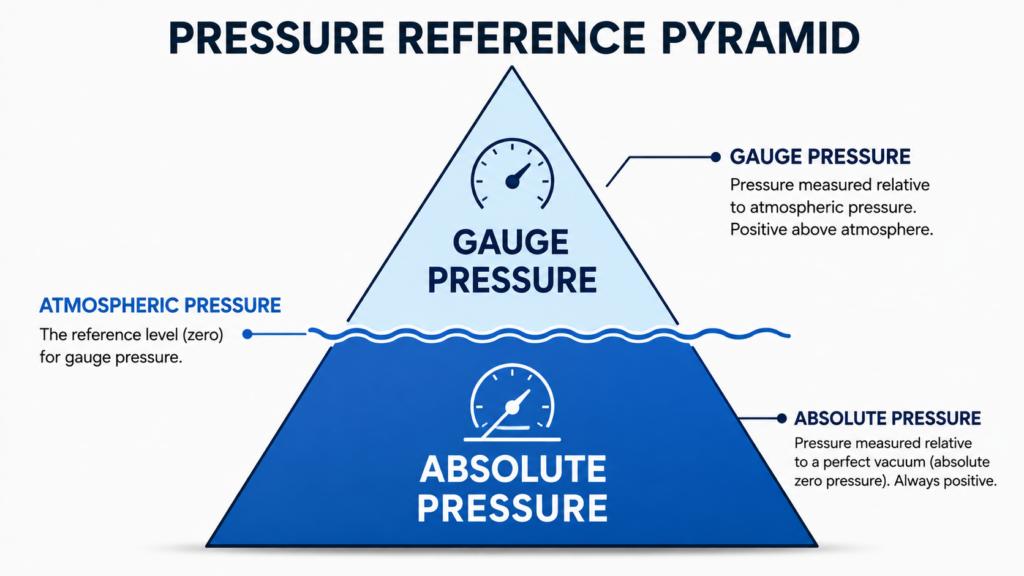
The top level is “gauge pressure”. The gauge pressure is measured entirely on the basis of the floating floor in the middle, up or down.
If a pressure gauge is usually placed flat on the workbench without any process pipes, it is actually staying on this floating floor. The sensor reading is now displayed as zero. Although it can feel the 14.7 psi atmospheric weight is dead on its diaphragm, its mechanical linkage or internal microprocessor will directly set this specific environmental weight to 0 PSIG.
Does Gauge Pressure Include Atmospheric Pressure?
Not contained at all. The gauge pressure transmitter will refer to the surrounding ambient air and directly deduct the weight of the atmosphere from the final reading.
| Measurement Type | Reference Point | Formula |
| Absolute Pressure | Perfect Vacuum | P_abs = P_gauge + P_atm |
| Gauge Pressure | Local Ambient Air | P_gauge = P_abs – P_atm |
If the gauge pressure on a factory air compressor shows 100 psi, the actual absolute pressure inside the tank is approximately 114.7 psi. The meter directly ignores the 14.7 psi of room air pressure acting on the outer wall of the tank and the sensor housing.
This “exclusion” is deliberately utilized by the calibration technician. In an open pipe system, the flow of liquid is driven by the pressure difference driven by the pump, rather than the thick layer of “heavy pressure” that the earth’s atmosphere presses evenly on all objects “. The local atmospheric pressure directly as the mathematical sense of “zero”, can greatly simplify the industrial plant in the complex fluid dynamics calculation.
How Does Atmospheric Pressure Affect Gauge Pressure Readings?
Atmospheric pressure affects the gauge pressure reading by physically moving the “zero point” of the sensor. Once the ambient air pressure drops, it means that the force pressing on the reference side of the instrument’s sensing diaphragm is reduced.
Suppose you maintain an absolute pressure inside your tank that is untouched by thunder, but then a 1 strong storm suddenly arrives outside, causing the local air pressure to plummet. At this time, a standard ventilated gauge pressure meter will suddenly show a higher reading than the original. It is not the pressure in the jar that rises, but the “floor” that serves as a reference falls.
Deviation From Altitude: A Real Case Of Field Calibration
Altitude changes are making the site calibration roll over frequently every day. In 2025, our team reviewed a major calibration failure at an HVAC (heating, ventilation and air conditioning) manufacturing plant in Denver, Colorado.
The factory purchased a batch of low-range pressure transmitters (0-50 psi), which were factory calibrated in a laboratory in Miami, Florida (that is, sea level height). At sea level, the atmospheric pressure baseline is 14.7 psi. Denver, on the other hand, is 5280 feet above sea level, where the atmospheric baseline is only about 12.1 psi.
Because the supplier sent a sealed gauge pressure (SG) transmitter instead of a vented gauge pressure (VG) transmitter, these sensors sealed the 14.7 psi of air in Miami in their reference cavity. When the equipment is shipped to Denver for installation, the ambient air exerts only 12.1 psi of pressure on the outer diaphragm. This 2.6 psi pressure difference has pushed the sensor diaphragm outward even before the process air has passed into the pipe. As a result, even if these sensors are placed on the workbench empty, the readings are all around 2.6 psi.
After 3 days of painstaking investigation, the engineering team always thought that there was an “unnecessary” blockage in the pipes. Finally, it suddenly dawned on them that only the local “zero point fine adjustment” of these transmitters was needed and 12.1 psi was set as the new baseline.
Vented (VG) Vs. Sealed (SG) Gauge Pressure Transmitters
The selection of the instrument directly determines the ability of the whole system to deal with the air pressure variable.
Vent gauge pressure (VG) transmitters are equipped with a 1 physical vent pipe or a miniature Gore-Tex vent in the electrical cable housing. This breathable design allows real-time ambient air to always be pressed against the back of the measuring diaphragm. As soon as the weather changes, the air pressure on the reference side will keep absolute synchronization with the indoor air pressure. Therefore, as long as the process is closed, the meter reading can always be accurately zero.
Sealed gauge pressure (SG) transmitters do not have this breather tube. The manufacturer welded it to death when leaving the factory and sealed the specific air pressure inside forever. Technician usually use SG sensors in wash-down environments, deep underwater, or highly corrosive chemical plants-because in these harsh environments, if ambient air is allowed to enter the electronic components, the entire circuit board will be scrapped immediately. However, as the local tianqi111 changes, the SG sensor will inevitably “zero drift”, and you must periodically use a HART handheld to manually zero it.
Coping With Variable Climate: The 3 Iron Law Of Instrument Zero
Precision measurement can not be separated from the radical zero management strategy. Follow the following mechanical operation steps, can help you effectively prevent the baseline drift:
Be sure to do zero trim after installation. Transporting the sensor across state lines will certainly change its physical baseline. Please install it to the final position, open the exhaust valve to allow it to contact the local indoor air, and then execute the zero fine adjustment command.
The snorkel should match the environment. In low-pressure gas applications (below 100 psi), air pressure fluctuations of only 0.5 psi can cause alarming percentage errors. At this time, exhaust gauge pressure sensors must be used. Also, remember to use a desiccant box to keep the snorkel dry.
For extreme accuracy, please look for absolute pressure sensors. If your chemistry is extremely demanding on tolerances and never allow wind and rain outside to affect your data, then simply abandon the gauge pressure altogether. Direct mounting absolute pressure transmitter. They rely on a completely sealed vacuum reference point to completely shut out weather factors.
People Also Ask
Why does my pressure gauge show a negative number after it is disconnected?
If the pressure gauge was previously calibrated at a high altitude or in a high pressure weather system, a negative number will be displayed after disconnection. When you take it to a low air pressure environment but do not reset it to zero, the reference pressure originally sealed inside will push the mechanical linkage in reverse, thus showing a negative reading of “false vacuum.
What is the difference between PSIG and PSIA?
PSIG (pounds per square inch gauge) measures pressure relative to the local ambient atmosphere. PSIA (absolute pounds per square inch) measures the pressure relative to a perfect, empty vacuum.
Can gauge pressure be negative?
Yes. A negative gauge pressure reading indicates a vacuum condition. This means that the pressure inside your system is already lower than the ambient atmospheric pressure outside.
How do I convert absolute pressure to gauge pressure?
Subtract the current local atmospheric pressure from your absolute pressure reading. If your absolute pressure is 30 psi and your local barometer says 14.7 psi, your gauge pressure is 15.3 psi.
Does the digital tire pressure gauge automatically compensate for altitude?
Most of the standard digital tire pressure gauges on the market are designed with ventilation. What they measure in real time is the pressure difference between the air inside the tire and the air outside. Since the local ambient air will naturally enter the meter as a reference, they will naturally compensate for the altitude.
Does atmospheric pressure really hold everything down?
That’s right. The weight of the earth’s atmosphere produces a constant force (about 14.7 pounds per square inch at sea level) that presses on all surfaces, liquids and gases exposed to it. The gauge pressure instrument simply removes this “constant weight” from the formula during calibration.