 Dypressuregauge
Differential Pressure Gauge Working Principle Explained
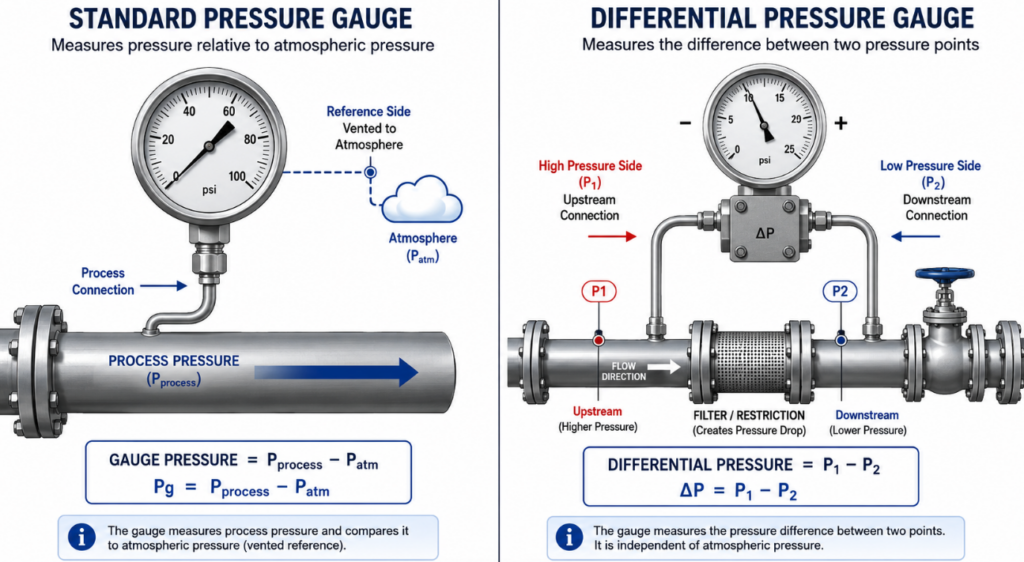
When checking the faults of field instruments at ordinary times, I found that many people still confuse absolute pressure and differential pressure. In fact, the core logic of the differential pressure gauge is to measure the difference between two independent pressure inputs within a single system, rather than competing with atmospheric pressure. After installation in the field, the process medium enters the instrument through two completely independent interfaces: the high pressure side and the low pressure side. Inside the case, this counteracting pressure acts on both sides of the sensing element. The higher pressure at the HP side needs to overcome both the lower pressure at the LP side and the resistance of the internal span spring, forcing the sensing element to physically deflect or displace. This linear displacement is then converted into rotational motion-now mostly by frictionless magnetic linkages or mechanical gears-and the final drive pointer marks an accurate pressure drop reading on the dial. For maintenance personnel who often have to stare at the filter status or pump performance, it is too important to understand the internal mechanical balance mechanism. It is directly related to whether you can do quasi-on-site calibration, prevent overpressure damage, or see through the reading of zero due to the reverse connection of the pipeline.
To thoroughly understand the above principle, we have to take apart the mechanical actions inside step by step. Whether it’s selecting a new factory or troubleshooting in the workshop, it’s absolutely no harm to understand how these internal parts are linked.
Make Clear The Difference Between Delta P And Atmospheric Pressure
One of the most basic principles of this meter is that it does not care about the atmospheric pressure around the meter. Ordinary pressure gauges measure the air pressure relative to the room you are standing in, but differential pressure gauges only stare at the inside of a specific closed system. By calculating P1 (high pressure) minus P2 (low pressure), the meter gives the exact difference, that is, Delta P or pressure drop.
Role Of HP And LP
When installing a differential pressure gauge on site, the process medium must enter through two separate interfaces:
- High pressure end: upstream, that is, before the fluid passes through the filter or pump.
- Low pressure end: downstream, I .e. after the choke part.
Normally, these two pressures must be directed to two completely isolated cavities inside the case before the instrument can operate normally, which is also the basis for preventing the media from stringing together.
Core Sensing Element: Diaphragm, Piston Or Bellows
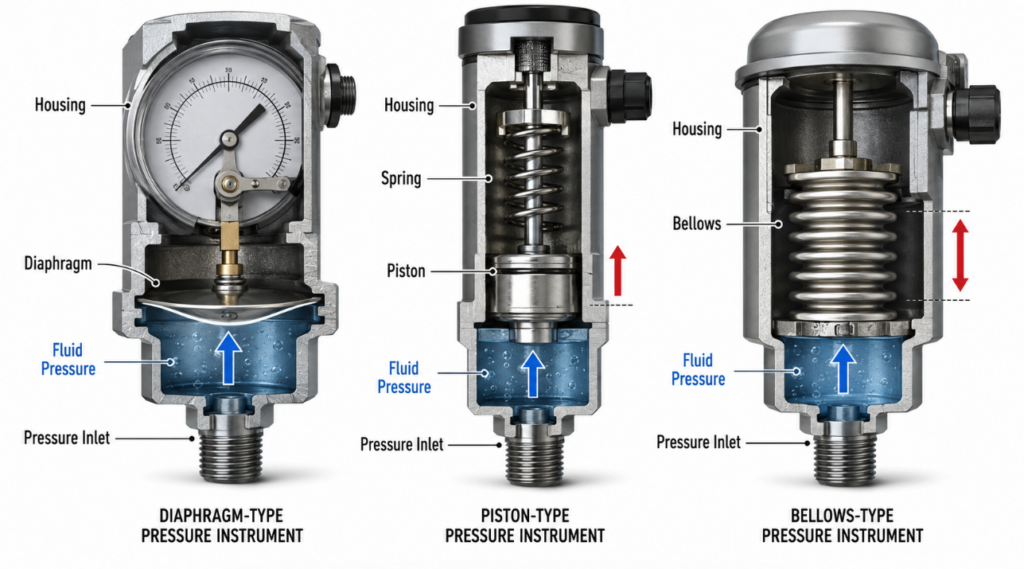
After the medium comes in from the interface, it will “meet” in the heart of the instrument, that is, the sensing element “. The selection of this area is quite critical. When designing instruments, high-quality manufacturers such as DY Pressure Gauge usually focus on the following three sensing technologies:
- Elastomeric diaphragm: a flexible seal that physically separates the HP and LP chambers. When HP rises, it drums forward. This gadget is very suitable for gas and clean media, especially in the absolutely do not allow the media side flow of the occasion.
- Precision piston: A solid cylinder that slides back and forth against a spring. Very durable, and in my experience, this is the most common for liquid lines.
- Corrugated tube: A telescopic element like an accordion, very sensitive to pressure changes, usually used in low-pressure gas systems.
Overcome The Resistance Of The Internal Range Spring
The sensing element does not move casually, there is a range spring against it. The pressure from the HP end must be large enough to overcome two things at the same time: the reverse thrust of the LP end fluid and the mechanical tension of the range spring. The stiffness of the spring directly determines the measuring range of this watch. When the thrust of the HP is large enough, it will push the sensing element to produce a linear deflection or displacement.
From Linear Motion To Rotary Motion
The deflected diaphragm or moving piston goes straight, but the hands on the dial have to turn. How does this turn around?
- Mechanical gear: The old design usually uses a rack and pinion mechanism, which abruptly turns the pointer through a mechanical connection.
- Frictionless magnetic linkage: I personally recommend the current advanced differential pressure gauge design, which is basically magnetic coupling. When the sensing element moves in a straight line, the magnet carried on it also follows, and the rotating magnet connected to the pointer is directly driven to rotate by magnetic force. This frictionless design greatly reduces mechanical wear and completely isolates the dial from the process medium.
Field Application And Troubleshooting
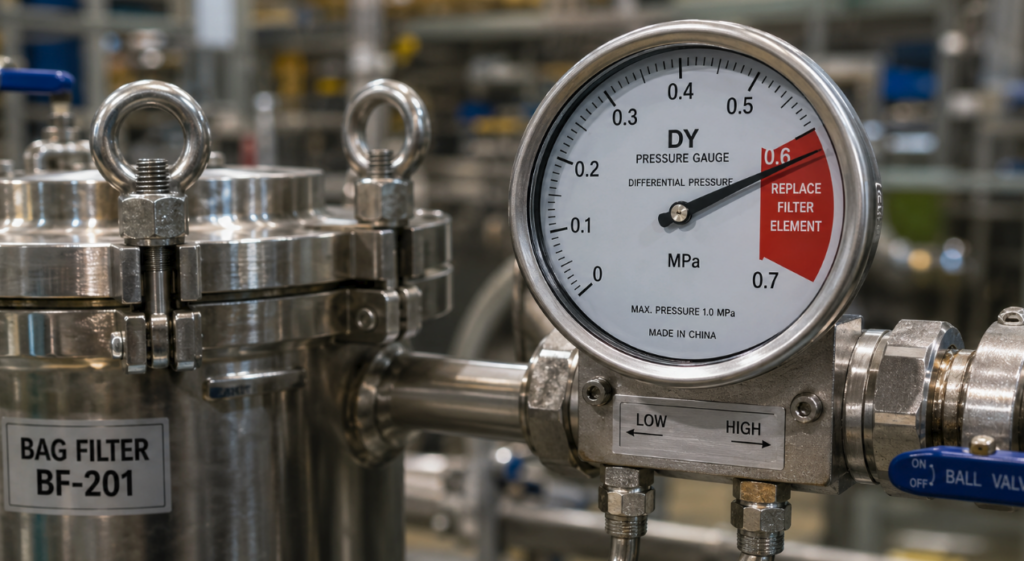
If you understand the principle, it will be much easier to work daily and grasp safety.
- Filter monitoring and pump performance evaluation: the filter is blocked, the downstream pressure will drop and the upstream pressure will rise. The deflection amplitude of the sensing element becomes larger and the pointer is pushed up, which accurately indicates when to change the filter element or whether the pump is not enough.
- Low-level error reading zero: the system is running, but the meter shows absolute zero. If you understand the principle, you will know what went wrong-the interface is reversed. If you accidentally connect the high-pressure pipe to the LP end, the internal mechanical structure will be held up to death and cannot deflect forward at all. I have indeed seen this kind of oolong situation too many times at the scene.
- Calibration and overpressure protection: This delicate balance between the sensing element and the range spring is a prerequisite for quasi-on-site calibration. This also shows how dangerous overpressure is. If there is a sudden pressure peak in the pipeline, which is far beyond the bearing limit of the spring, the diaphragm or piston will be permanently deformed, and then the watch will have to be scrapped and replaced.
Differential Pressure Gauge With Block Pair For System
Whether it is HP/LP port, sensing element or magnetic linkage, differential pressure gauge is definitely a precision instrument. In order to prevent overpressure damage and ensure that the monitoring data of the filter and pump are reliable, you must use the kind of equipment whose internal mechanical structure is impeccable.
If you happen to be responsible for maintenance or purchasing, and want to find some instruments with accurate calibration and stable performance, it is a good choice to look at DY Pressure Gauge’s comprehensive solution. Their products strictly follow these reliable principles that we disassemble today, and maintain long-term accuracy even in the most demanding industrial environments.
Author:David Mitchell
I’ve commissioned, calibrated, and troubleshooted thousands of field instruments across various factory floors. I don’t just read technical manuals—I deal with real pipeline pressure drops, sticky pointers, and reversed port connections every single day. My goal here is simple: to break down complex mechanical gauge principles into practical, no-nonsense knowledge that you can actually use to keep your systems running safely.