 Dypressuregauge
Calibration of Pressure Gauge Systems: 7 Safety Rules
You execute the calibration of pressure gauges (k840) safely by enforcing Double Block and Bleed (DBB) isolations, purging hazardous media from the dead leg, and verifying absolute zero trapped kinetic energy before unthreading the instrument. Field operators who calibrate a pressure gauge (k668) on live industrial manifolds risk lethal shrapnel explosions and toxic gas exposure. Relying on a single closed isolation valve during routine calibration pressure gauge (k773) checks triggers catastrophic facility blowouts due to invisible valve seat leakage. Let’s break down the exact 7 HSE safety rules, the 2026 acoustic leak detection standards, and the strict B.L.C. isolation framework senior safety directors mandate to calibrate pressure gauges (k802) without causing fatal accidents.
The “B.L.C.” Blast-Prevention Framework
HSE auditors mandate the B.L.C. (Block, Lock, Clear) framework to eliminate human error during instrument demounting. You must apply this strict sequential logic to isolate the mechanical energy before attempting to remove any dial from a process line.
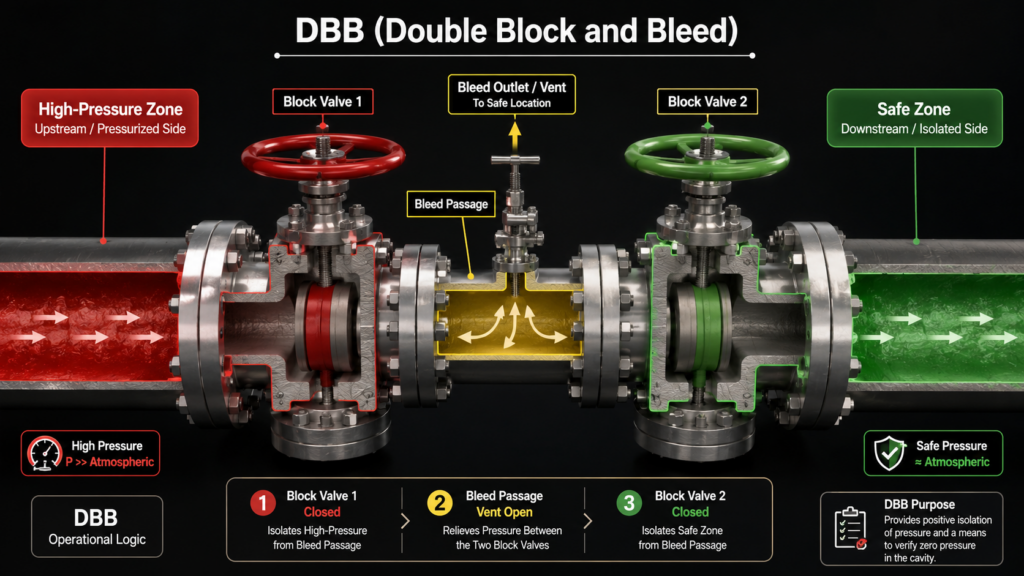
Block: Enforcing Double Block And Bleed (DBB)
You block the hazardous process fluid by closing two independent isolation valves in series and opening a bleed valve situated directly between them. A single valve invariably leaks over time due to internal seal wear. If the primary valve passes high-pressure gas, the open middle bleed valve directs that dangerous energy safely to the atmosphere or a flare header, ensuring zero pressure reaches the gauge manifold you intend to work on.
Lock: Executing Physical LOTO
You physically padlock the closed isolation valves using standard Lockout/Tagout (LOTO) devices. Hanging a paper tag on a valve handle fails to stop a misinformed operator from opening the line while you are holding the unthreaded gauge. Securing a heavy-duty steel padlock through the valve actuator prevents any accidental fluid release during the entire calibration window.
Clear: Purging The Dead Leg
You flush out the trapped chemical residue lingering in the dead leg (the short pipe section between the final valve and the gauge) by injecting nitrogen or clean water. Toxic fluids like hydrogen sulfide (H2S) or corrosive acids remain pooled inside this pipe cavity even after you drop the pressure. Opening the threads without clearing this toxic pocket sprays liquid directly onto your hands and face.
The 7 Strict HSE Rules for Field Calibrations
Senior instrument technicians follow seven non-negotiable safety rules to survive extreme industrial environments. Violating any single rule below converts a routine maintenance task into a fatal incident.
Rule 1: Never Stand In The Direct Line Of Fire
You must position your body to the side of the gauge face when cracking the threaded connection loose. If a pressure spike occurs or the threads fail, the blowout-back safety casing ejects the rear rubber plug, or the front glass shatters outward. Standing directly in front of the dial face guarantees severe facial trauma from flying metal shrapnel or hazardous fluid spray.
Rule 2: Prohibit NPT And BSP Thread Mixing
You cause instant mechanical failure by forcing a British Standard Pipe (BSP) parallel thread into a National Pipe Thread (NPT) tapered socket. Technicians force these mismatched threads together using massive wrenches, assuming the tight fit means a secure seal. The mismatched thread pitch strips the internal brass or steel grooves. Once you reapply high process pressure, the stripped socket acts like a gun barrel, firing the heavy gauge directly into the plant environment.
Rule 3: Ban Oil Calibrators On Oxygen Service Gauges
You trigger immediate adiabatic combustion by introducing hydraulic oil into an oxygen-rated pressure gauge. Field technicians often use a standard oil-filled deadweight tester to calibrate pressure gauge (k745) instruments. If they attach an oxygen gauge to this oil bench, microscopic hydrocarbon oil droplets coat the inside of the Bourdon tube. When the operator reinstalls the gauge on the pure oxygen line, the high-pressure oxygen violently reacts with the oil residue, exploding the gauge head instantly. You must exclusively use specialized water-based or dry nitrogen calibration benches for all oxygen service components.
Rule 4: Mandate Whip Checks On Calibration Hoses
You stop out-of-control hydraulic hoses by attaching steel whip checks across all quick-connect fittings on your portable calibrator. High-pressure calibration hoses (rated for 10,000 PSI) snap violently if a fitting fails. An unconstrained hose whipping at high speed fractures bones and causes fatal blunt-force trauma. Whip checks physically tether the hose to the calibration pump, forcing the ruptured line to drop safely to the ground.
Rule 5: Isolate High-Temperature Steam 24 Hours Prior
You prevent severe thermal burns by locking out high-pressure steam lines a full 24 hours before unthreading the pigtail syphon. The brass or steel isolation valve retains 400°F (200°C) heat long after you shut off the steam source. Attempting to wrench a hot gauge off a live steam manifold melts standard safety gloves to the operator’s skin.
Rule 6: Ban Live-Line Zero Adjustments
You compromise the structural integrity of the process line by opening the gauge casing and turning the zero-adjust screw while the system remains under pressure. Calibrating pressure gauges (k865) requires true atmospheric zero. Adjusting the pointer to account for a suspected zero-drift on a live, pressurized system masks severe metal fatigue inside the Bourdon tube, leaving a dangerously weakened instrument exposed to sudden blowout risks.
Rule 7: Execute The Micro-Bleed Sniff Test
You confirm complete pressure evacuation by turning the gauge stem only one-quarter to one-half turn loose. Stop and listen intently. If you hear a continuous hissing sound or see fluid bubbling from the threads, the isolation valve has failed. Retighten the gauge immediately and initiate emergency line shutdown procedures. Fully unthreading a gauge that is audibly venting pressure guarantees a catastrophic blowout.
| Calibration Action | The Hazard | The HSE Rule |
| Standing directly in front of the dial face when loosening | Severe facial trauma from metal shrapnel or hazardous fluid spray | Rule 1 |
| Mixing NPT and BSP threads | Projectile blowout (Shrapnel) | Rule 2 |
| Using hydraulic oil on an oxygen service gauge | Adiabatic combustion (Lethal Explosion) | Rule 3 |
| Operating high-pressure hoses without whip checks | Fractured bones and fatal blunt-force trauma | Rule 4 |
| Unthreading gauges from steam lines without a 24-hour lockout | Severe thermal burns (Gloves melting to skin) | Rule 5 |
| Performing zero adjustments on live, pressurized systems | Sudden blowout risk from masked metal fatigue | Rule 6 |
| Fully unthreading a gauge without the micro-bleed sniff test | Catastrophic blowout from failed isolation valves | Rule 7 |
2026 HSE Trend: Acoustic Emission Leak Detection
OSHA and global HSE auditors in 2026 reject the practice of relying solely on an analog dial reading to confirm zero line pressure. A stuck pointer often reads 0 PSI while 500 PSI of hazardous gas sits trapped directly behind it.
Modern safety protocols mandate the use of portable Acoustic Emission (AE) ultrasonic detectors prior to any physical dismantling. The operator presses the ultrasonic probe against the primary isolation valve body. The device detects the high-frequency sound waves generated by gas or liquid slipping past a damaged valve seat. If the AE detector lights up, the operator knows the valve is passing hazardous energy, and they abort the calibration procedure immediately. This technology entirely eliminates the “blind faith” technicians historically placed in aging isolation valves.
Field Case Study: A $2.5M OSHA Fine from a Single-Valve Failure
Bypassing DBB protocols resulted in a massive toxic release and a $2.5 million OSHA fine at a Texas petrochemical facility in late 2024. A maintenance technician attempted an in-situ calibration on a high-pressure anhydrous ammonia line.
The facility relied on a single gate valve to isolate the gauge. The technician closed the valve, saw the gauge drop to zero, and began unthreading the unit. Unknown to him, the gate valve seat possessed a severe corrosion crack, and the gauge pointer was stuck due to mechanical binding. As he backed the gauge off the final thread thread, 300 PSI of liquid ammonia blew the gauge out of his hands. The toxic gas engulfed the mechanical room, sending three workers to the intensive care unit and triggering a mandatory plant-wide evacuation. Replacing the single valve with a DBB manifold and mandating the B.L.C. safety framework prevents this specific disaster entirely.
People Also Ask (FAQ)
Is It Safe To Calibrate A Pressure Gauge While The System Is Running?
No. You must isolate the gauge from the live process fluid, depressurize the dead leg entirely, and remove the gauge to a safe test bench. Calibrating an instrument while it is subjected to live process pressure violates all major HSE protocols.
What PPE Is Required For The Calibration Of Pressure Gauges?
At a minimum, you must wear impact-rated safety goggles, heavy-duty chemical-resistant gloves, and a face shield when cracking the threaded connection loose. If the gauge monitors toxic gases, you must wear a personal gas monitor (H2S, LEL, or Ammonia detector).
Why Can’t I Use Hydraulic Oil To Calibrate An Oxygen Pressure Gauge?
Oxygen reacts violently with hydrocarbons. Pumping hydraulic oil into the Bourdon tube coats the internals with flammable residue. When you return the gauge to the high-pressure oxygen line, adiabatic compression ignites the oil instantly, causing a lethal explosion.
How Do I Safely Depressurize A Pressure Gauge Manifold?
Close the primary process isolation valve. SLOWLY open the manifold bleed valve to route the trapped high-pressure fluid into a safe catch basin or flare line. Verify the pressure reads absolute zero before applying a wrench to the gauge stem.
What Happens If I Install A BSP Gauge In An NPT Port?
The mismatch in thread pitch prevents a mechanical seal. The technician will force the threads together, stripping the metal grooves. The connection will hold temporarily until a pressure spike hits, violently firing the gauge out of the socket like a projectile.