 Dypressuregauge
Digital Air Pressure Gauge For Air Compressor
When choosing a digital air pressure gauge for an air compressor, the core depends on three things: accuracy, durability and compatibility. If these three points are not properly controlled, the subsequent maintenance costs can make you feel very expensive.
A professional-level digital display must have an accuracy of at least ±0.5% or even ±0.25% over the full range. It is more importantly to completely eliminate the common “parallax error”—of mechanical pointer tables, which is the problem where you don’t get the same reading from the side as from the front. The housing had to be made of 304 or 316 stainless steel with a high-performance piezoresistive pressure sensor to withstand the endless vibrations and occasional pressure pulses of an air compressor.
For the interface, it’s best to look for standard 1/4″ NPT or BSPP threads so that it’s possible to install it “plug and play”. In addition, the IP65’s protection level is standard. After all, there is a lot of dust and high humidity in the machine room, so it is really not possible if the seal is not good. The display should preferably be backlit, and units such as PSI, Bar, and MPa can be switched with one click, saving technicians from having to use their mobile phones to calculate unit conversions in dimly lit computer rooms.
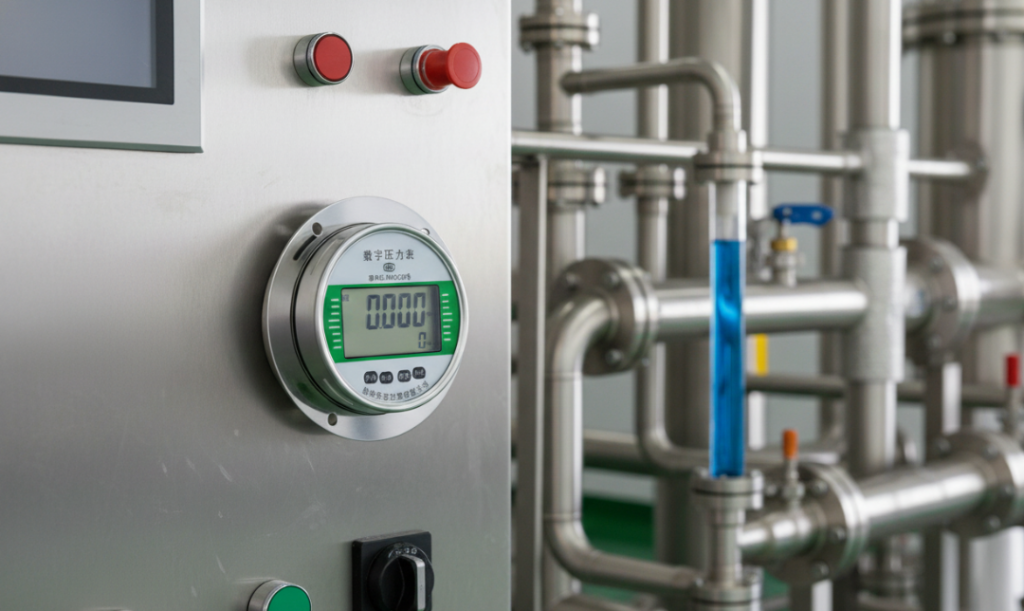
1. Accuracy Is Non-Negotiable
In industrial air compressor applications, even a slight deviation in pressure can lead to inefficient pneumatic tools or even system downtime. Traditional pointer tables have a hard flaw, namely “parallax”. The technician’s station is slightly tilted, so the number read out is inaccurate.
So industrial maintenance must be presented on a digital display table and given a certain value directly. By choosing the right table with ±0.5% or ±0.25% FS accuracy, your pneumatic system will operate strictly within the design parameters. Stop having workers staring at that dangling pointer and guessing the pressure, that doesn’t work in a modern factory.
2. Industrial-Grade Durability
The working environment of the air compressor is “harsh” to put it bluntly. Continuous vibrations and sudden pressure shocks are the killers of ordinary pressure gauges. To ensure the longevity of this gauge, we need to look at these two points:
- 304 or 316 Stainless Steel Enclosure: Don’t touch those cheap plastic or brass ones, corrosion resistance and structural strength are not in the same order of magnitude.
- High-performance piezoresistive sensor: Traditional Bourdon tube mechanical structure is prone to metal fatigue. Piezoresistive sensors are solid-state technology that directly converts pressure into electrical signals. They are particularly durable and are designed to handle the pulse pressure of air compressors.
- High Burst Pressure: This is a critical safety redundancy. When the system occasionally experiences a surge in pressure, a good digital display gauge will not be killed on the spot “suddenly” and will continue to serve.
3. Extremely Fast Integration And Universal Compatibility
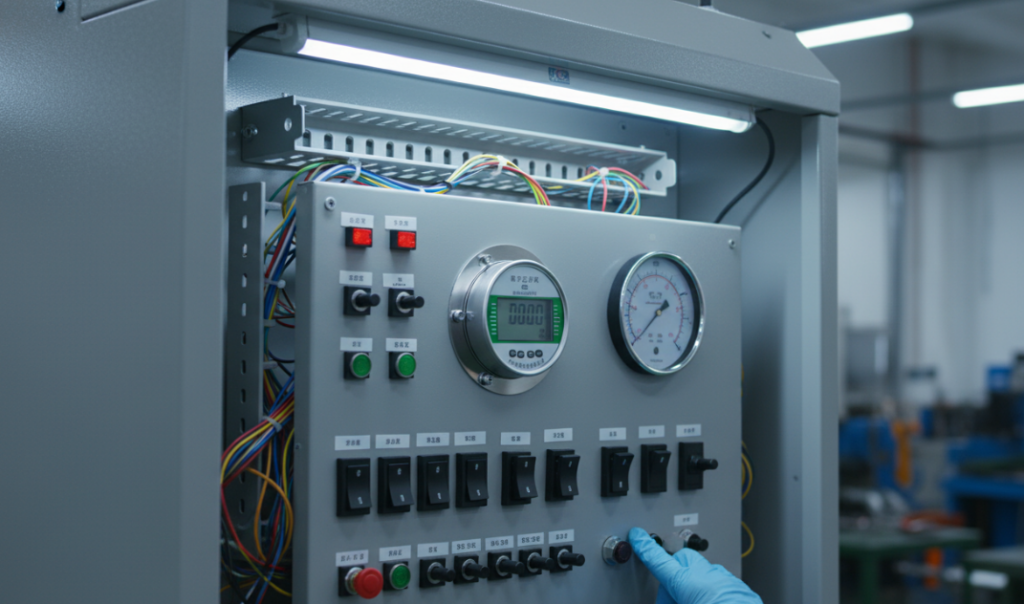
Compatibility is a lifeline, and no one wants to spend half a day down the road just to get a new gauge.
- Thread Standard: Make sure you choose 1/4″ NPT or BSPP, which is universally accepted.
- Environmental protection: IP65 means dust and spray protection. In those plants that need regular flushing or dust flying, this level is for life-saving purposes.
4. Ease Of Use
Whether a digital display is good or not can be determined by looking at the screen. Industrial machine rooms are often poorly ill-lit, with some corners even painted black.
- Multi-unit LCD display: It is very important to be able to switch freely between PSI, Bar, MPa, kg/cm². You can save a lot of trouble by not having to convert units manually.
- Backlight function: High contrast plus backlight, it is the savior of technicians reading in narrow, dark spaces.
- Automatic shutdown: This small function often reflects the most details and can significantly extend battery life and reduce the frequency of battery replacement maintenance.
5. Long-Term Return On Investment (ROI)
Upgrading to a professional digital display solution is actually helping factories save money:
- Reduced calibration frequency: Digital sensors have much greater calibration stability than mechanical parts and do not need to be re-tuned without moving.
- Protect downstream tools: With stable pressure, those expensive pneumatic tools will naturally have a longer life.
- Lower Total Cost of Ownership (TCO): Counting in less repair time and less frequent replacements, digital displays are actually more cost-effective.
In general, if you are responsible for a critical industrial air system, don’t drop the chain on the pressure gauge. Choose a digital one, choose a stainless steel one, and you will find that the operation and maintenance pressure in the later period is more than half less.
Author: Robert Miller
With experience in industrial maintenance and pneumatic system optimization, I have seen firsthand how minor pressure inaccuracies can spiral into costly downtime. I specialize in helping facility managers transition from legacy mechanical systems to high-precision digital monitoring.
The prev: How To Repair Air Pressure GaugeThe next: Can An Air Pressure Gauge Be Used For Oil