 Dypressuregauge
How To Repair Air Pressure Gauge
Many times when we encounter a broken air pressure gauge in an air compressor or pneumatic system while doing maintenance, our first reaction is how to fix it. In fact, the score depends mainly on whether it is an external fault or an internal fault.
For small external problems such as leaking joints and cracked gauge masks, just wrap some raw material tape or change the glass after pressure relief and it will be solved. But if there is a problem with the internal mechanical structure, such as the pointer getting stuck, not returning to zero, or the reading is completely off, if you are using industrial pressure gauges, don’t disassemble or repair them. If you open the case and pick at the fragile Bourdon tube or the movement, its calibration will be completely ruined. At the factory, the downtime, labor costs and serious safety risks caused by this uncalibrated bad gauge are definitely far more than the money to buy a new gauge. The easiest and safest way is to avoid any extremely risky recalibration and directly replace it with a durable, earthquake-resistant liquid-filled stainless steel pressure gauge.
Locate The Problem First
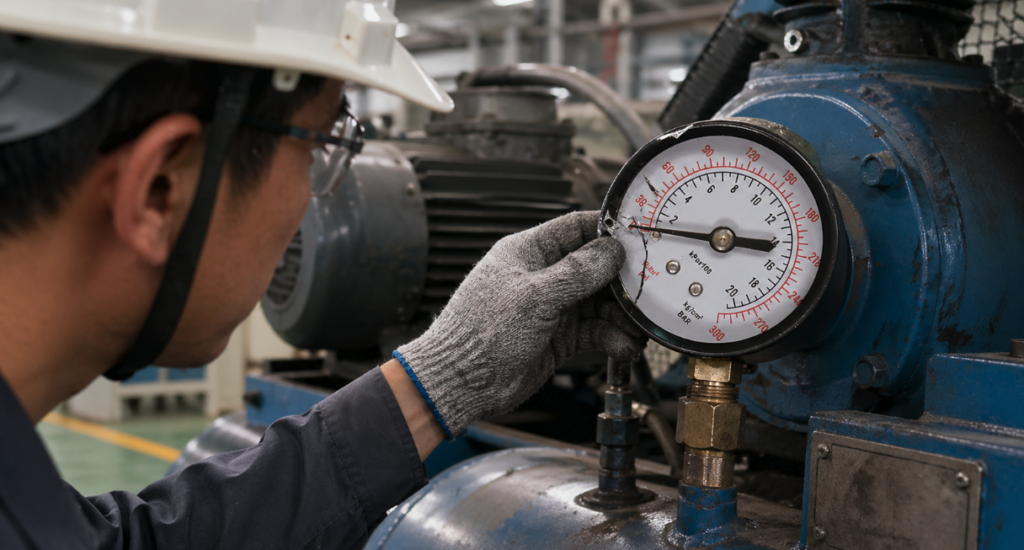
It is definitely important to get the problem straight before moving your air compressor or pneumatic system. On industrial sites, there are two types of pressure gauge failures that can be fatal: minor external problems (safe and repairable) and internal mechanical failures (must be replaced).
Forcing internal failures often ends up getting worse. So the first step to getting started is definitely to look with your eyes first and observe the specific performance of this gauge when it is running.
How To Deal With External Problems
If it is diagnosed as an external problem, the repair process is actually quite direct. Share the two most common external failures and how to deal with them safely:
Repair of leaky joints
Leaks in the connections can cause readings to go false and system efficiency to drop. The processing steps are as follows:
- System pressure relief: This step is the most critical. Before hitting the meter, the air pressure in the pneumatic system must be completely drained.
- To remove the pressure gauge: Take a wrench of the right size and clamp the flat surface of the gauge joint to tighten it. Remember, never hold the case by hand and twist it hard, as it will easily unscrew the case.
- Wrap the PTFE raw material tape: Scrape the old sealant or residue on the threads clean, then wrap the new raw material tape tightly along the thread direction to ensure airtightness.
- Reinstall: Screw the gauge back into the connector, then slowly pressurize the system and test it to see if it is leaking.
Replacement of cracked gauge masks
A broken glass will allow dust and moisture to run into the dial, but this does not mean that the movement inside is necessarily broken.
- After the system safely releases pressure, unscrew or pry off the outer shield ring directly.
- Clean out the broken glass. Be very careful at this time and don’t let the glass residue fall under the dial hands and get stuck in the movement.
- Just replace it with a new glass cover of the same size and fix the cover ring back as is.
Why Never Fix Internal Mechanical Faults
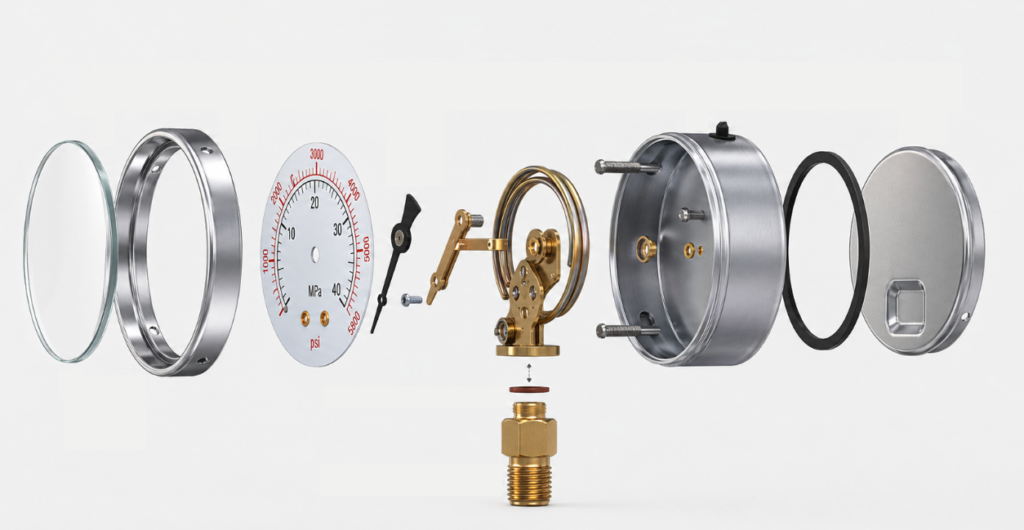
As long as your gauge has a needle that is stuck, cannot return to zero, or the reading is obviously off, it means that the internal movement has been scrapped.
The heart of an industrial pressure gauge is the very delicate Bourdon tube inside and the connected movement. These components are precision calibrated at the factory. Once the case is opened, trying to straighten the stuck needle by hand, or to break the Bourdon tube, its calibration parameters are permanently ruined. A meter that has been manually intervened, you can no longer expect it to give you an accurate air pressure reading.
The Hidden Costs Of Forcing Repairs Inside
The production rhythm in the factory is generally very tight. Repairing a broken gauge inside is not only a technical misjudgment, but also a business operation that costs money.
- Labor and downtime costs: A skilled mechanic would be there to dismantle and tinker for half a day, and would also have to try to recalibrate. These hours’ wages, combined with the loss of system downtime, would have allowed you to buy several brand new gauges.
- Serious safety hazard: Using a “repaired” gauge that cannot be accurately calibrated is extremely risky. If you think about it, if the meter reading is lower than the actual pressure of the system, the operator may continue to pressurize the air compressor or pneumatic pipeline, which is extremely likely to cause catastrophic equipment explosion and worker casualties.
Directly Upgrade To A Durable Model
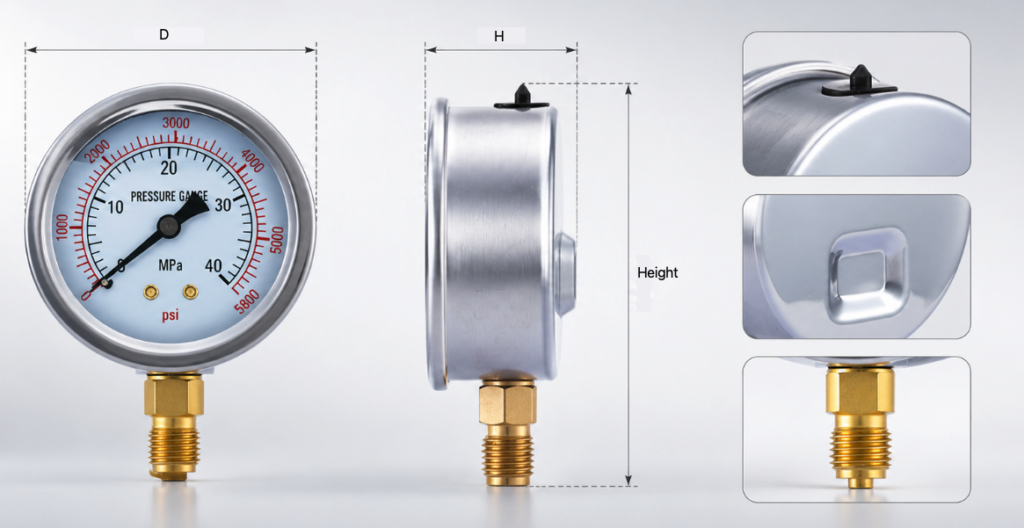
When encountering internal failures, the most cost-effective and safest approach is to skip those unreliable recalibration processes. Don’t waste your time joking about factory safety and just replace the broken gauge with an upgraded meter.
For those pneumatic environments with high vibration and heavy machinery, ordinary dry pressure gauges actually die very quickly. The ideal alternative is a durable, shock-resistant, liquid-filled stainless steel pressure gauge. The liquid filled in the gauge can well buffer the vibration of the hands, prevent the hands from jumping around, and also lubricate the internal movement. This basically essentially cuts off the internal glitch that broke your last gauge.
If you’re looking for an industrial-grade alternative that reduces downtime and provides maximum safety, DY Pressure Gauge offers a range of high-end liquid-filled stainless steel pressure gauges, which are designed and developed specifically for air compressors and pneumatic systems in demanding operating conditions.
Author: Mark Davis
Hi, I’m a senior maintenance engineer with over 16 years of hands-on experience in industrial air compressors and pneumatic systems. I specialize in troubleshooting industrial instrumentation, and I’m passionate about sharing practical, no-nonsense maintenance advice.
The prev: High Precision Pressure TransmitterThe next: Digital Air Pressure Gauge For Air Compressor