 Dypressuregauge
The Sensing Portion Of A Bi-Metallic Stem Thermometer Is
Its sensing area extends from the end of the probe to that “small concave point” (dimple, that inconspicuous little score on the stainless steel rod). To get a true reading, this entire section of sensing element —usually 2 to 3 inches at the front end of the pole— must be buried in the thickest part of the food. From what I’ve observed, many people are used to just tapping the tip like with an electronic thermocouple, and that’s definitely going to cause problems. A bimetallic thermometer has a coil of metal spring-loaded induction inside it, and if you stick just one section in, it will take a reading of the “mixing temperature” of the food and air, an error that can be fatal in the kitchen.
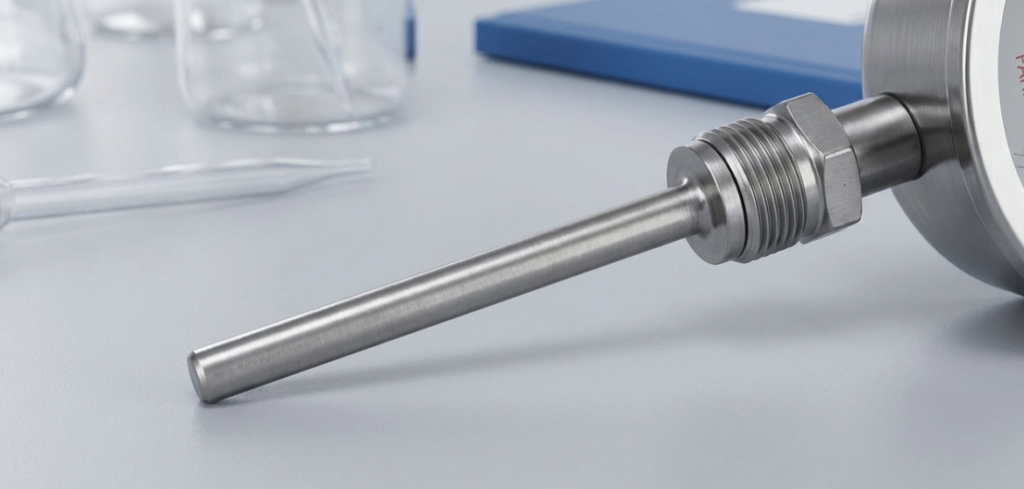
Don’t Underestimate The “Pit” On The Probe
For those who are used to using precision instruments such as DY Pressure Gauge, finding that “dent” is the first step in entering the industry. This little score is not meant to look good, it is a serious calibration mark.
The sensing zone of a bimetallic thermometer is not a point, but a space. If you’re measuring thin meat like hamburger patties, or a liquid with a very shallow water level, as long as the liquid level doesn’t pass through that indentation, the thermometer will be there “blindly”. It will average out the hot air in your pan and the cold air around you, giving you the illusion that it’s either ridiculously high or horribly low.
How Does The Bimetallic Strip Inside Move?
To understand why the sensing area should be left 2-3 inches, you have to look at its internal organs. Hidden in the stainless steel rod is a bimetallic coil, which is actually a spring made by pressing two metals with different expansion rates together.
- Heat transfer: Heat is transferred into the pole and the coil begins to twist.
- Mechanical linkage: This physical twisting moves directly with the hands on the dial.
The necessity of burying everything: Because the coil itself is so long, you have to make the entire coil reach the same temperature as food for the pointer to be accurate. That’s why the industry defines its sensing zone as the distance from the tip to the indentation.
Choosing Bimetal Or Thermocouple?
When choosing tools in industrial or catering scenarios, you need to understand the temper of different technologies:
- Bimetallic rod thermometer: large sensing area (tip to indent). Solid skin, no batteries required, cheap, suitable for large pot cooking or long-term monitoring.
- Thermocouple/thermistor: The sensing point is just at the tip. It is necessary to measure the thinness of food, but it is more delicate and much more expensive.
In fact, in most business situations where endurance and reliability are sought, high-quality bimetallic thermometers from the DY Pressure Gauge are already standard, provided you know how to plug them in.
How To Measure To Be Considered A Major?
To preserve data accuracy, you have to follow these three rules:
- Be sure to cover the indentation: Insert the probe at least 2.5 to 3 inches deep.
- Don’t touch the container wall: The sensing area should be suspended in the center of the food, not against the bottom of the pot or the wall of the tube. The heat transmitted there is fake.
- Calibrate regularly: Everything mechanical tires. I recommend calibrating it regularly using the “freezing point method” to make sure the coil inside is not causing trouble with the dial.
To Summarize
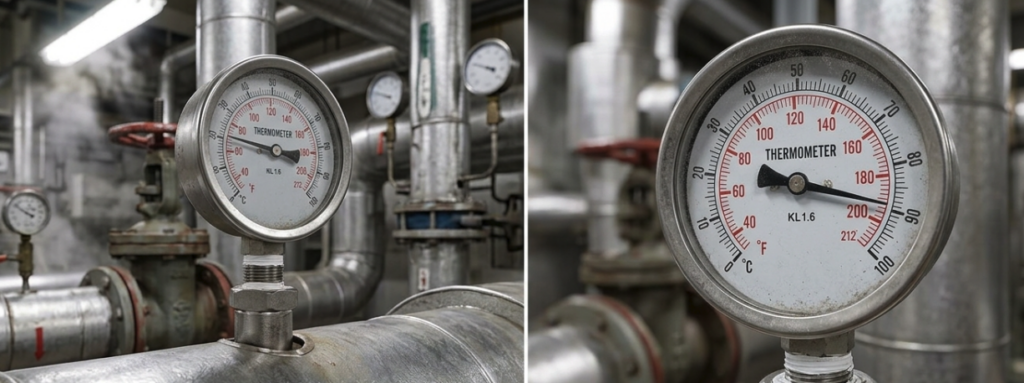
It should be basic common sense for practitioners to understand that the sensing area of a bimetallic thermometer is from the tip to the indentation. Your data and food safety are only guaranteed if you guarantee that the 2-3 inch section is completely buried.
If you need a bimetallic thermometer that’s both accurate and durable, look into the industrial-grade line of lower DY Pressure Gauge; they really do a solid job of durability.
Author: David Yang
“I am a specialist in precision instrumentation with years of experience in the industrial gauge and catering equipment industry. Having worked extensively with high-durability tools like DY Pressure Gauge, I’ve observed how a simple misunderstanding of a sensing zone can lead to critical errors in both professional kitchens and industrial settings. “
The prev: How To Calibrate A Metal Stem ThermometerThe next: Can I Use Air Pressure Gauge For Water