 Dypressuregauge
What Is A Diaphragm Pressure Gauge
Unlike the principle which relies on the straightening of the Bourdon tube under pressure, the diaphragm pressure gauge works on the basis of “elastic deformation”. When the process medium enters the pressure chamber, it acts directly on the huge surface area of the diaphragm. This circular, corrugated metal film creates a small displacement upward. The most ingenious thing about this mechanism is that it converts this linear displacement of the diaphragm into the rotational motion of the dial pointer through a set of precise connecting rods and gears.
Because the diaphragm is tightly clamped between the two flanges, it actually forms a completely sealed barrier. This means that the movement parts inside the gauge head ——those fine gears and hairspring—— never come into contact with the process medium. This physically eliminates the possibility of internal corrosion and mechanical failure.
Why Do Engineers Prefer Diaphragm Pressure Gauges?
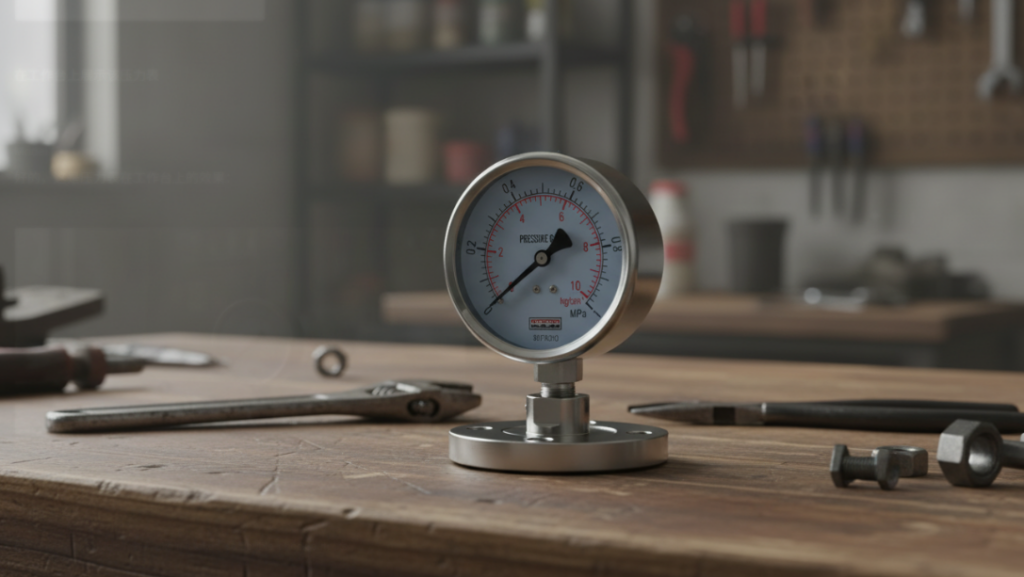
In many industrial projects, ordinary pressure gauges simply cannot survive the trial operation period. The core advantages of diaphragm design are reflected in the following three aspects:
- Extremely Excellent Anti-clogging Ability: When treating wastewater, pulp or chemical slurry, ordinary pressure interfaces can easily produce “bypass” phenomena, that is, media accumulation leading to blockage. The diaphragm table has a wide and flat induction surface on which the medium can hardly accumulate. This “anti-blocking” characteristic ensures that it can operate continuously for a long time in harsh environments, eliminating a lot of maintenance costs.
- Super Strong Overload Protection: This is a killer trick for the design. When the system experiences an unforeseen pressure peak, the diaphragm is physically supported by the upper flange, preventing the diaphragm from bursting. In contrast, once overloaded, Bourdon tubes are prone to permanent deformation and even cracking. Under working conditions with large pressure fluctuations, the robustness of the diaphragm meter is significantly higher.
- High Precision At Low Pressure Ranges: Measuring micropressure (e.g. mbar or inH2O levels) requires a large enough inductive area to generate sufficient thrust to drive the pointer. The circular diaphragm provides just this large area of pressure, which makes it very sensitive in low-pressure gas or liquid systems, where ordinary meters tend to be unresponsive.
Core to Against Corrosion
The key to the reason why diaphragm gauges “which are free of toxins” are the customizability of the fluid receiving parts. Because only the diaphragm is in direct contact with the medium, we can tailor the drug to different chemical environments “symptomatic”:
- 316L Stainless Steel: An industrial-standard entry-level configuration suitable for general industrial and food-grade applications.
- PTFE (Teflon) lining/coating: The first choice when dealing with strong acids and bases. Even in working conditions that stainless steel cannot withstand, Teflon is stable.
- Hastelloy or Monel: These are special alloys specially prepared for extremely harsh chemical corrosive environments in the petrochemical or pharmaceutical industries.
Typical Application Scenarios
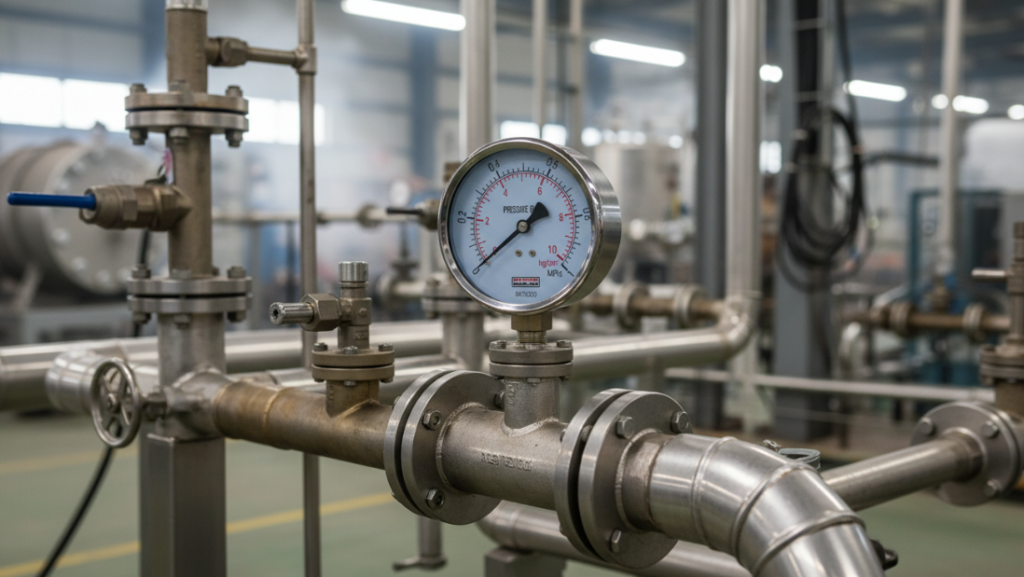
Diaphragm pressure gauges are not just a measuring tool, they are more like a solution for complex working conditions. You’ll typically see it in the following places:
- Chemical treatment: Treatment of corrosive media such as strong acids and caustic soda.
- Water treatment and wastewater: Measure the pressure of sludge pipes or fluids containing large amounts of impurities.
- Petrochemical: Maintain stable performance in high vibration and high corrosion environments.
- Food and Beverage: Use hygienic diaphragms to ensure that there is no media residue at the instrument interface and it complies with hygienic regulations.
Why You Need A Diaphragm Pressure Gauge
When you need a system with extremely high reliability and no room for error, a diaphragm pressure gauge is the kind of anti-blocking, corrosion-resistant artifact “you can’t go back to it after using it”. It protects the precision movement with a physical barrier, ensuring long-term measurement accuracy.
Ultimately, whether you’re dealing with sticky slurries or aggressive chemicals, choosing the right membrane material (whether it’s the standard 316L or the expensive PTFE lining) is key to ensuring the longevity of your device and the stability of your system.
Author: Mark Sterling
“Hi, I’m an instrumentation engineer in field maintenance and industrial system design, I’ve seen firsthand how the wrong equipment can lead to costly downtime. I specialize in helping teams navigate complex measurement challenges—from corrosive chemical processing to high-viscosity slurries—by leveraging robust diaphragm technology. “