 Dypressuregauge
How Does A Diaphragm Pressure Gauge Work
The working principle of diaphragm pressure gauges can actually be summarized into four words: elastic deformation.
When the process medium (whether gas or liquid) enters the lower case of the meter, it acts directly on a flexible circular diaphragm, which we often call “diaphragm”. The pressure forces this diaphragm to produce an extremely precise displacement. Then, through a high-precision mechanical link or push rod, this linear displacement is captured and transmitted to the movement assembly. Inside the movement —usually a combination of sector and center gears—, this tiny deformation is amplified and converted into circular motion of the hands on the dial.
The biggest difference between a diaphragm gauge and a regular spring tube pressure gauge is that the diaphragm acts as a strong physical barrier. This makes it an ideal solution for measuring corrosive media, high viscosity fluids or slurries, as it completely blocks the media from entering the delicate internal components, thus avoiding clogging or chemical corrosion.
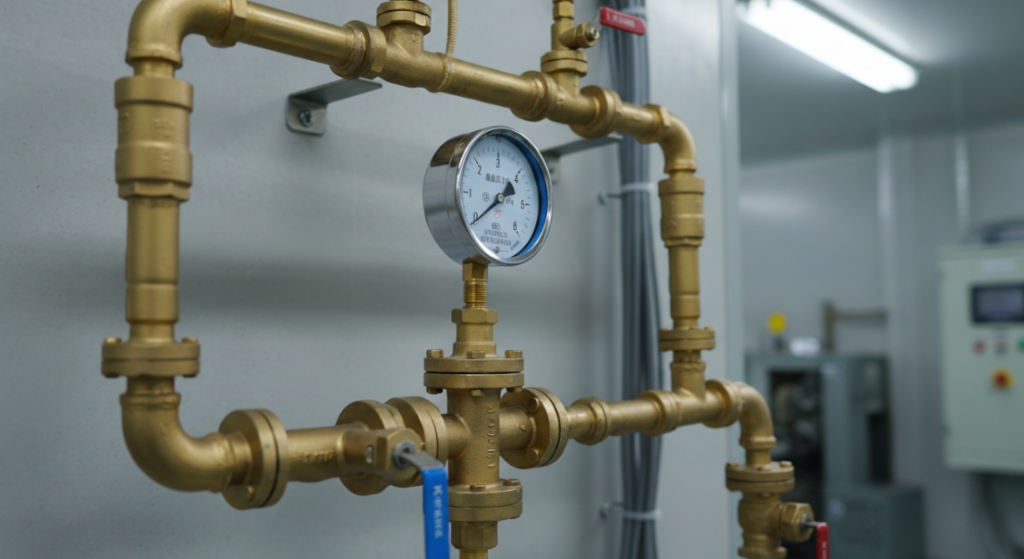
Elastic Deformation Mechanics In Diaphragm Tables
The reliability of diaphragm pressure gauge operation depends entirely on the physical principle of elastic deformation. Unlike those rigid components, the diaphragm is a precisely designed circular film that we typically process into a corrugated shape. This corrugated design is not for looks, but to increase the sensitivity and linear travel of the diaphragm.
When the medium is introduced into the lower cavity of the case, the pressure acts evenly on the entire surface area of the diaphragm, causing the diaphragm to bend upward. The accuracy of this measurement process depends entirely on the material properties and thickness of the diaphragm. At the time of manufacture, these parameters must be rigorously calculated to ensure that the amount of displacement of the diaphragm is in absolute positive proportion to the applied pressure.
The Process From Linear Displacement To Pointer Rotation
The true “technical content” of the pressure gauge, reflected in the seamless conversion from fluid pressure to mechanical reading. This process consists of three key stages:
Capture: A high-precision push rod or mechanical link is directly placed on the center of the diaphragm.
Transmission: As the diaphragm flexes, it drives the push rod to move in a straight line. This displacement is usually very small and must rely on an extremely sophisticated set of movement components to be visible to the naked eye.
Amplification: The movement is transmitted using a sector gear system. This gear set amplifies the push rod’s tiny vertical motion, converting it into a large rotational motion, which drives the pointer across the dial and gives an accurate real-time pressure reading.
Why Is Design Crucial?
Why, in many schemes, would engineers rather spend a little more money and choose a diaphragm gauge rather than a spring tube? The most central reason is the structural isolation of internal components.
In the diaphragm table, the medium is completely enclosed within the lower case. This creates a solid physical line of defense between the process fluid and the sensitive movement (those tiny gears, hairspring, and pins).
Corrosion resistance: By choosing special materials for the diaphragm (such as coating PTFE Teflon, or using expensive specialty alloys), the meter can handle a variety of strong acids and bases without damaging the internal mechanism.
Viscous and slurry handling: The medium does not need to enter narrow pipes (like spring pipes), so when measuring high viscosity fluids or slurries containing suspended solids, there is no need to worry about the meter being scrapped due to clogging.
The Inevitable Choice To Deal With Extreme Working Conditions
The mechanical design of diaphragm meters is not just about reading a number, but more importantly, protecting the life of the meter. In those industrial environments prone to crystallization, in the presence of pulsations or with severe chemical attack, the diaphragm is able to transmit force without allowing the medium to enter “the viscera”, which ensures continuous accuracy of the measurement.
If you choose at DY Instrument, it’s crucial to understand the logic of this mechanical isolation. Choosing the right gauge can greatly reduce downtime and avoid the troublesome catastrophic failure of instruments in harsh industrial applications.
Author: James Henderson
“Hi, with years of hands-on experience in engineering and onsite equipment design, I specialize in helping professionals navigate the complexities of industrial pressure measurement. Throughout my career, I’ve seen how the right mechanical design—like the robust physical barrier of a diaphragm gauge—can save a facility from costly downtime and instrument failure.”
The prev: Can Gauge Pressure Be NegativeThe next: What Is A Diaphragm Pressure Gauge