 Dypressuregauge
Can Gauge Pressure Be Negative
Yes, gauge pressure can be completely negative. In the technical field, we usually call this state “vacuum” or “suction pressure”.
Over the years working with various pressure systems, I ‘ve found that many field operators get confused when they see negative dials. It’s very simple: when you see a negative reading, the absolute pressure of the system is already below the local atmospheric pressure.
Since the standard pressure gauge is based on the surrounding ambient air as a “zero reference”, then any more than the outside air “thin” or less pressure environment, will pull the pointer below zero. For example, in HVAC vacuuming, engine intake manifold diagnostics, or water pump suction lines, you often encounter negative values-usually expressed in inches of mercury or negative PSI. If your application repeatedly jumps between positive and negative pressure, this does not mean that the equipment is broken, but that you may need a compound pressure gauge, which is specifically designed to measure the vacuum range and positive pressure on the same dial.
Understand The “Zero” Reference Point
To figure out why the pressure gauge shows a negative value, we must first look at how the standard pressure gauge “thinks. Most pressure gauges used on site will automatically ignore the weight of the air around us, which we call ambient atmospheric pressure.
When a pressure gauge is placed on the table and no system is connected, the pointer points to zero. This does not mean that there is no pressure, but that the pressure inside the dial and the air pressure outside are completely even. Therefore, when you connect this watch to a system where the air is partially drawn away, the internal mechanism will react to this “thinning” air and move the pointer in the opposite direction-that is, into the negative value zone.

Where Will You Encounter Negative Pressure
I ‘ve seen negative pressure readings almost as routine for technicians. The following is its specific performance in some common industrial applications:
Heating, Ventilation, Air Conditioning and Refrigeration: Technologists use a vacuum pump to remove air and moisture during a “system vacuum. Moving the pointer into the negative pressure zone is the only way to confirm that the system is clean and can be charged with refrigerant.
Pump suction line: the pump to pump the liquid from low to high, you must create a “suction” or negative pressure zone at the entrance. Monitoring this negative value is critical to prevent overloading of the pump or cavitation that could damage the impeller.
Car diagnosis: A well-functioning engine is actually like a huge vacuum pump. By measuring the negative pressure of the intake manifold, the technician can judge whether the engine’s internal valves and seals are working properly.
Significance Of Vacuum Units
Once the pointer drops below zero, the way we talk about units tends to change. While positive pressure is commonly used in PSI, the technician typically switches to inHg when reading negative pressure.
This may be a bit of a detour for novices, but this is just another way to measure the size of “suction. Whether the readings are negative PSI or higher inHg, they express the same thing: the pressure inside the system is much lower than the world outside the pipeline.
Compound Pressure Gauge
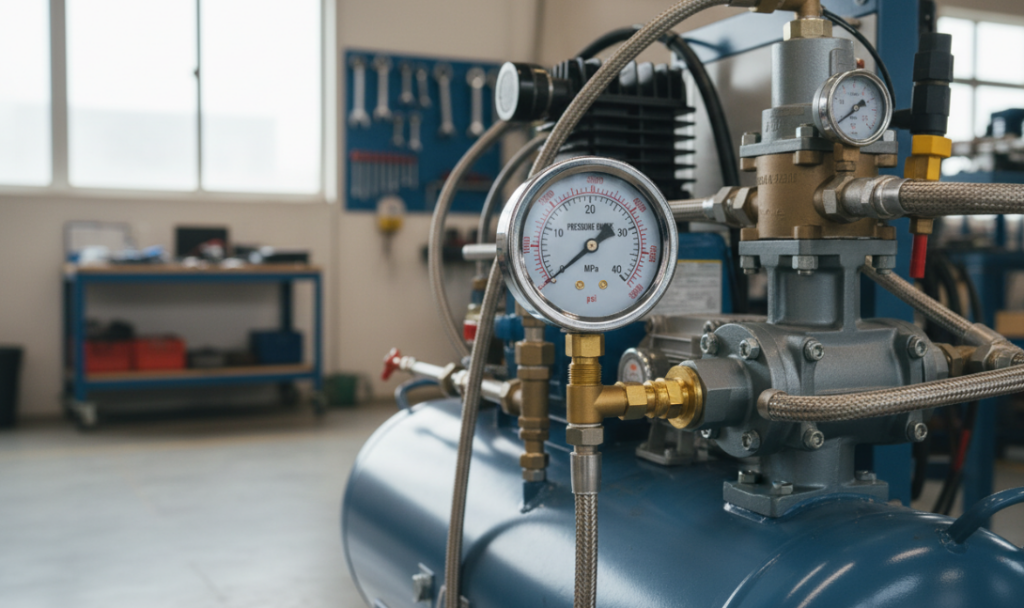
A typical mistake I have seen in the field is the use of a standard “positive pressure only” meter in a system that occasionally has a vacuum. If your process is fluctuating-say a tank that is pressurized during the day but creates a vacuum at night as the temperature cools-the standard gauge may be damaged or the readings may jump.
At this time, compound pressure gauge comes in handy. Unlike the standard table, the scale of the composite table extends from the zero position to both directions. It allows you to monitor “suction pressure” and positive pressure at the same time on the same dial, without the need to change the instrument frequently. This is definitely the most reliable tool for technicians dealing with dynamic systems.
Final Advice To Practitioners
If you stare at the pressure gauge and see a negative number, don’t rush to assume that the instrument is broken. It just tells you that your system has entered a vacuum relative to the surrounding air. By figuring out this logical relationship between the system and the atmospheric pressure, you can more accurately diagnose the health of your equipment and make sure you’re not picking up the wrong tools.
Author: Mark Edwards
I specialize in helping technicians troubleshoot complex pressure and vacuum systems. My passion lies in translating deep mechanical physics into practical, field-ready solutions, ensuring that every professional can select and use the right tools for peak system performance.
The prev: How Accurate Are Digital ThermometersThe next: How Does A Diaphragm Pressure Gauge Work