 Dypressuregauge
Can I Use Air Pressure Gauge For Water
In short, yes, but I wouldn’t recommend it for long.
Physically speaking, pressure gauge and water gauges are indeed universal, but there is a issue in this: the internal structure of ordinary pressure gauge has no consideration of waterproofing. Once the water gets in, the internal parts will quickly rust and fail. Unless you test it once in an emergency and then dry it out immediately, you are destroying the meter yourself.
It is crucial to understand the nuances of these two types of meters. It’s not just a question of whether it can be used, it’s also directly related to the integrity of the system and your subsequent maintenance costs.
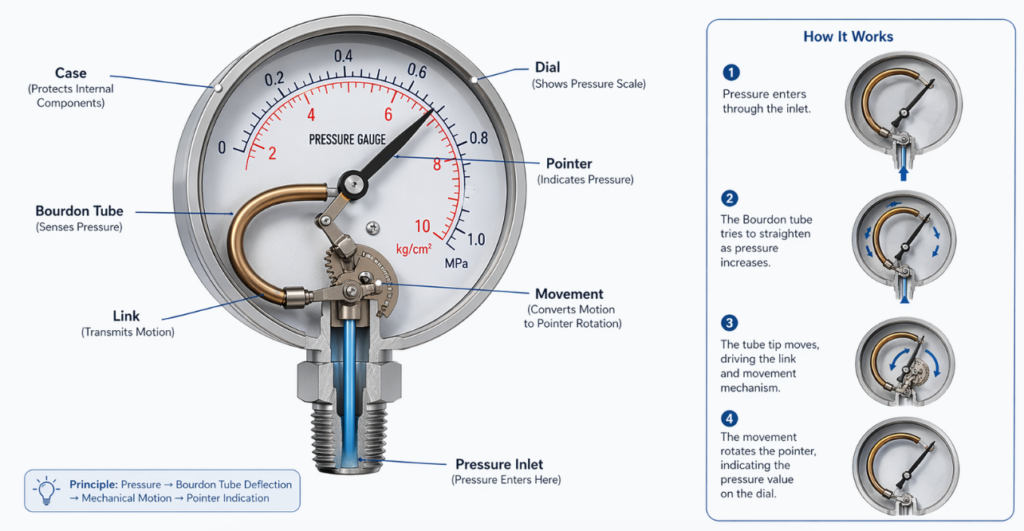
The Physical Underlying Logic Of Pressure Measurement
Whether measuring air pressure or water pressure, their core components are usually Bourdon tubes or diaphragm mechanisms. When fluid (whether air or water) enters the watch body, it squeezes these internal components, causing displacement that drives the hands on the dial.
In physical terms, the mechanical force exerted on the induction element by an air pressure of 100 PSI and a water pressure of 100 PSI is exactly the same. So, if you’re just doing an emergency or doing a one-time reading check, a pressure gauge can give you accurate water pressure data.
Why Is It Dangerous To Measure Water In Industrial Operations?
While the physical principles are connected, material compatibility is completely different. In an industrial environment, choosing the wrong tool often means data drift and even downtime risks.
- Internal corrosion and material compatibility
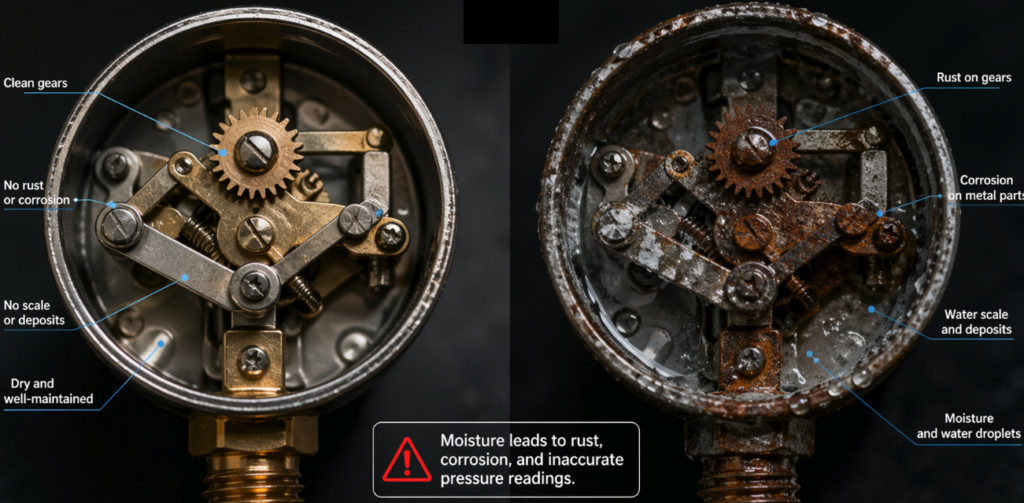
Most standard pressure gauges are designed for dry environments. Their internal parts —such as bourdon tubes, gears, and connecting rods— are usually made of brass or carbon steel that has not been specially corrosion-resistant. Once water enters these tables, the interior quickly becomes a hotbed of rust and mineral deposits. Over time, the mechanism would “hair-stuck” get stuck, and either the pointer would stop in half-empty or read ridiculously badly. - Seal and gasket failure
The sealing rings used in pressure gauge (especially consumer-grade products) are designed for air. Water has a completely different viscosity, chemistry, and air. If the water contains additives or is industrial water with higher hardness, these seals will degrade much faster than when exposed to compressed air, eventually leading to leakage. Near precision industrial equipment, such leaks can burn out surrounding electronic components. - “Essential difference between dry ”and “filled” tables
In professional water systems, we often use liquid-filled pressure gauges (usually filled with glycerin or silicone oil). These liquids act as a cushion against vibrations and lubricate internal mechanical structures.
Ordinary pressure gauges have absolutely no such protection. In the water system, there is often a “water hammer effect” or instantaneous pressure peak. Under this mechanical impact, the internal mechanism of the pressure gauge may be shattered instantly.
When Is It Necessary To Use A Professional Water Pressure Gauge?
You should go straight to a professional water pressure gauge in the following scenarios:
- Long-term installation: Any meter that needs to be hung on the water pipe 24/7 must be at the water pressure level, otherwise internal corrosion cannot be avoided.
- High accuracy requirements: The water pressure gauge is calibrated taking into account the density of the liquid, which ensures the hydraulic system receives the most accurate data.
- Corrosive environment: such as industrial water treatment. In this case, you need a stainless steel pressure gauge like the ones in our catalog, which is the only way to withstand the stress of years of service.
How To Maintain It?
In case you really don’t have a meter, you’ll have to hold the pressure gauge for a while. Remember to do these steps to save your life after taking the test:
- Drain thoroughly: After the reading is complete, vigorously shake out any remaining water in the meter.
- Air blow drying: It is best to connect an air gun with a compressor and blow it at the inlet of the pressure gauge to use the dry air to remove the residual moisture.
- Regular approval: When using it to measure air pressure afterwards, remember to compare it with the standard table to see if there is any deviation in calibration due to rust.
Recommendations
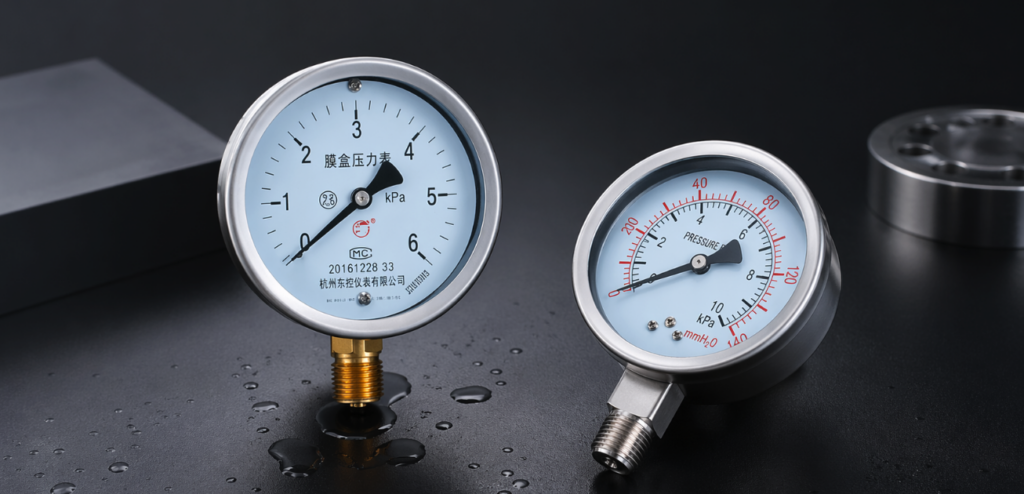
While the technical answer is “Yes”, it’s most cost-effective to let the tools do their jobs. Choose a professional water pressure gauge not only for accuracy, but also for safety, durability, and to protect your entire fluid system.
If you’re looking for a high-quality, durable industrial water system pressure gauge, check out DY Pressure Gauge. We have a range of stainless steel gauges designed specifically for water and hydraulic applications, specifically designed to handle those harsh operating conditions.
Author: Alex Chen
“Hi, I’m a fluid systems engineer with years of experience, I’ve seen firsthand how the wrong tool can lead to costly downtime. My expertise lies in optimizing system integrity and reducing long-term costs through precise instrument selection. I am passionate about sharing technical insights to help fellow engineers and purchasers navigate the nuances of pressure measurement, ensuring every system runs safely and efficiently with professional-grade solutions.”