 Dypressuregauge
Can Pressure Gauge Be Mounted Horizontally
Technically, a horizontal pressure gauge does work, but if you have a standard radial pressure gauge in your hand and haven’t made any special adjustments, generally wouldn’t recommend it.
The issue is often the effect of gravity on the internal Bourdon tube and movement components. When a meter that is supposed to be mounted vertically is placed sideways, the weight of the internal parts and the pointer itself will produce a “zero offset”, which will directly destroy the accuracy level of the meter. Although axial pressure gauges were designed for horizontal mounting (such as panel mounting), if you insist on using a standard vertical pressure gauge in the horizontal position, you must recalibrate it after installation to compensate for the pull of gravity on the transmission mechanism.
Additionally, if it’s a glycerin-filled model, horizontal mounting significantly increases the risk of oil leaks, and air bubbles may just stop in the center of the dial, blocking your view. This is a nightmare for operations and maintenance in critical B2B application scenarios. In order to comply with ASME B40.100 or EN 837-1 standards, you have to either directly select the axial design table or make zero adjustments on site, otherwise the reliability of the system is impossible to talk about.
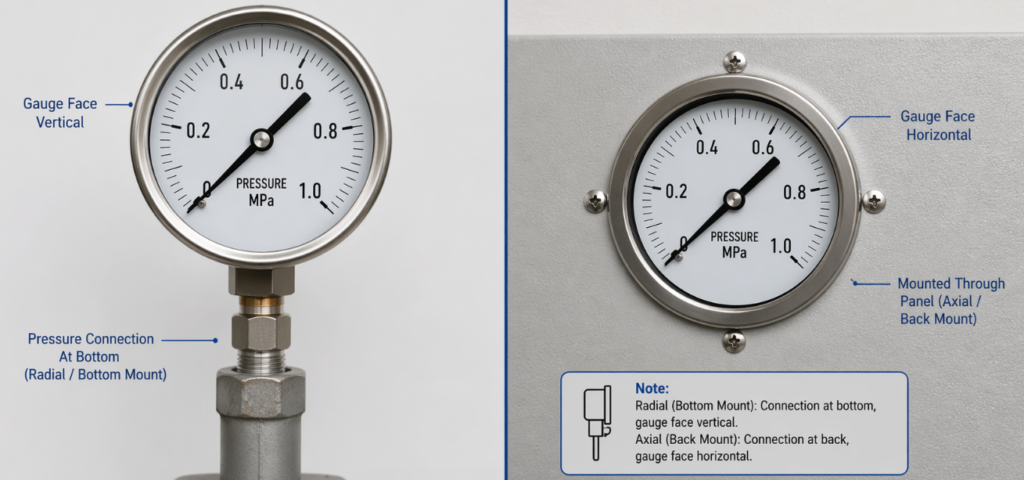
Why Installation Direction Is So Important
In an industrial environment that pursues high precision, a pressure gauge is not just a dial, it is a precision-calibrated mechanical instrument. Most industrial pressure gauges use a Bourdon tube ——a C-shaped, spiral, or twist-type tube that expands under pressure.
When manufacturers like calibrate standard radial pressure gauges, they do it in the vertical state. In this state, gravity acts evenly on the inner links. However, when you rotate it 90 degrees to horizontal:
- Gravity on the pointer: The mass of the pointer itself pulls the tip of the needle away from true zero.
- Bourdon tube deformation: The geometry of a tube in its “stationary” state changes due to its own weight, resulting in a permanent zero shift.
Different Types of Pressure Gauges
Choosing the right installation type is the most effective way to avoid these issues during system design phases.
Axial Pressure Gauge: Standard For Horizontal Mounting
If your system design requires the dial to be flush with the panel, or to be mounted on an upward horizontal pipe, an axial gauge (center-back or eccentric-back) is the only correct option. These tables are designed with the load of internal components in the horizontal plane in mind, ensuring that accuracy levels (such as Grade 1A or 2A) do not shrink.
Radial Pressure Gauge: Standard For Vertical Mounting
Standard radial tables are designed for vertical installation. Using them sideways is often a “makeshift on-site” practice that introduces unnecessary risks. If space constraints necessitate this, engineers must account for the mechanical errors introduced by this change in orientation.
Risks Of Horizontal Installation Of The Liquid Filled Gauge
Glycerol- or silicone-oil-filled pressure gauges are common in harsh environments with intense vibrations or pulsations. But placing such tables horizontally usually leads to two main operational failures:
- Surge in oil spill risk: The seals of standard vertical pressure gauges are optimized for level pressure in the vertical state. Once rotated 90 degrees, the filling hole plug or watch glass seal is subjected to continuous lateral pressure, and oil leakage is almost inevitable over time.
- “Bubbles” Occlusion: In a horizontal position, the inevitable bubbles inside the liquid-filled meter will usually wander to the center of the dial. This blocks the scale or pointer tip, making it impossible for the operator to see the reading at all when checking critical systems.
Follow The Standard
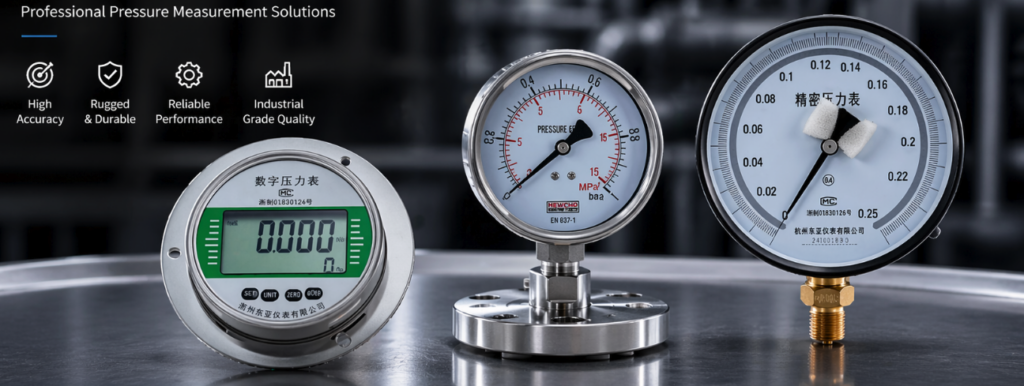
Compliance is non-negotiable in areas such as oil and gas. Both ASME B40.100 in the United States and EN 837-1 in Europe clearly state that meters should be installed in the direction in which they were calibrated.
If your application environment forces you to wear a vertical gauge horizontally, you must perform a field zero adjustment.
- How to operate: After installation, with the system at zero pressure, use the adjusting screw (if available) to turn the pointer back to the zero scale.
- Limitations: Note that this only corrects “zero offset” and does not necessarily fully compensate for the linearity of the meter over the entire range.
Summary
When you ask “can a pressure gauge be worn horizontally”, the answer depends on your requirements for accuracy and longevity:
- Best Practice: For any horizontal or panel mounted application, specify a center-mounted or eccentric-mounted pressure gauge directly.
- Emergency Plan: If you must use a radial pressure gauge, make sure it is a dry pressure gauge (to avoid oil leaks) and recalibrate it after installation.
- Advice: Always consult your supplier to ensure the internal structure of the meter is optimized for your specific mounting plane.
Prioritizing the correct installation direction is a protection of system integrity, which also ensures personnel safety and extends the service life of the instrument. The extra effort put into the early selection is totally worth it compared to the hassle of post-maintenance.
Author: David Chen
“Hi, I’m an industrial systems engineer with over a decade of hands-on field experience in mechanical instrumentation and system design. Throughout my career, I have focused on the precision and reliability of pressure measurement in complex environments. From troubleshooting Bourdon tube ‘zero offsets’ to ensuring compliance with ASME and EN standards, I specialize in helping engineers and procurement experts select the right instrument for the right orientation.”
The prev: Can I Use Air Pressure Gauge For WaterThe next: What Does A Pressure Transmitter Do