 Dypressuregauge
High Precision Pressure Transmitter
To choose a real high-precision pressure transmitter, you have to look deep and study how it handles zero-point drift and how to slow down sensor degradation in harsh environments.
The truly reliable solutions currently on the market basically use advanced piezoresistive silicon sensors or isolated capacitive sensors, and must be combined with strict active temperature compensation and factory multi-point calibration. This combination punch can not only effectively guarantee 0.075% FS (full scale) or even higher accuracy, but most importantly, it can eliminate temperature drift from the underlying logic and ensure long-term stability. Combined with the 4-20mA signal mount HART protocol, interference-free data transmission can be achieved in complex automation systems. This is not just for good-looking readings, but to help factories block out those expensive downtime losses, safety hazards and defective product rates.
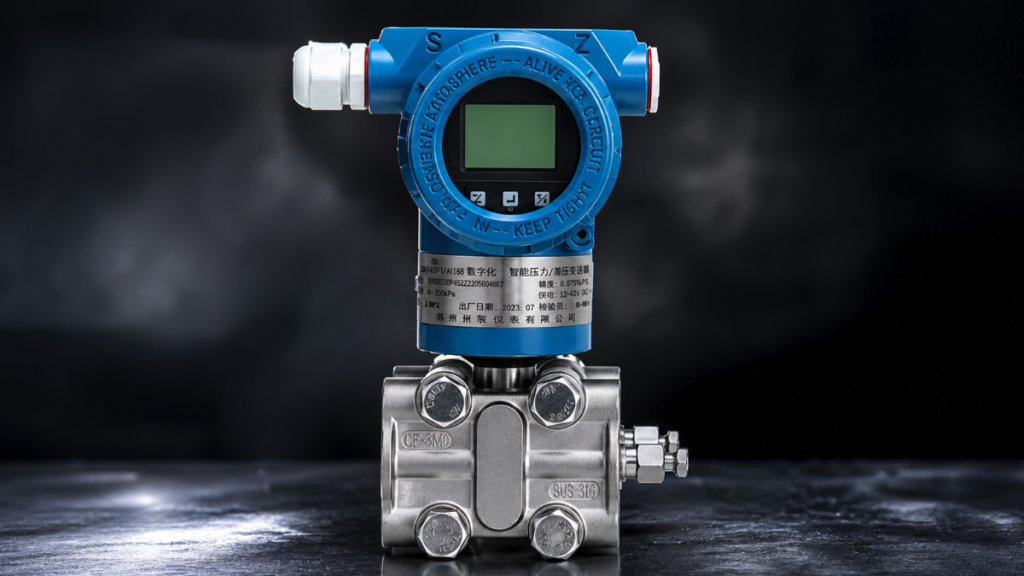
The Foundation of High Precision
If we want to meet the stringent requirements of modern research and development and fine processing, the sensor “heart disease” must be eliminated. There are generally two mainstream technical routes in high-precision transmitters:
- Advanced piezoresistive silicon sensors: exploit the piezoresistive effect of semiconductors. Such chips, etched on a silicon substrate, are micrometer-scale sensitive to pressure fluctuations. Many of the tiny pressure jumps that ordinary sensors miss are invisible to such sensors.
- Isolated Capacitive Sensor: If you have a particularly “brown” environment there, or if durability is extremely important, capacitive technology is usually the first choice. It reads by measuring the change in capacitance between the sensing diaphragm and the fixed electrode, with very good linearity and is particularly resistant to mechanical fatigue.
Dry Out By Active Temperature Compensation “Zero Drift”
Anyone who has run around the site knows that temperature fluctuations are the number one natural enemy of precision. A transmitter that performs perfectly in a 25°C lab might go straight “strike” or have readings jump around on an 80″C line, which is called zero drift.
The solution to this problem for high-precision transmitters is active temperature compensation. Simply put, it means burying a temperature probe in the fuselage and watching the temperature changes of the environment and medium in real time. The internal microprocessor runs a complex set of algorithms to hedge off the errors caused by thermal expansion in real time. This, combined with the multi-point calibration at the factory ——that is, repeated testing under different pressure and temperature gradients——, ensures that the accuracy of 0.075% FS is calculated under all operating conditions, rather than in the laboratory “ideal state”.
Long-Term Stability In Harsh Environments
For industrial engineers, it is important whether the transmitter is accurate on the first day of installation, but whether it can be accurate six months after installation is the real skill. If the sensor is degraded, the so-called high accuracy is a piece of waste paper.
It is the hard product such as the stainless steel shell, coupled with a special oil-filled sealing process, that isolates the delicate sensing element from corrosive media and severe vibration. This engineering obsession effectively prevents so-called “calibration drift” (calibration creep). In industries that are extremely sensitive to parameters, such as chemicals, oil and gas, or pharmaceuticals, a little drift may mean that a batch of drugs is useless or a safety bomb is directly planted.
4-20mA With HART Protocol
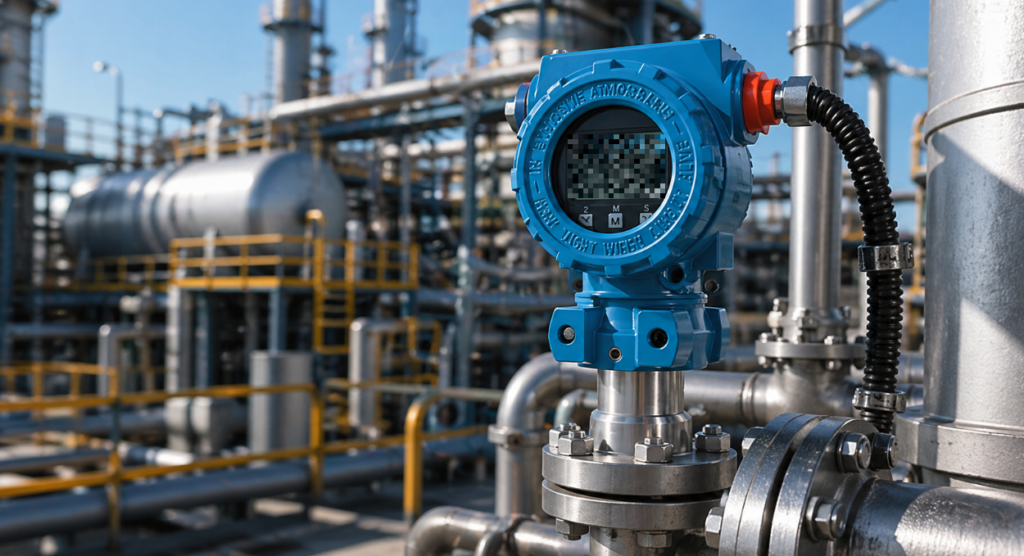
In the era of Industry 4.0, inaccurate data transmission and inaccurate measurement are equally deadly. High precision transmitters must be able to chat with PLC or DCS systems “enjoyable chat”.
- 4-20mA analog output: Its biggest advantage is its strong anti-interference ability and its ability to extend the line transmission without being afraid of electromagnetic noise.
- HART Protocol: This is a layer of digital signals superimposed on a 4-20mA analog loop. What I value most is its two-way communication capability. Engineers can remotely calibrate, diagnose, and even monitor the “health” of transmitters from the control room without having to run to the oil-stained site.
This combination ensures that the high-precision data captured by the sensor can be transmitted to the high-level machine intact, which is the basis for the operation of complex industrial automation.
Hold On To Your Bottom Line Of Profits
Buying a transmitter with a 0.075% FS accuracy rating should not be considered an expense but a strategic investment to protect production capacity. By choosing a device like the DY pressure gauge that integrates advanced silicon sensors, active compensation, and the HART protocol, you are effectively eliminating uncertainty in production.
Ultimately, preventing costly downtime accidents and ensuring optimal yield is more than just taking a pressure reading; it’s about ensuring that your critical process controls run both steadily and efficiently through this ultimate level of accuracy and stability.
Author: Robert Chen
“I am an industrial automation engineer with experience in process control and instrumentation. Having spent years troubleshooting equipment in harsh environments—from sweltering chemical lines to high-vibration oil rigs—I’ve learned that true precision is measured by long-term stability, not just a lab rating.”
The prev: How Does A Pressure Transmitter WorkThe next: How To Repair Air Pressure Gauge