 Dypressuregauge
How Can Gauge Pressure Be Negative? Physics Solved
Yes, gauge pressure can be negative. Gauge pressure becomes negative the exact moment a closed system’s internal pressure drops below the surrounding local atmospheric pressure. Engineers and physicists refer to this state as a vacuum or suction.
If you are staring at a fluid mechanics homework problem or prepping for the FE (Fundamentals of Engineering) exam, a negative pressure reading often feels like a math error. You cannot have “negative” air, right?
You are entirely correct. You cannot have negative air molecules. The confusion stems from a misunderstanding of reference points. To permanently understand how can gauge pressure be negative, you must stop thinking of pressure as an absolute physical quantity and start treating it like a financial bank account.
The Bank Account Framework: Demystifying Pressure References
Textbooks overcomplicate thermodynamic states. Let’s strip the math away and use the Bank Account Framework to solve the absolute vs. gauge pressure debate.
The Baseline: Atmospheric Pressure ($0 Balance)
Think of the local atmospheric pressure pushing down on you right now as your checking account balance sitting at exactly $0.00.
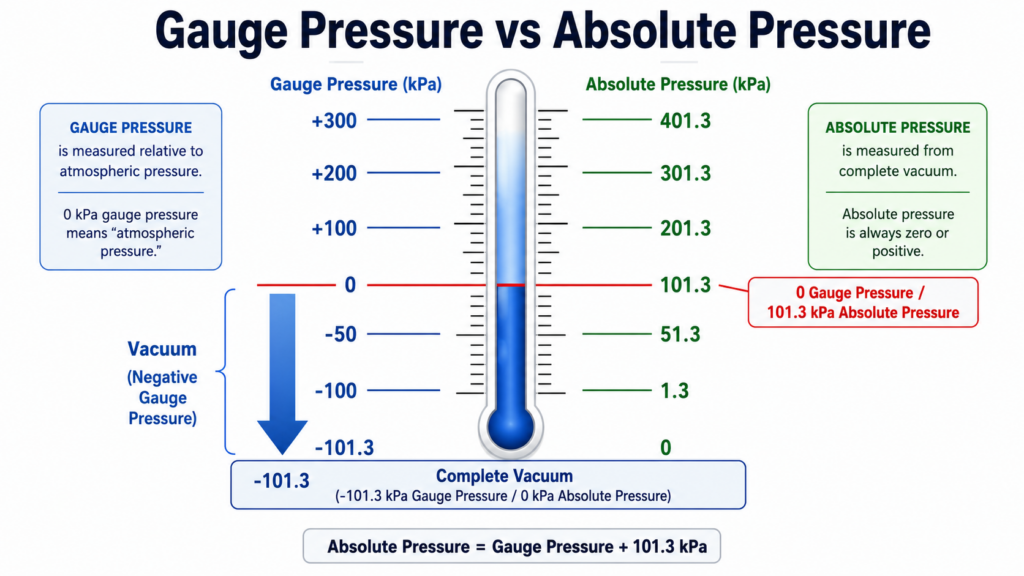
When a pressure gauge is sitting unattached on a workbench, it reads 0 PSI or 0 kPa. It ignores the heavy blanket of Earth’s atmosphere (typically 101.3 kPa at sea level) because the gauge is calibrated to use the room’s current atmosphere as its zero-point baseline.
The Debt: Negative Gauge Pressure (Overdraft)
Can gauge pressure be negative? Absolutely. Just like you can overdraw your checking account and carry a negative balance (-$50), a closed pipe can have fewer gas molecules inside it than the air outside it.
When you suck liquid up a straw, your lungs expand, expanding the volume and reducing the gas collisions inside your mouth. The pressure in your mouth drops below the atmospheric pressure outside. Your gauge pressure is now negative. The heavier outside air physically pushes the liquid up the straw to equalize the imbalance.
The Bottom: Absolute Vacuum (Total Bankruptcy)
Can you have negative gauge pressure forever? No. There is a hard limit.
If atmospheric pressure is your $0 baseline, an absolute vacuum (zero molecules of gas remaining in a space) represents the absolute bottom. At sea level, this bottom is precisely -101.3 kPa (gauge). You cannot pull a vacuum deeper than a perfect vacuum. Your “overdraft limit” is capped by whatever the local atmospheric pressure happens to be.
The FE Exam Trap: Negative Absolute Pressure
Engineering professors construct exam questions specifically to exploit student confusion between gauge and absolute values.
The universal pressure equation is simple:
PAbsolute=PAtmospheric+PGauge
The trap occurs when you calculate a deep vacuum system. Let’s say a manometer reads a negative gauge pressure of -60 kPa in a lab where the atmospheric pressure is 100 kPa.
PAbsolute=100kPa+(−60kPa)
PAbsolute=40kPa
The absolute pressure is a positive 40 kPa. In classical thermodynamics and standard engineering exams, absolute pressure can never be negative. A negative absolute pressure implies less than zero molecular collisions, a physical impossibility in macroscopic engineering. If you select a negative absolute pressure on your FE exam multiple-choice sheet, you immediately fail that question.
Real-World Physics: What Happens at Extreme Negative Gauge Pressure?
Understanding theoretical math is fine, but mechanical engineers deal with the violent physical consequences of negative gauge pressure daily.
HVAC Suction Lines And Compressor Recovery
Refrigeration technicians rely heavily on negative gauge pressure. Before charging a newly installed air conditioning system with refrigerant, technicians hook up a vacuum pump to the copper lines. They pull a negative gauge pressure to boil off any residual moisture trapped inside the pipes. At a deep enough negative pressure, water physically boils into a gas at room temperature and gets sucked out by the pump.
The Cavitation Destruction (Pump Impellers)
Water pumps create flow by generating a high-pressure zone at the discharge and a low-pressure (negative gauge) zone at the suction inlet.
If a pump operates incorrectly or the inlet is restricted, the gauge pressure on the backside of the spinning metal impeller drops drastically. If this negative gauge pressure drops below the fluid’s vapor pressure limit, a catastrophic phenomenon called cavitation occurs.
The water violently flash-boils into thousands of microscopic vapor bubbles. A split-second later, as these bubbles move into a higher-pressure zone, they collapse. This collapse generates localized supersonic shockwaves. Over a few weeks, these microscopic shockwaves act like shotgun blasts, blasting holes directly through solid stainless steel impellers.
Mechanical Gauges vs. Absolute Sensors (The 2026 Tech Shift)
Standard mechanical dials (Bourdon tube gauges) are built to measure gauge pressure. They have an open vent hole in the casing that constantly samples the local room air pressure to maintain their zero-reference point.
Modern semiconductor manufacturing and aerospace testing require ultra-high vacuum environments. You cannot measure a vacuum chamber down to 10−9 Torr with a standard mechanical dial.
The industry standard has shifted entirely away from gauge pressure references in these applications. Facilities now utilize hot-filament ionization gauges and capacitance manometers. These smart sensors do not care about the room’s atmospheric pressure. They measure absolute pressure by calculating the exact electrical conductivity or capacitance of the remaining sparse gas molecules in the chamber.
| Pressure State | Gauge Pressure Reading | Absolute Pressure Reading | Example Scenario |
|---|---|---|---|
| Pressurized Tire | Positive (e.g., +32 PSI) | Greater than Patm | Driving a car. |
| Open to Air | Zero (0 PSI) | Equal to Patm | An empty cup on a table. |
| Vacuum / Suction | Negative (e.g., -5 PSI) | Between 0 and Patm | Drinking through a straw. |
| Perfect Vacuum | Max Negative (e.g., -14.7 PSI) | Exactly Zero | Deep space / Quantum labs. |
Frequently Asked Questions (People Also Ask)
Can Gauge Pressure Be Negative But Absolute Pressure Be Positive?
Yes. This is the exact definition of a vacuum system. If you have a closed tank with a pressure slightly lower than the room outside, the gauge pressure is negative. However, because there are still gas molecules moving around inside the tank, the absolute pressure remains a positive number.
What Is The Lowest Possible Negative Gauge Pressure?
The lowest possible negative gauge pressure is exactly equal to the negative value of the local atmospheric pressure. At standard sea level, atmospheric pressure is 101.325 kPa (14.7 PSI). Therefore, the lowest possible gauge pressure you can ever achieve is -101.325 kPa (-14.7 PSI). You cannot remove more air than all of it.
Why Does A Vacuum Read As A Negative Pressure?
A vacuum reads as a negative pressure because pressure gauges are calibrated to read zero at atmospheric pressure. When you pull a vacuum, you are removing gas molecules from a closed space, dropping the pressure below the atmospheric baseline. The gauge needle drops below its zero mark, displaying a negative integer.
Does Negative Pressure Mean Negative Force?
No. Pressure is scalar, but force is a vector (it has a direction). A negative gauge pressure simply means the fluid inside a vessel is pushing outward with less force than the atmosphere is pushing inward. The net force points inward, which is why a thin plastic bottle collapses and crushes inward when you suck the air out of it.
How Do You Convert Negative Gauge Pressure To Absolute Pressure?
Use the formula: Absolute Pressure = Atmospheric Pressure + Gauge Pressure. If your local atmospheric pressure is 14.7 PSI and your gauge reads -5 PSI, your absolute pressure is 14.7 + (-5) = 9.7 PSI absolute.
Can A Bourdon Tube Pressure Gauge Measure Negative Pressure?
Yes. Many Bourdon tube gauges are built as “compound gauges.” The dial starts at zero in the middle. The needle moves clockwise for positive pressure (e.g., compressed air) and counter-clockwise into the negative range to measure vacuum (e.g., suction lines).