 Dypressuregauge
What Is Negative Gauge Pressure? A Clear Definition & Field Guide
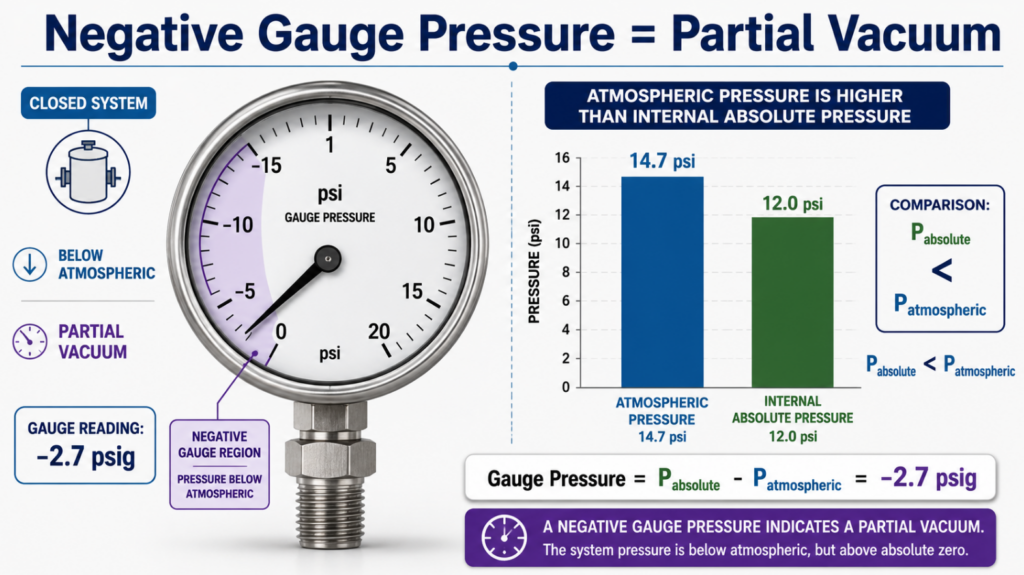
The so-called negative gauge pressure, to put it bluntly, is the pressure inside the closed system, which is actually lower than the surrounding local atmospheric pressure. For example, if the atmospheric pressure in your area is 14.7 psi and the absolute pressure inside the system is 12.0 psi, then your gauge pressure is -2.7 psig. In engineering circles, people are used to calling this state a “local vacuum”. Don’t underestimate this minus sign. Many technicians eventually broke the pump impeller, messed up the pressure difference balance in the clean room, and even triggered 1 unwarranted sensor alarms because they couldn’t eat it. Today, let’s take a look at 1 how this indicator can control the stability of the fluid system, and see how to avoid the calibration “big pits” that often lead to equipment paralysis “.
Hit The Essence: What Does Negative Gauge Pressure Mean?
Gauge pressure this thing is born to take the local atmospheric pressure as the “zero point. Therefore, the presence of a negative gauge pressure simply means that the pressure on the system has fallen below the local environmental baseline. At this time, if you use a standard Bourdon tube pressure gauge, you will see the pointer directly fall below the “0” scale and enter the negative value zone.
To fully understand negative gauge pressure, you have to distinguish it from “absolute pressure” (absolute pressure). Absolute pressure is based on the “absolute vacuum” (that is, the state without any matter) as the zero point. Because of this, absolute pressure can never be negative. What about gauge pressure? It follows the weather and altitude. When you remove the air from a sealed tank, the pressure drops. At this point, the atmosphere outside the tank on the tank wall extrusion degree, has exceeded the tank fluid outward top force. In actual operation, this pressure difference between inside and outside is what we call negative gauge pressure.
The Z-R-A Pyramid Model: A Thinking Thing For Clearing Stress Indicators
You may not know that up to 80% of failures in industrial pneumatic systems are caused by the wrong sensor reference value. To give field operators a glimpse of these stress indicators, we summarize a “Z-R-A (zero-reference-alignment) pyramid” model.
Bottom layer: absolute pressure (constant pie). Its zero point is never touched by thunder, and it is always an absolute vacuum. Like deep space testing, weather forecasting and thermodynamic calculations, it’s all used.
Middle level: positive gauge pressure (thrust). Its zero point is the local air pressure in the room you are in, and the readings are all positive. Compressed air pipelines, hydraulic cylinders and car tires look at this data.
Top layer: negative gauge pressure (suction pie). The zero point is also the local air pressure in the room, but the reading will drop below zero. Do suction cups, vacuum distillation, or isolation wards in hospitals, just keep an eye on this floor.
| Pressure Metric | Zero Reference | Value Range | Typical Industrial Application |
|---|---|---|---|
| Absolute Pressure | Perfect vacuum, or 0 PSIA | Always positive, from 0 upward | Vacuum chambers, weather forecasting, aerospace testing, thermodynamic calculations |
| Positive Gauge Pressure | Local atmospheric pressure, or 0 PSIG | Greater than 0 PSIG | Compressed-air systems, hydraulic cylinders, pressure vessels, vehicle tires |
| Negative Gauge Pressure | Local atmospheric pressure, or 0 PSIG | Below 0 PSIG, typically down to approximately −14.7 PSIG at sea level | Suction cups, vacuum packaging, vacuum distillation, hospital isolation rooms |
| Differential Pressure | Pressure difference between two measurement points | Positive, negative, or zero depending on flow direction | Filter monitoring, airflow measurement, cleanrooms, pumps, heat exchangers |
Practical Application: Why Is Negative Gauge Pressure So Deadly?
“Protective cover” for HVAC and clean rooms”
Modern building management systems rely on precise negative pressure to lock pollutants in the air. Hospital isolation wards or semiconductor clean rooms, for example, are mandated to maintain a specific negative gauge pressure (usually between -0.01 and -0.03 inches of water) relative to the external corridors. Such a slight negative pressure difference can ensure that when the door is opened, the air can only go in, holding down dangerous germs or chemical dust to prevent them from slipping into the public passage. HVAC technicians usually have to rely on the kind of high-sensitivity differential pressure transmitter to pinch this indicator to death.
Industrial Pumps and the “Cavitation Killer”
Pump cavitation often occurs because the concept of negative suction pressure has not been properly understood. When a centrifugal pump is operating, it creates a negative gauge pressure at the suction inlet, which draws the liquid from the lower-level tank into the pump. However, if this negative gauge pressure falls below the vapor pressure of the pumped liquid, the liquid will boil instantaneously at room temperature. Immediately afterward, countless tiny vapor bubbles form and burst violently upon striking the metal impeller. This microscopic-scale “implosion” is so powerful that it can directly tear visible metal fragments from a stainless steel pump impeller. Therefore, operators must keep a constant watch on the “Net Positive Suction Head (NPSH) requirement,” ensuring that the negative gauge pressure never crosses that critical red line.
“The Altitude Trap”: A Costly Calibration Pitfall
Atmospheric pressure varies with altitude, which can directly bias gauge pressure readings. Suppose you calibrate a sensor at sea level; its default local atmospheric reference is 14.7 psi. However, if you were to transport this calibrated sensor, still sealed in its original packaging, to Denver, Colorado (elevation 5,280 feet), the local atmospheric pressure would actually be only about 12.1 psi.
At this point, the data from the sensors will go haywire. A system operating at an absolute pressure of 13.0 psi will register as a vacuum (-1.7 psig) in Miami, but at Denver it will read as positive pressure (+0.9 psig). In a PLC (programmable logic controller) program, hardcoding the reference value of 14.7 psi instead of retrieving real-time atmospheric pressure data is a typical rookie mistake. Nowadays, even the most advanced piezoresistive pressure transmitters for the IoT come equipped with built-in real-time barometric compensation. They continuously measure the ambient barometric pressure and dynamically adjust the zero‑point reference in real time, effectively preventing “false negative‑pressure alarms” triggered by extreme weather or sudden changes in altitude from ever arising.
Case Study: Resolving The “Ghost Vacuum” Fault In High-Altitude Chillers
We once took on the case of a commercial cooling plant in Salt Lake City (elevation 4,226 feet) and resolved its frequent shutdown issues. 1 time, when a severe winter storm passes through, the chiller in this system will trip due to a “low suction vacuum” fault.
We reviewed the sensor data and found that a static sea-level atmospheric pressure reference value of 14.69 psia had been hard-coded into the PLC. Meanwhile, during winter low-pressure storms, the actual atmospheric pressure in Salt Lake City has dropped to 12.30 psia. At that time, the intake line was operating steadily at 12.0 psia with no issues whatsoever. However, because the PLC used that static sea-level reference value in its calculations, it computed a negative gauge pressure of –2.69 psig, immediately determining that the system had exceeded the –2.5 psig safety threshold and triggering an emergency shutdown.
After identifying the root cause, we replaced all the aging sensors with dual‑node digital transmitters equipped with real‑time ambient‑pressure compensation. The PLC immediately recognized the reality: the actual local negative gauge pressure was only -0.30 psig. Those so‑called “phantom faults” vanished in an instant. During the following winter, the system’s uptime improved by a full 14%.
Frequently Asked Questions (FAQ)
What is the difference between vacuum and negative gauge pressure?
The two describe exactly the same physical state. In engineering, “vacuum pressure” is a positive quantity that indicates the degree to which a system’s pressure falls below atmospheric pressure. Meanwhile, “negative gauge pressure” simply appends a minus sign to denote the very same numerical value. For example, a vacuum of 3 psi is exactly the same as a gauge pressure of -3 psig.
Can absolute pressure be negative?
Absolutely impossible. Absolute pressure is measured with absolute vacuum as the “absolute zero” reference point. The pressure of matter cannot be lower than a state in which there are no molecules at all. Only gauge pressure can register negative values, because its zero reference is the fluctuating atmospheric pressure.
In a closed-loop water circulation system, what does negative gauge pressure signify?
In a closed-loop system, the occurrence of negative gauge pressure indicates that the water pressure inside the pipe is lower than the ambient atmospheric pressure. This is an extremely dangerous sign: ambient air can enter the system through minute gaps—such as around valve seals or pipe threads—and be drawn in, ultimately causing air blockage and severely accelerating internal corrosion of the piping.
How do you measure negative gauge pressure?
You can measure it using a compound pressure gauge, a U‑tube manometer, or a dedicated vacuum pressure transmitter. The dial of a compound pressure gauge is quite distinctive: on a single scale, it can display both positive pressure—typically in psi or bar—and negative pressure—usually in inches of mercury (inHg).
Why does my gauge’s negative pressure reading fluctuate wildly during heavy rain?
Heavy rainfall is typically associated with low-pressure weather systems. As soon as the storm arrives, the local (atmospheric) pressure will drop. Since your pressure gauge uses the local ambient air pressure as its zero reference, once that baseline drops, even if the pressure inside your system remains rock‑solid, the gauge reading will still shift.