 Dypressuregauge
How Do I Read A Thermometer
Trying to accurately read the value of a dial thermometer is actually more complicated than many people think. In the first step, you must keep your line of sight absolutely level with the pointer, which is to physically eliminate parallax. Then, stare at the dial to see if it’s in Celsius (℃), Fahrenheit (℉), or double-scale. I find that many people are very sloppy when looking at the spacing between the ticks: you have to count the scale values carefully between large ticks. For example, if there are four short lines between 10° and 20°, then each square actually represents 2 degrees.
To ensure accurate measurement, the stainless steel probe (Stem) must be submerged to a sufficient depth ——at least 2 inches when measuring liquids. And don’t rush, you have to wait for the pointer to stabilize completely, which usually takes 15 to 30 seconds, depending on the calibration status and response speed of the bimetallic sensor. Once the needle is stationary, keep an eye on the point where the needle tip meets the scale line to read it, so you can ensure your lab operations or food processing are under close temperature monitoring.
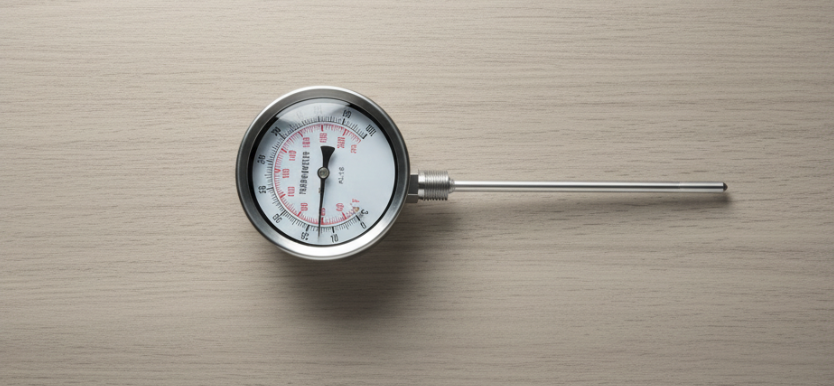
Deeply Understand The Accuracy Of Dial Thermometers
For peers who frequently come into contact with stainless steel bimetallic thermometers, accurate readings are directly related to process safety and quality control. Although digital displays are intuitive now, reading such manual dials actually tests more technical details. Only by handling these details can the data obtained be considered reliable.
Completely Eliminate Parallax
The most common “rollover” scene when reading a dial is looking at it at an angle. To get an accurate reading, your line of sight must be perpendicular to the dial surface. If you peek from the side, the pointer will appear to be pointing in a position that is off from its actual position. You have to get your eyes on a horizontal line with the tip of the needle to completely kill the parallax.
Understanding Dial And Index Values
Before you start measuring, take a look at the units. Many industrial bimetallic thermometers are double-scale (inner and outer rings).
Look at the circle: Make sure you are looking at the correct circle of units.
Calculate the index value: Remember, not all thermometers are 1 degree grid. You get to count the ticks between two numbers. If there are only four lines between 10 °and 20°, then each grid is 2 degrees. Misreading index values is the most frequent source of measurement error.
Probe Immersion Depth And Response Time
The accuracy of a bimetallic sensor is highly dependent on the quality of its contact with the measured medium.
Immersion depth: The sensing element is retracted in that stainless steel rod. To ensure adequate heat transfer, the probe must reach a minimum immersion depth, which is usually at least 2 inches when measuring liquids.
Stabilization process: Unlike electronic sensors that read instantly, this thing takes time to respond to even a high-quality bimetallic thermometer. You have to hold the needle, completely still ——usually between 15 and 30 seconds—— before starting to record.
Final Reading Determination
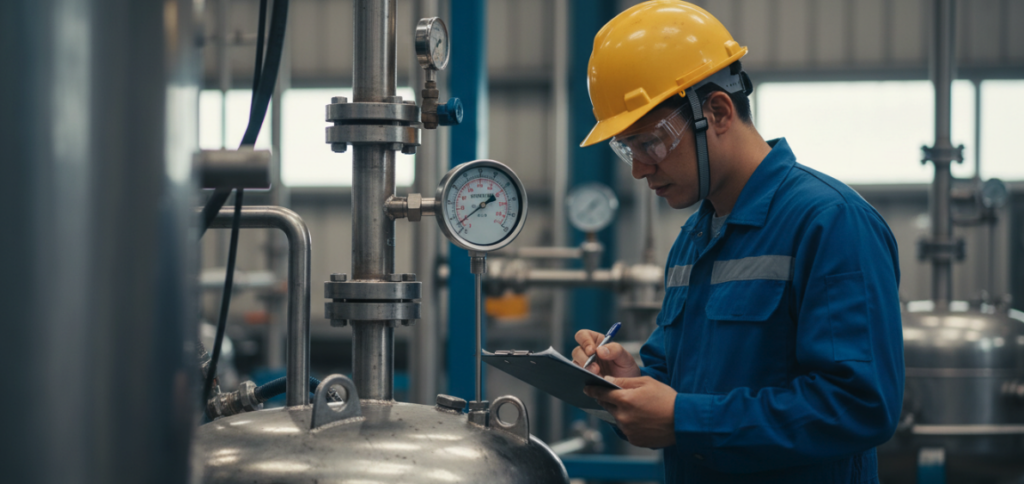
Wait until the needle is completely “lying flat” still and focus on the very end of the needle tip. The point where the needle tip meets the scale line exactly is your final value. This dedication to precision ensures that your industrial, laboratory or cooking process is strictly locked within the required temperature range, preventing equipment damage or product scrap.
Just follow these technical steps and you’ll be able to perform with the high precision you expect from this bimetallic thermometer. After all, the upper limit of a tool depends on its design, while the lower limit depends on the person operating it.
Author: Alex Thompson
Hi, I’m an engineer with years of hands-on experience in process safety and industrial quality control. Throughout my career, I’ve worked extensively with stainless steel bimetallic thermometers in both laboratory and food processing environments. I am passionate about technical precision, and I believe that the reliability of data starts with mastering the smallest operational details.
The prev: How To Calibrate Differential Pressure TransmitterThe next: How To Fix A Pressure Gauge