 Dongyayibiao
How Often Should Pressure Gauges Be Calibrated
10Learn How To Set Pressure Gauge Calibration Cycles Based On ASME B40.100, Risk Assessment, And Environments.
View detailsFrom the core logic, any thermometer must first reach a thermal equilibrium with the environment, and then convert the reading through some physical effect. But in industrial applications, the situation is much more complicated: glass liquid thermometers rely on thermal expansion and contraction; thermocouples play with the Seebeck effect; and thermal resistance (RTD) uses the linear law of metal resistance with temperature.
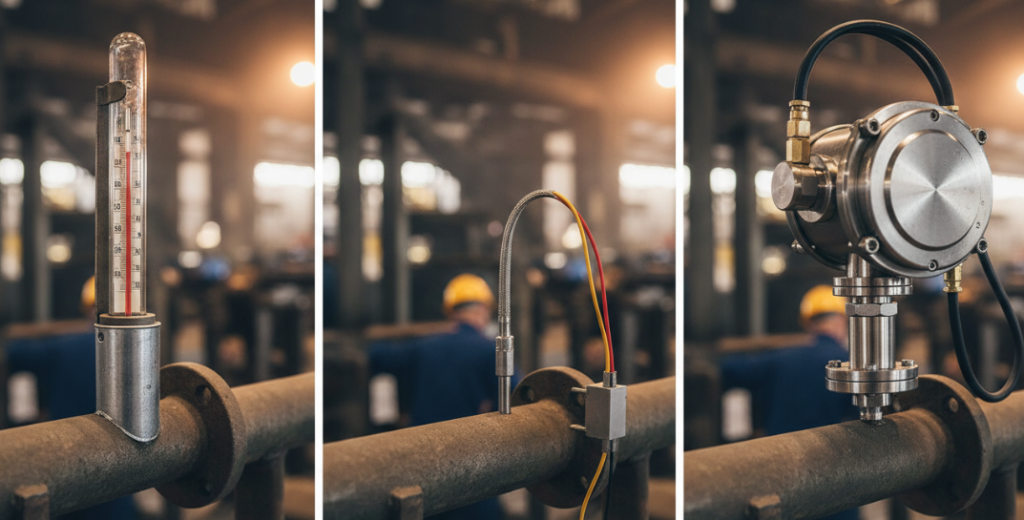
The principle is very simple: the thermal expansion coefficient of the liquid is much larger than that of the glass shell, and when the temperature is high, the liquid will go to the top of the thin tube. Although this kind of thing is used less in modern high-automation factories, it cannot be completely replaced in some static monitoring occasions that do not require external power supply. However, the response speed of this thing is really touching, and on devices with vibration, the glass tube cracks without paying attention, so it is only suitable for non-core positions that are not painful or itchy.
If your process is always thousands of degrees, the thermocouple is basically the industry’s first choice. Its core logic is the Seebeck effect: two different metal wires are welded together at one end, and if there is a temperature difference between the two ends, an electromotive force will be generated. I personally like to use it because it is solid enough and does not require additional power supply. Metal contacts will age at high temperatures, resulting in signal drift. Regular calibration is necessary, otherwise you will not know if the reading is off.
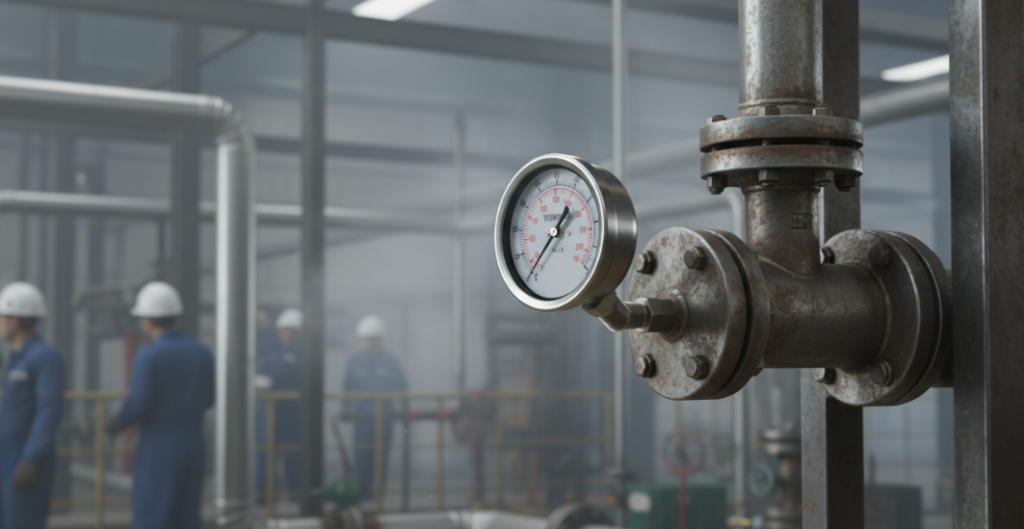
If your requirements for control accuracy are “harsh”, choose RTD. Its principle is very elegant: the resistance value of metal (usually platinum) shows excellent linearity with temperature. RTD measurements are more stable and predictable than thermocouples. In an automated control system, the data link of an RTD is usually very reliable. Of course, it also has shortcomings. For example, the response time is usually not as fast as that of thermocouples, but in a closed-loop system that requires accurate data feedback, it can really save engineers a lot of worry.
The selection is not only based on the measuring range, but also the key to match the working conditions. For example, in an environment with large vibration, do not touch glass products; if it is a strong corrosive environment, the material of the outer sheath of the sensor (such as stainless steel, Inconel or special coating) is even more important than the internal sensing principle. As for calibration, the curve of RTD is more regular and the maintenance period is relatively fixed. However, if the thermocouple runs at the upper limit of the measuring range all the year round, the calibration frequency must be raised, otherwise the drift phenomenon will give you a headache.

Understanding the physical logic behind these thermometers is the first step in preventive maintenance. By clarifying whether the system needs the “tough” of thermocouples or the “precision” of RTD, you can avoid common sensor drift, signal noise or sudden instrument failures. The choice of the right instrument is actually to spend less money-after all, reducing unplanned downtime is our ultimate pursuit of industrial instruments.
Author: David Miller
I have spent over 10 years working on the front lines of industrial automation and maintenance. Having dealt with countless system failures and sensor calibrations, I am passionate about bridging the gap between complex physical principles and practical, on-site troubleshooting.
Learn How To Set Pressure Gauge Calibration Cycles Based On ASME B40.100, Risk Assessment, And Environments.
View details
Learn Why Negative Gauge Pressure Occurs In Vacuum And HVAC Systems And How To Interpret Your Gauge Readings.
View details
Mechanical Vs. Electronic: Discover The Key Differences Between Pressure Gauges And Transmitters For Industrial Control.
View details
Learn How Bourdon Tube Pressure Gauges Work, Troubleshoot Common Failures, And Discover Expert Maintenance Tips.
View details
HelloPlease log in