 Dypressuregauge
Pressure Gauge And Transmitter
Whether to choose a pressure gauge or a pressure transmitter, the standard answer lies in the “data architecture” of your system. If your project is designed to save money, requires no power, and requires only a glance from a field worker to perform a safety inspection, a Bourdon tube pressure gauge is definitely the first choice. But if your design involves remote monitoring, requires access to a PLC system, or pursues extremely high process monitoring accuracy, then you must write a 4-20 mA signal, HART protocol, or pressure transmitter output by Modbus. In those realistic, high-risk industrial environments, the most reliable engineering practice is actually to create a “redundant hybrid system”—— transmitter responsible for transmitting real-time data to the control room, and the mechanical meter remains on site as a floor-keeping indicator when power is cut off or the calibration cycle occurs. This is to ensure both automation efficiency and operational safety on site.
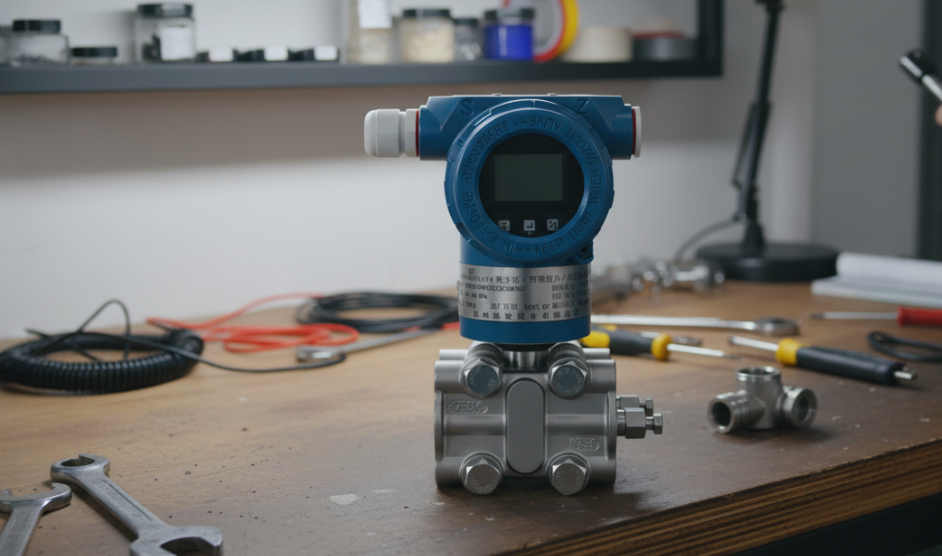
Data Architecture
If the main readers are the technicians who patrol the workshop, then the mechanical pressure gauge is definitely the standard. This thing uses a Bourdon tube to directly drive the pointer for analog display. Its greatest advantage is that it does not require an external power supply; even if the entire plant is without power, it can still work normally, which is the last reliable line of defense in manual safety inspections.
Conversely, if this data is presented to a PLC or DCS to trigger an alarm, control a pump, or perform historical trend analysis, then the pressure transmitter is a non-negotiable choice.
Pressure Transmitter
In modern industrial design, pressure transmitters are the bridge between physical pressure and digital intelligence. It is not as simple as a pressure gauge, it can convert pressure into a standard electrical signal:
- 4-20 mA signal: Long transmission distance and minimal signal loss, very stable.
- HART protocol: It can also run digital communications based on analog signals, and remote diagnosis and equipment configuration rely entirely on it.
- Modbus/Digital Output: Ideal when multiple sensors share a single communication bus.
The value of a transmitter lies in its high-precision monitoring. Although the watch head can give you visual feedback, high-quality transmitters such as those produced by DY Pressure Gauge can provide the precise control required by demanding industries such as chemicals and pharmaceuticals.
The Game Between Cost-Effectiveness And Operational Accuracy
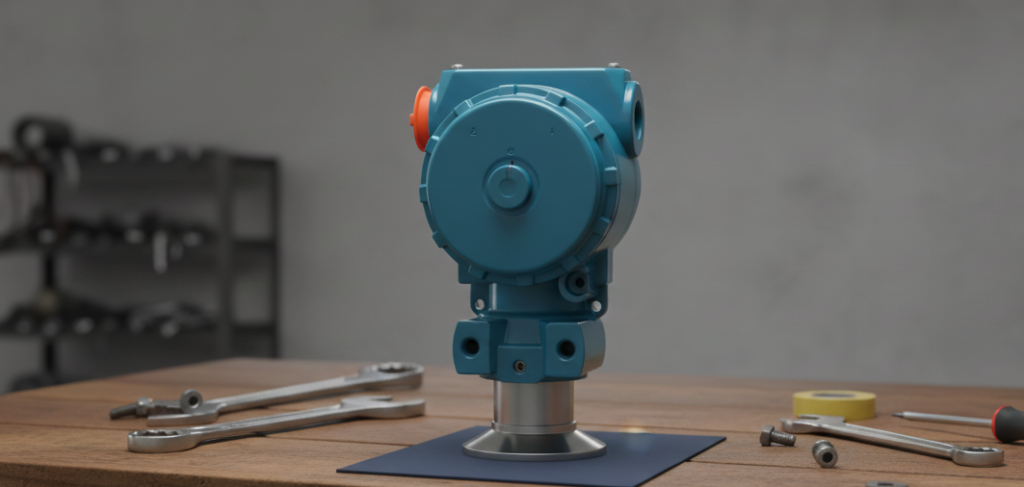
The pressure gauge does have an overwhelming advantage in terms of initial purchase cost, it is a separate unit and does not even have to pull the wire.
The long-term operating cost of a pressure transmitter in an automated system is actually lower. With remote monitoring, you don’t need to send people around, reducing manual errors in meter reading and enabling predictive maintenance through real-time trend analysis. An optional transmitter is actually buying a reliable pair of “eyes” for your automation system.
Advanced Form Of Engineering Design
- Fault-guaranteed operation: In case the 4-20 mA circuit breaks or the control room goes black, the mechanical watch can ensure that the on-site operator still has a number in his hand and will not be blinded.
- Simplified calibration cycle: Two meters together can be done “consistency check”. If the transmitter’s numbers deviate too much from the pointer of the header, it’s clear that it’s time to calibrate.
- Instant safety on site: During power-on or emergency stops, on-site personnel need high-intensity readings that can be seen at a glance, rather than flipping through screens or pulling out hand aerators.
Choose The Right Hardware For Your Design
Whether your project focuses on the rugged, power-free simplicity of a Bourdon tube pressure gauge or the high-end, high-precision digital integration of a pressure transmitter, choosing a supplier is crucial.
At DY Pressure Gauge, we specialize in specialized hardware for both dimensions. Our meters are designed to withstand the torture of industrial sites. Whether you are designing for manual safety inspection or fully automated control, ensuring that pressure monitoring is accurate, reliable and meets international standards is the main job of our engineers.
Author: Robert Harrison
I’ve dedicated my career to bridging the gap between mechanical reliability and digital precision. Having led numerous large-scale projects in the petrochemical and water treatment industries, I specialize in designing robust pressure monitoring systems that prioritize both automated efficiency and on-site safety.
The prev: Diaphragm Seal Pressure TransmitterThe next: Manómetro de Bourdon