 Dypressuregauge
Private-Label Pressure Gauge Project for a Frankfurt Industrial Distributor
An industrial equipment distributor in Frankfurt asked Dongya Instrument to develop a small private-label pressure gauge range for its machinery and maintenance customers. It already sold gauges, but its catalog had grown through several suppliers. Similar-looking products arrived with different thread descriptions, dial layouts and carton labels. The distributor wanted to launch its own line with fewer stock-keeping units and a specification that its sales team could quote without checking each batch by hand.
We approached the request as an OEM supply project. Printing a logo was only one part of it. The buyer needed agreed product families, pressure ranges, connections, artwork, packaging and inspection documents, all tied to the same part numbers that would appear in its catalog and warehouse system.
Project at a glance
| Customer | Industrial equipment distributor, Frankfurt, Germany |
|---|---|
| Program | Private-label mechanical pressure gauges for machinery and maintenance buyers |
| Product families | 100 mm stainless steel Y-100BF gauges and 100 mm vibration-resistant YN-100ZT gauges |
| Customization | Customer logo, approved dual-unit dial artwork, specified connection, SKU label and carton identification |
| Sample plan | 18 approval samples across three initial catalog SKUs |
| Opening order | 900 gauges: 300 pieces per SKU |
The distributor’s problem: one catalog description, several actual products
The distributor’s purchasing manager showed us three versions of a “100 mm industrial pressure gauge” that had been sourced over time. Each could measure pressure, but the details did not line up. One carried only a bar scale, another used a different case finish, and a third had a connection description that did not match the drawing used by the sales team. Warehouse staff had to open cartons to confirm what they had received, while the sales team could not promise a customer that a replacement would look and fit like the previous batch.
The buyer wanted a stainless steel option for general industrial process orders and a vibration-resistant option for hydraulic equipment. Its end customers usually searched by use, dial size, range and thread rather than by the manufacturer’s model code. We therefore built the approval sheet around those buying details. Our internal model references stayed in the specification, but the catalog names described the application first.
How we defined the private-label range
We proposed two Dongya product families: the Y-100BF stainless steel pressure gauge for the distributor’s general industrial line and the YN-100ZT vibration-resistant pressure gauge for equipment exposed to vibration. Dongya’s product information lists the 100 mm Y-100BF and YN-100ZT at accuracy class 1.6. The customer selected three opening SKUs after reviewing the ranges and applications requested most often by its sales team.
For each SKU, we recorded the range, unit scale, thread, mounting orientation, case and wetted-material requirements, dial artwork and packaging instruction. We did not infer a process connection from the dial diameter. The buyer supplied its common mating-connection drawings, and we checked the thread and sealing method against each SKU before making samples. The process medium also remained part of the inquiry for end uses where material compatibility could not be assumed from a general catalog description.
The branding work had its own approval step. The customer sent vector logo artwork and a proposed bar/psi dial. Our first proof made the secondary psi markings too prominent at the lower end of the scale. The distributor’s product manager asked us to give the primary bar scale a clearer reading path and keep the logo outside the main graduations. We revised the proof, then printed the sample dials against the signed artwork rather than working from an email description of the design.
Samples, carton labels and incoming inspection

We prepared 18 approval samples, six of each SKU. The distributor checked the dial against its catalog mock-up, measured the process threads, reviewed the case finish and compared the gauge readings with its receiving-inspection method. Its warehouse team also tested the carton and individual SKU labels. One sample carton used an abbreviated product description that looked too similar to another range on the shelf. We changed the label format before the opening order so staff could distinguish the three SKUs without opening every box.
The signed sample pack included the product drawing, dial artwork, label proof and document list. That pack became the reference for our production team and the customer’s incoming inspectors. The buyer did not request an unspecified blanket “international certificate.” It specified the factory conformity documents it needed and agreed that any third-party test report would be ordered separately for a defined model, range and sample quantity.
The first 900-piece order
After approval, the distributor placed an opening order of 300 pieces for each of the three catalog SKUs. The quantity was above the 100-piece MOQ stated in Dongya’s company information and allowed the buyer to stock its first private-label range without launching too many variants at once. We confirmed the specifications, packing and shipping details before production.
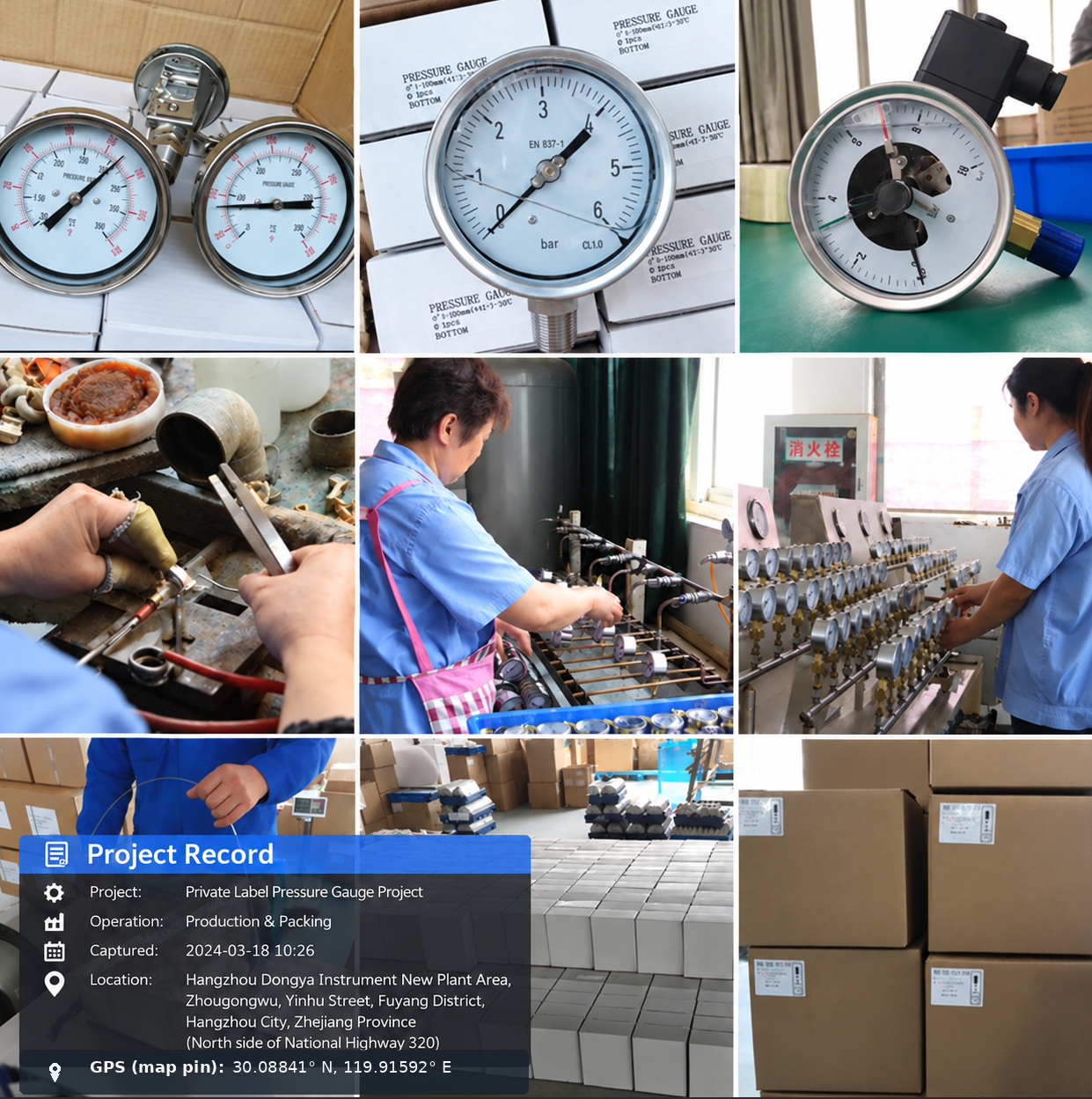
Our pressure-gauge process covered incoming-part checks, assembly inspection, finished appearance and zero-position checks, indication checks on rising and falling pressure, sealing checks and record retention. The custom dial and labels were checked against the signed proofs. Accepted gauges received the agreed packaging and product conformity documents, with an internal outgoing inspection record available for the customer’s receiving file.
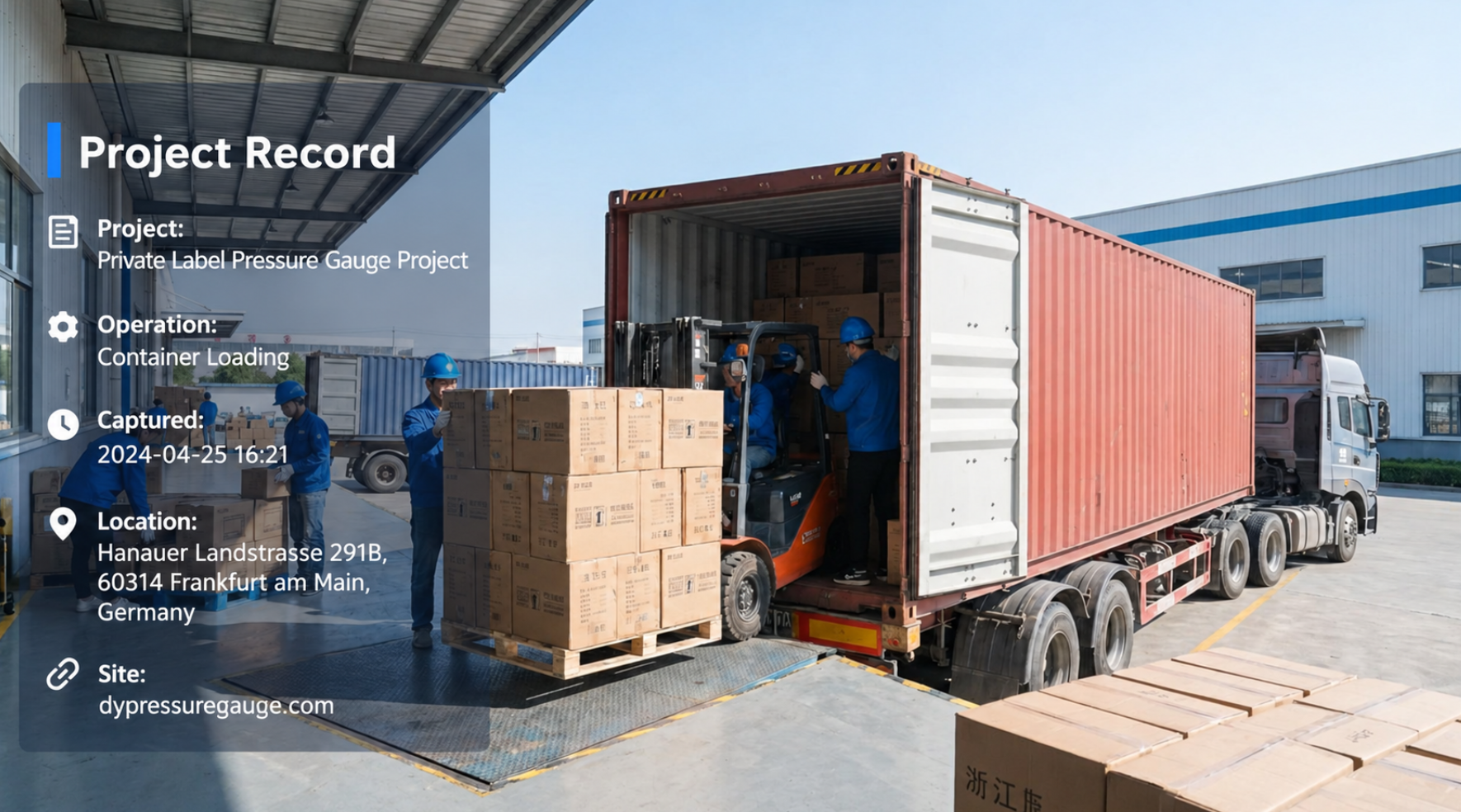
When the shipment arrived, the distributor used the approved sample pack to receive each SKU. It checked the ranges, connections, dial artwork and labels before putting the gauges into catalog stock. The first catalog release then had a fixed technical description and a matching replacement part for each item. The buyer could place a repeat order by referencing the approved SKU and drawing revision rather than rebuilding the specification from earlier emails.
What made the OEM program work
The useful outcome was a controlled product range, not a logo on an otherwise undefined gauge. Engineering had approved the physical configuration, marketing had approved the dial, the warehouse could recognize each carton, and purchasing had one revision-controlled specification for reorders. That alignment reduced the chance that a later batch would be the wrong thread, the wrong scale or the wrong branded item for a customer’s equipment.
For distributors planning a similar private-label program, the first decision is usually which few SKUs deserve a controlled launch. Range, connection, materials, accuracy, dial units, packaging and documentation should be agreed before sample approval. Price and lead time can then be quoted against a real specification instead of an ambiguous “100 mm pressure gauge” request.
Start a private-label pressure gauge order
Send us your intended applications, target ranges, dial sizes, connection drawings, material requirements, artwork, units, annual volume and document needs. We can review the product family and prepare an approval plan for your catalog. Explore our pressure gauge range or contact Dongya with your OEM brief.