 Dypressuregauge
What Does a Negative Gauge Pressure Mean? Real Examples
Simply put, negative gauge pressure occurs when the pressure in a closed system is lower than the external atmospheric pressure. In engineering we usually call this “partial vacuum”. If the gauge shows -3 psig, it means that the system internal pressure is 3 psi lower than the local atmospheric pressure.
Don’t take the sudden drop of negative gauge pressure lightly, thousands of centrifugal pumps and suction lines are scrapped every year. Many operators tend to take negative readings as a simple instrument calibration error, until the pump impeller is cavitation (Cavitation) smashed to pieces. Next, we need to break up the internal reaction after the pipeline pressure falls below zero and explain clearly: how to check these readings and why blind faith in ordinary pressure gauges in high altitude areas will directly destroy your equipment.
A.C.T. Pressure Law: Cracking The “Negative Pressure Zone” Puzzle
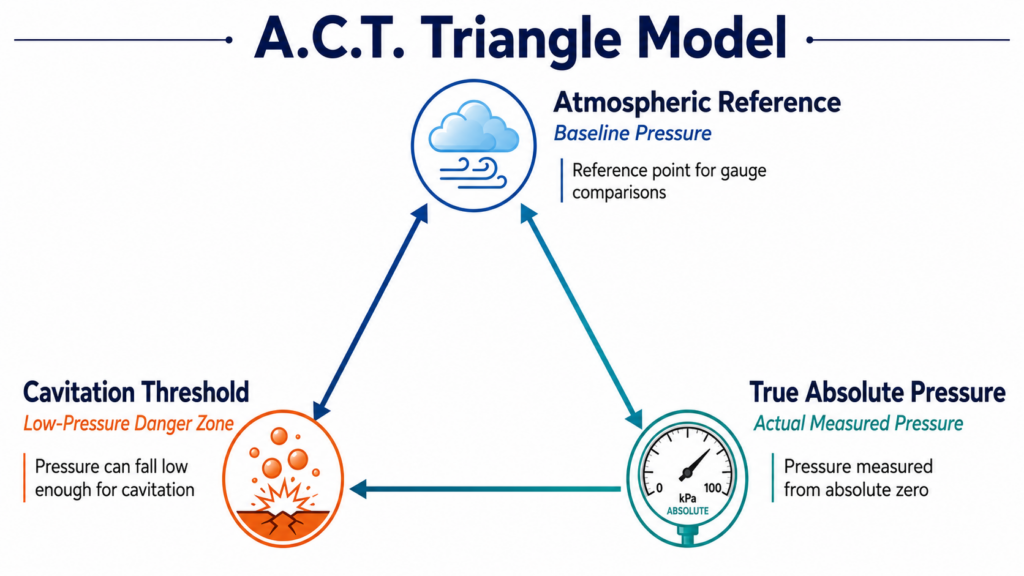
Engineers often stumble in diagnosing inhalation problems because they only stare at isolated negative numbers. The A.C.T. rule requires that you evaluate negative gauge pressure in 3 steps, in order: atmospheric reference (Atmospheric baseline), cavitation threshold (Cavitation threshold), and true absolute pressure (True absolute pressure). In a word, unless you know the exact atmospheric pressure in the current workshop, you should never trust that negative reading easily.
The atmospheric reference (A) determines your starting point (zero point). Whether at sea level (14.7 psia) or on a mountain several kilometers away (12.2 psia), a standard pressure gauge will point to 0 psig at room temperature and pressure. But reading -5 psig in Denver (at high altitude) is definitely closer to absolute vacuum than reading -5 psig in Miami (at sea level), and the hazard factor is not an order of magnitude at all. You must adjust the maintenance warning line according to the specific altitude of the factory.
The cavitation threshold (C) defines your “danger zone”. If the absolute pressure drops too low, the water will boil at room temperature. If the negative gauge pressure approaches the saturated vapor pressure of the fluid, a large number of bubbles will be generated in the system, and these bubbles will burst violently on the surface of the metal impeller, which is extremely destructive. For industrial pumps, accurately figuring out the negative pressure limit when a specific fluid is vaporized is the key to prevent the equipment from quickly folding its life.
The real absolute pressure (T) restores the physical truth. Add the local barometric pressure to the negative gauge pressure reading and you get the true absolute pressure (psia). This final data is the only hard indicator for you to accurately select a vacuum pump or program an IIoT (Industrial Internet of Things) smart sensor.
Negative Gauges In Industrial Systems: Three Real-World Scenarios
Standing in front of heavy equipment, what does the negative gauge look like when it is pressed to the bottom? Let’s look at a few specific scenes.
1. Centrifugal pump suction line (fatal cavitation trap)
The centrifugal pump can work normally, relying entirely on atmospheric pressure to “press” the liquid into the suction port. A negative gauge pressure on the suction line indicates that the pump is pumping against friction, gravity, or a closed valve. A healthy system typically displays a slight negative pressure of about -2 psig. However, if the reading suddenly drops to -8 psig, there is no doubt that the suction inlet filter screen is blocked, the isolation valve is not open, or the water supply tank has bottomed out. At this time, the pump is in a state of “starvation” and water shortage, which will produce a deeper vacuum, which will inevitably lead to the complete scrapping of the mechanical seal.
2. HVAC compressors and refrigerant recovery
The HVAC technician must rely on a negative gauge pressure to confirm that the entire system is completely sealed and free of any moisture inside before filling the refrigerant. They will use a vacuum pump to vacuum the copper tube until the pressure gauge pointer is deeply embedded in the negative area (for accuracy, it is usually measured in microns of mercury, approaching -14.7 psig). If the vacuum pump is turned off and the negative pressure slowly rises to zero, it means that the system is leaking.
3. Medical suction equipment and siphon
During the procedure, the hospital needs to use a controlled negative gauge pressure to clear the respiratory tract and drain the fluid. Wall regulators usually limit the negative pressure to a safe range, such as -1.5 to -3.0 psig(-80 to -150 mmHg). Exceeding this extreme value will directly damage human tissue. Such systems rely on a central centralized vacuum pump to maintain this constant negative pressure in the main pipeline.
Veteran Will Also Step On The Pit: Operators Often Encounter Three Major Mistakes
Misreading negative pressure data can destroy expensive equipment. Here are a few of the classic traps that field engineers see repeatedly.
Myth 1: Think standard equipment can draw a perfect vacuum of -14.7 psig.
In standard industrial piping, it is simply not realistic to achieve a perfect vacuum (-14.7 psig below sea level). If your digital transmitter shows exactly -14.7 psig or even lower, don’t hesitate, it must be that the sensor is broken, the line is broken, or the range scaling parameters in the PLC are written incorrectly.
Myth 2: Forget to calculate the proportion when calculating the lift.
Pumping up a high-density liquid requires a much greater negative gauge pressure than pumping water. The vacuum required to pump the sulfuric acid up 10 feet is much higher than pumping 10 feet of water. If the operator mechanically covers a water-based pressure gauge in a chemical application, the selected pump is absolutely too small to pump fluid at all.
Myth 3: High altitude can cause sensor readings to drift.
Some people feel that if the pressure gauge is sealed and calibrated well in a sea level environment, it will “extract wind” as soon as the instrument is taken to a high altitude area. For example, a sealed pressure gauge sent from a coastal factory may be pointed directly at the positive pressure position as soon as it is unboxed at a plateau factory. In this case, you must first deflate (relieve) the instrument so that it returns to zero at the actual local atmospheric pressure, and then the negative pressure data it measures will be trusted.
| Fluid Type (Approx. Specific Gravity) | Elevation | Max Theoretical Negative Gauge Pressure* | Required Vacuum for 10-ft Lift | Max Theoretical Lift Capacity |
| Water (SG: 1.0) | Sea Level | -14.7 psig | -4.33 psig | 33.9 ft |
| Water (SG: 1.0) | 5,000 ft | -12.2 psig | -4.33 psig | 28.2 ft |
| Oil (SG: ~0.85) | Sea Level | -14.7 psig | -3.68 psig | 39.9 ft |
| Oil (SG: ~0.85) | 5,000 ft | -12.2 psig | -3.68 psig | 33.1 ft |
| Acid / Sulfuric (SG: ~1.84) | Sea Level | -14.7 psig | -7.97 psig | 18.4 ft |
| Acid / Sulfuric (SG: ~1.84) | 5,000 ft | -12.2 psig | -7.97 psig | 15.3 ft |
Uncovering The -7 Psig Suction Pipe Failure “The Man Behind It”
In November 2023, an industrial sewage treatment plant encountered a difficult problem: the impeller of a 50-horsepower (HP) centrifugal pump in the plant kept breaking. The masters went to check the daily records of the SCADA system and found that when the pump was operating normally, the pressure on the suction side was always steadily maintained at -2 psig. But the evil thing is that every Tuesday afternoon, the pressure drops to -7 psig in an instant, and each time it lasts only a short 45 seconds.
The maintenance team replaced two water pumps in a row but was unable to completely break the roots. Finally, everyone realized what was happening and decided to review the subtle fluctuations in the sensor data that were easily overlooked.The result was a surprising discovery: this -7 psig pressure drop point hit the backwash program of the automatic filter in time and downstream with perfect fit.
It turned out that the backwashing operation would pump a large wave of water from the shared water supply tank, causing the tank level to plummet. This means that the centrifugal pump has to work harder to suck the water up 3 feet more. It is this extra head burden that forces the water absorption pressure directly into the dangerous negative pressure red line area, thus triggering the short-lived but extremely destructive vapor erosion phenomenon. After finding the root cause of the disease, the factory installed a frequency converter (VFD) in the equipment. Now, as soon as it enters the backwashing stage, the pump will drop the speed slightly. Since then, the negative gauge pressure has stabilized at -3 psig, and the centrifugal pump has not been on strike again.
Frequently Asked Questions (FAQ)
In plain language, what exactly is negative gauge pressure?
Simply put, it’s a pressure lower than the current atmospheric pressure around you. If a tube has negative gauge pressure inside, it becomes a “vacuum cleaner” that desperately tries to suck in outside air or liquid.
Can gauge pressure really be negative?
That’s of course. The gauge pressure itself is calculated with the local atmospheric pressure as “zero point”. As long as the actual pressure in the tube is lower than the current atmospheric pressure, the number read out on the pressure gauge is naturally negative.
What is the lowest negative gauge pressure?
At sea level, the absolute limit is about -14.7 psig (about -1.01 bar). This represents a perfect absolute vacuum in which all matter is evacuated. In reality, there can be no lower pressure than a perfect vacuum.
What is the relationship between gauge pressure and absolute pressure?
Absolute pressure = atmospheric gauge pressure. If atmospheric pressure is 14.7 psi and your gauge pressure is -5 psi, your absolute pressure is 9.7 psia. Note that absolute pressure can never be negative.
Why is negative gauge pressure dangerous for pumps?
A decrease in pressure will reduce the boiling point of the liquid. If the negative gauge pressure is dropped too much, the liquid in the pump will instantly boil and vaporize into bubbles. These bubbles will collapse violently inside the pump body, causing serious physical damage to the metal, which is called “cavitation”.
How do you measure negative gauge pressure?
Generally use vacuum gauge or joint pressure gauge (Compound gauge) to measure. The dial of the linked pressure gauge has both positive and negative numbers: positive pressure is read clockwise from zero and negative pressure is read counterclockwise (usually in inches of mercury inHg).