 Dypressuregauge
Why Are Pressure Gauges Filled With Glycerin? 5 Pros
Why should glycerin be added to the pressure gauge? More than just shockproof
Why should glycerin (glycerol) be filled in the pressure gauge? Simply put, it is for the purpose of earthquake resistance, lubricating the fragile internal gears, squeezing out oxygen and preventing corrosion, and preventing the dial from fogging by the way. With these physical blessing, the pressure gauge not only reads accurately in the harsh industrial environment, but also has a long life.
However, it is not enough to know “why you add glycerin. If it is used in the wrong place, it may cause the equipment to be completely scrapped and even cause spontaneous combustion. Today, I will thoroughly talk about the mechanical advantages of glycerin, share my personal summary of the “P.A.T. Selection Rule”, and take you to avoid the dark pits that cause 80% of the pressure gauges to be scrapped in advance.
5 Big Hard Core Advantages Of Glycerin Pressure Gauge
Engineers do not need to use dry pressure gauges. They have to choose liquid filling gauges, not to look advanced. The high viscosity of pure glycerin (or 99.5% aqueous solution) can bring mechanical advantages that dry watches cannot compare.
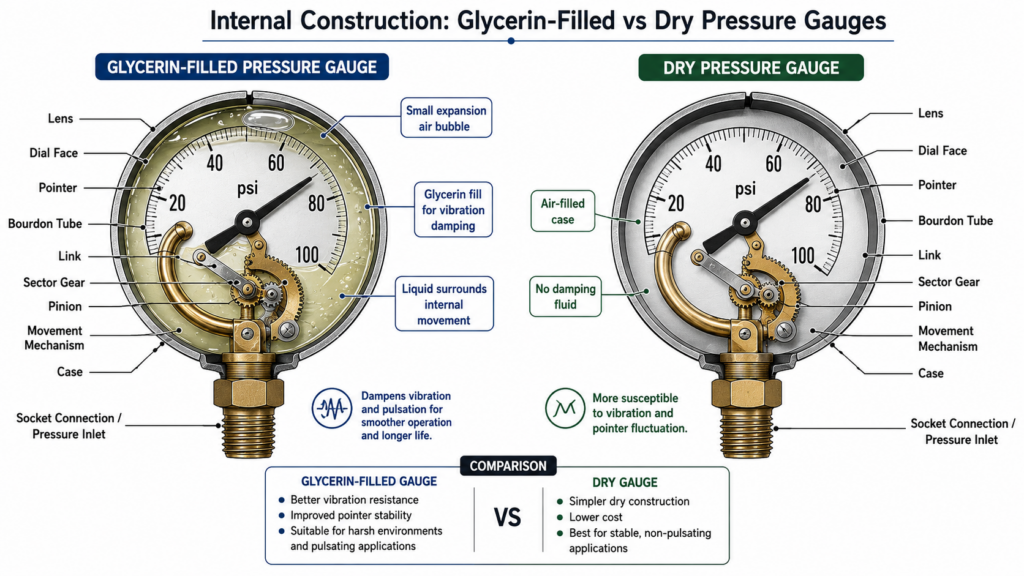
Hydraulic damping, completely say goodbye to pointer jumping
Glycerol absorbs instantaneous pressure spikes and high-frequency mechanical shocks. When you look at the hydraulic system of a heavy-duty pump or compressor, the pointer of the dry gauge often shakes like a sieve chaff and cannot read at all. The high viscosity of glycerin becomes a natural “shock absorber” at this time, which can firmly hold the Bunden tube and buffer gear transmission. In this way, the operator can see a stable and accurate reading at a glance, and no longer need to guess.
All-weather internal lubrication, double life
Glycerin will form a permanent lubricating film on the surface of all active metal parts inside the case. The dry watch was full of metal hard-hitting, shaking and shaking, the gears were soon smoothed, and the watch was scrapped directly. The sticky nature of glycerin can greatly reduce the friction between the sector gear and the central gear. In the case of high-frequency work, the life of the instrument can even be extended by two or three times.
Squeeze away oxygen to prevent internal organs from rusting
When the case is filled with liquid, it squeezes out all the air and the chemicals inside that are prone to reaction. In the factory, sulfur dioxide or moisture with salt is usually indispensable. Once these gases are drilled into the dry meter, the copper or stainless steel movement inside will suffer. Glycerin is like an airtight protective wall, completely isolating the delicate mechanical structure from the corrosive environment outside.
The dial in high humidity environment is definitely not fog
Glycerin fills the internal space, and the water vapor has nowhere to condense. In places where the temperature is hot and cold in the outdoor drilling platform or cold storage flushing area, dry watches often suck in humid air, and the inside of the watch glass is immediately pasted with a layer of white fog, which not only cannot see the scale clearly, but also accelerates rust. Because there is no air cavity inside the liquid filling surface, no matter how the dew point outside changes, the glass will always be clear and bright.
The choice of high cost performance under harsh working conditions
Compared with those expensive synthetic fluids, the shock absorption effect of glycerin is not bad at all, but the price is much more fragrant. Silicone oil or fluorine oil does have a wider range of temperature resistance and more stable chemical properties, but it is too expensive. For 80% of conventional industrial applications (operating temperature between -20°C and 60°C), glycerin is definitely the best balance between earthquake resistance and budget.
The “P.A.T.” Selection Triangle Of Insigneurs
There is a systematic method for selecting pressure gauges. After analyzing the failures of fluid systems for more than ten years, I summarized this P.A.T. selection rule. Before the next purchase order, you might as well go through these three points 1 your mind:
P-Pulsation Severity (pulsation severity): Look at the frequency of pressure fluctuations. If the pressure pulse exceeds 10 times per minute (such as reciprocating pump), it is not negotiable, and glycerin meter must be used for hydraulic shock absorption.
A – Ambient Temperature (ambient temperature): Find out where the meter is installed. Glycerin is perfect for indoor use, but if it is installed outdoors in winter, the glycerin will freeze into crystals. At this time, you must change to silicone oil.
T-Target Media Compatibility: Find out what chemicals are flowing through the tubes. Although the filling liquid does not normally come into contact with the measuring medium, the two will mix in the event of a Bunden tube rupture. Glycerin is safe when it comes to water, oil and air, but when it comes to strong oxidants, it’s the 1 disaster.
| Fluid Type | Pulsation Rating | Temp Range | Incompatible Media |
| Dry (No Fill) | Low (< 10 spikes/min) | Standard / Ambient | N/A (No fill fluid to mix) |
| Glycerin | High (> 10 spikes/min) | Indoors (Above Freezing) | Strong Oxidizers |
| Silicone | High (> 10 spikes/min) | Outdoors (Freezing Winters) | Strong Oxidizers |
| Halocarbon | High (> 10 spikes/min) | Broad / Standard | None (Safe for Strong Oxidizers) |
Expert Warning: Glycerin Table Absolutely Cannot Be Used In 3 Scenes
Most people who do purchasing know that the filling meter is good, but not many people know its physical limit. Put the glycerin watch in the wrong place, and the safety instrument becomes a ticking time bomb.
Explosion trap of strong oxidizer
Glycerol reacts violently 1 it meets strong oxidants. If you install a glycerin meter on a system that handles chlorine, nitric acid, or hydrogen peroxide, as long as a Bourdon tube has a leak with a large pinhole, the glycerin and the oxidant 1 mix, and a catastrophic exothermic reaction (direct explosion) will be triggered immediately. This occasion must be honest and practical inert fluorine oil.
The “syrup” effect of extreme cold
1 the temperature drops, glycerin will become particularly thick. Below -20°C, ordinary glycerin sticks like syrup and can even jam the action of the Bourdon tube. At this time, the pressure shown by the pressure gauge will be low, because the mechanical structure inside cannot push this thick layer of mucus. If the operator believes this false data, the 1 will accidentally overpressure the system. Extremely cold environment of the factory, must specify the use of silicone oil.
High temperature discoloration yellow
If glycerol is exposed to high temperatures above 60°C for a long time, it will degrade and become dark yellow or even dark brown. The time is 1 long, the liquid inside is turbid, and the scale cannot be seen clearly. Moreover, the high temperature will also make the liquid expand. If the rubber plug on the top of the watch does not have a pressure relief valve, the expanding liquid can fly the front glass top.
Real Case: How A Hydraulic Stamping Factory Saved More Than $40000 A Year
Say more theory, it is better to look at the account book. There is a factory that makes auto parts. They have 15 hydraulic presses, and the dry pressure gauges installed on them have to be replaced almost every 3 months.
Why is it broken so fast? The violent, high-frequency pressure spikes of the hydraulic system abruptly shattered the sector gears in the dry gauge. The repairman has to take 45 minutes to change the watch each time, not to mention the cost of 40 yuan per watch.
Later, I went to their factory to do an investigation and replaced all these watches with glycerin watches with built-in throttle screws.
Take a look at the data comparison:
Change the table before life: 3 months.
Life after changing glycerin meter: 38 months (currently in normal service).
The cost of equipment has plunged: the annual cost of buying a watch has fallen directly from $7200 to almost zero.
Labor is saved: maintenance workers snatch back more than 300 hours of watch change time every year, and now they are engaged in preventive maintenance of hydraulic systems.
Combined annual profit: Hardware costs plus labor efficiency translate into a total savings of $42,000.
So you see, hydraulic damping is not only an expense of buying accessories, it’s actually a solid investment in plant uptime.
FAQ
Can I add liquid to the glycerin pressure gauge myself?
Yes. Most filled meters have a rubber vent plug on top. You can pick it open and take a small funnel or syringe to add it. Remember to add 80% to 90% full, leaving a small bubble at the top to give some place for thermal expansion and cold contraction.
What is the difference between silicone oil table and sweet oil table?
The main thing is that the tolerance temperature is different. For normal environments (-20°C to 60°C), glycerin is industry standard. However, silicone oil can maintain a suitable viscosity in a wider and more extreme temperature range (-40°C to 60°C or even higher), so if it is extremely cold outdoor weather, silicone oil must be selected.
Why is there a bubble in my filling meter? Is it leaking?
The bubble was deliberately left. 1 the temperature rises, the liquid expands. This small air cavity is the buffer zone left for glycerin expansion. Otherwise, the internal pressure 1 and the front glass will burst.
Is it filled with glycerin, will it affect the accuracy of the pressure reading?
No, it won’t. The liquid just stays quietly in the case and does not run into the Bourdon tube to contact the process medium. It is purely for damping the pointer. The accuracy level of the glycerin meter (such as 1% or 1.5 full scale) is exactly the same as that of the dry meter, and because the pointer does not jump, the reading you can see with the naked eye is more accurate.
Can I use a liquid filling meter on the air compressor?
It’s so capable. The heavy-duty air compressor is particularly shaken, and the liquid-filled meter can absorb this mechanical vibration, which not only prolongs the service life of the meter, but also gives you a stable reading. For compressed air systems, glycerin is absolutely safe and easy to use.