 Dypressuregauge
What Is A Pressure Gauge Snubber & Why Use A Syphon?
A pressure gauge snubber is a mechanical restrictor fitting designed to absorb violent kinetic pressure spikes (pulsations) before they tear apart the internal gears of a gauge. A syphon is a coiled pipe fitting used in pressure gauges to create a physical water trap, actively blocking high-temperature live steam from entering and melting the gauge’s delicate Bourdon tube. Plant managers waste thousands of dollars annually replacing blown-out gauges simply because they bolt instruments directly to reciprocating pumps and steam headers. We will break down the exact kinetic and thermodynamic mechanics of these two mandatory protective accessories so you can permanently stop process leaks and instrument failures.
What Is a Pressure Gauge Snubber?
A snubber dampens the kinetic energy of fluid surges. When a reciprocating pump pushes fluid, it creates a high-frequency pressure wave. If this wave hits an unprotected gauge, the indicator needle flutters violently, rendering the dial unreadable and snapping the internal hairspring within weeks. The snubber sits between the process line and the gauge, forcing the violent pressure wave through a microscopic restriction. This slows the fluid velocity and smooths the kinetic shockwave into a steady, readable pressure curve.
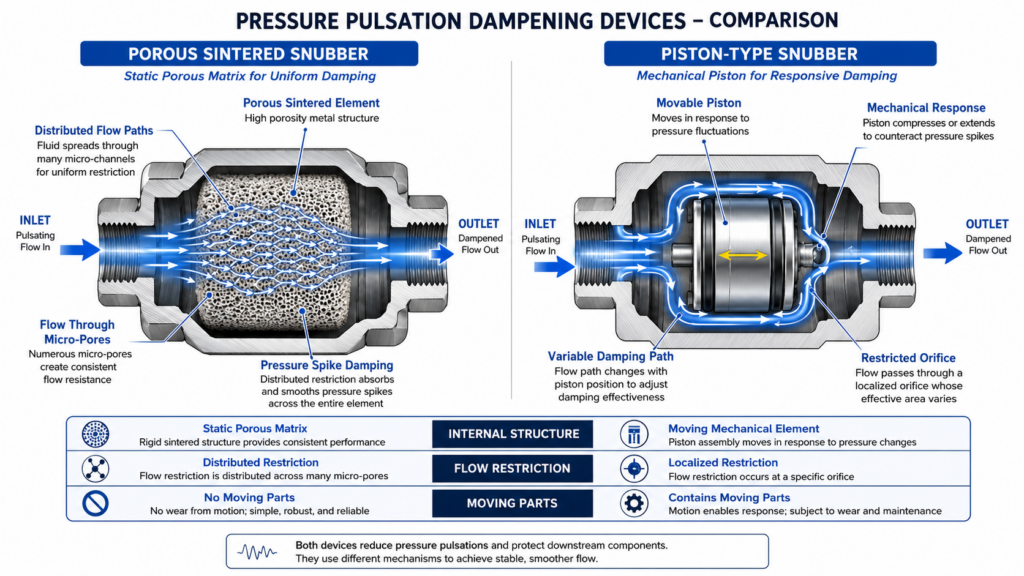
Sintered Metal Vs. Piston Snubbers
Engineers must match the snubber’s internal geometry to the fluid’s physical state.
A sintered metal snubber contains a porous metallic disc (often 316 stainless steel or bronze). The fluid forces its way through thousands of microscopic holes. Designers use sintered snubbers strictly for clean gases, light oils, and filtered water.
A piston snubber (or moving-piston snubber) features a tiny internal pin that moves up and down within a cylinder. The constant movement of the piston physically knocks away debris. Engineers mandate piston snubbers for heavy slurries, wastewater, and thick crude oil where a porous disc would instantly clog.
Why Syphon is Used in Pressure Gauge Applications
A syphon mechanically limits conductive and convective heat transfer. Standard pressure gauges utilize soft-soldered brass internals that melt at approximately 150°C (300°F). Industrial steam lines routinely exceed 250°C. A syphon forces the steam to travel through a looped geometry. The ambient air cools the loop, causing the steam to condense into liquid water. This trapped liquid water acts as an impenetrable thermal barrier. The hot steam pushes against the cold water plug, transferring the physical pressure accurately to the gauge without transferring the lethal heat.
Pigtail Vs. Coil (U-Type) Geometries
Piping orientation strictly dictates syphon geometry.
Technicians install Pigtail Syphons (which look like a looping pig’s tail) exclusively on vertical pipe taps. The loop traps the condensate perfectly when mounted upright.
Technicians install Coil Syphons (U-Type) on horizontal pipe taps. The U-shape ensures the water plug remains seated at the lowest gravitational point. Installing a pigtail syphon sideways on a horizontal pipe allows the water plug to drain back into the process line, instantly destroying the gauge.
| Accessory Type | Primary Threat Mitigated | Process Media | Installation Orientation | Typical Temp Limit |
| Pigtail Syphon | Conductive & convective heat transfer (prevents melting) | High-temperature live steam | Vertical pipe taps only | Routinely exceeds 250°C (482°F) |
| Coil (U-Type) Syphon | Conductive & convective heat transfer (prevents melting) | High-temperature live steam | Horizontal pipe taps only | Routinely exceeds 250°C (482°F) |
| Sintered Metal Snubber* | Violent kinetic pressure spikes (pulsations) | Clean gases, light oils, and filtered water | Any (Not strictly orientation dependent) | Standard gauge limits (60°C – 100°C) |
| Piston Snubber* | Violent kinetic pressure spikes (pulsations) | Heavy slurries, wastewater, and thick crude oil | Any (Not strictly orientation dependent) | Standard gauge limits (60°C – 100°C) |
The S-T-M Accessory Matrix: An Engineer’s Framework
Guessing which accessory to use leads to rapid mechanical failure. The S-T-M (Shock, Temperature, Media) Matrix provides a strict diagnostic sequence for instrument protection.
Step 1: Analyze Shock (S)
Identify the pump type driving the fluid. Centrifugal pumps produce smooth, continuous flow and rarely require snubbers unless located immediately at the discharge nozzle. Reciprocating pumps, diaphragm pumps, and hydraulic stamping presses generate severe kinetic spikes. You must install a snubber on these systems.
Step 2: Analyze Temperature (T)
Check the maximum continuous operating temperature of the process fluid. If the fluid exceeds the gauge manufacturer’s wetted-part rating (typically 60°C to 100°C for standard models), you must install a cooling accessory. Use a syphon for condensable hot gases like steam. Use a capillary line or cooling tower accessory for hot non-condensable liquids like thermal transfer oils.
Step 3: Analyze Media Viscosity (M)
Evaluate fluid cleanliness and viscosity before buying a restrictor. Snubbers have tiny orifices. Syphons feature narrow 1/4″ or 1/2″ internal diameters. Pumping high-viscosity asphalt or crystallizing resins into either of these accessories will create a permanent concrete-like blockage. For thick media, abandon snubbers and syphons entirely and specify a flush-diaphragm seal instead.
Expert Pitfalls: 2 Installation Mistakes Destroying Gauges
Field failure data proves that buying the right accessory means nothing if the installation violates physical thermodynamics.
The Dry Startup Steam Trap
Starting a steam system with an empty, dry syphon destroys the pressure gauge on day one. A syphon requires time to build its protective water plug. During initial plant startup, live steam rushes entirely through the empty loop and hits the gauge before any condensation occurs. Technicians must manually pre-fill the syphon loop with water before threading the pressure gauge onto the assembly.
The Over-Torqued Sintered Disc
Mechanics often crush sintered metal snubbers by overtightening the NPT threads. The porous metal disc sits near the base of the thread. Applying excessive torque with a pipe wrench distorts the housing and fractures the sintered disc, causing metallic shrapnel to blow directly into the Bourdon tube. Technicians must use the manufacturer’s specified torque values and apply thread sealant tape, never raw mechanical force, to seal the joint.
Real-World Data: Boiler Feed Pump Case Study
A recent failure analysis at a 50MW biomass power plant highlights the absolute necessity of combining both accessories. The plant’s boiler feed pump exposed a direct-mounted 316SS gauge to 350°C steam and 60 Hz hydraulic pulsations.
Scenario A (No Protection): The gauge experienced catastrophic Bourdon tube rupture in 14 days due to combined thermal fatigue and mechanical wear.
Scenario B (Pigtail Syphon + Piston Snubber): Plant engineers installed a pre-filled pigtail syphon to drop the instrument-facing temperature to 85°C, followed by a stainless steel piston snubber to flatline the 60 Hz pulsation. The replacement gauge maintained 1% accuracy for 36 months without drift.
People Also Ask (FAQs)
Can I Use A Pressure Gauge Snubber For Air?
Yes. You should use a fine-grade sintered metal snubber for compressed air and pneumatic systems. The porous disc easily allows clean air to pass while blocking sudden compressor surges.
Do I Need A Syphon For Hot Water?
Not necessarily. Syphons are designed primarily for condensable vapors like steam. For hot liquid water, the water will simply fill the syphon and stay hot, offering minimal convective cooling. For extremely hot liquids, a cooling tower (finned siphon) or a long capillary tube is required to dissipate heat.
What Is The Difference Between A Snubber And A Needle Valve?
A snubber provides fixed, passive flow restriction specifically calibrated for dampening pulses. A needle valve is an adjustable, active isolation valve. While technicians sometimes partially close a needle valve to “choke” the flow and mimic a snubber, this practice causes severe valve seat erosion.
How Do You Clean A Clogged Pressure Gauge Snubber?
You can clean a porous snubber by reversing the flow direction with a high-pressure clean solvent or using an ultrasonic cleaner. However, if a sintered snubber clogs with hardened resin or heavy particulate, you must discard and replace it.
Can A Syphon Act As A Snubber?
No. A syphon provides zero kinetic dampening. The coiled pipe simply redirects fluid to trap condensed liquid for thermal protection. If your steam line also suffers from violent pump pulsations, you must stack a snubber on top of the syphon.
Which Direction Should A Pigtail Syphon Face?
The loop of the pigtail must sit completely vertical. This ensures gravity holds the condensed water plug at the bottom of the loop, preventing live steam from bypassing the water barrier.