 Dypressuregauge
Bourdon Tube vs Diaphragm Pressure Gauge: Top Traits
A Bourdon tube pressure gauge relies on a flattened, coiled metal tube that physically uncoils under internal fluid pressure to drive a dial pointer. A diaphragm pressure gauge uses a flexible, corrugated metal or elastomeric membrane that deflects upward under pressure, keeping the process fluid completely isolated from the upper mechanical linkages. Process engineers destroy thousands of Bourdon tubes annually by mistakenly exposing them to viscous slurries or crystallizing fluids that harden inside the tube’s dead-end. You must match the gauge’s internal physical geometry directly to your fluid’s chemical state to prevent catastrophic instrument blowouts and toxic plant spills.
What Is A Bourdon Tube Pressure Gauge?
A Bourdon tube gauge functions exclusively as a dead-ended pressure measurement cavity. The fluid physically enters the C-shaped, helical, or spiral metal tube. As pressure increases, the cross-section of the tube attempts to become circular, causing the entire coil to straighten slightly. This micro-movement transfers through a gear sector to the indicator needle.
Designers specify Bourdon tubes strictly for clean, non-viscous liquids and gases. Air compressors, hydraulic power units, and clean water pipelines utilize Bourdon gauges because they offer extreme accuracy (up to 0.1% full scale) at a fraction of the cost of specialty gauges. You cannot use a Bourdon tube for any fluid that contains suspended solids, as the debris will pack into the closed end of the tube, permanently blinding the sensor.
| Gauge Type | Working Principle | Wetted Parts Exposure | Best For | Overpressure Tolerance |
| Bourdon Tube Pressure Gauge | Fluid enters a C-shaped, helical, or spiral metal tube. Pressure causes the coil to straighten slightly, driving a gear sector and needle. | Fluid physically enters a dead-ended measurement cavity. | Clean, non-viscous liquids and gases (e.g., air, clean water, hydraulics). | Low (Ruptures violently if exposed to severe overpressure). |
| Diaphragm Pressure Gauge | Fluid pushes against a flexible corrugated membrane. The membrane deflects upward, pushing a drive rod connected to the dial gears. | Process fluid is completely isolated from the gauge body and mechanisms. | Viscous slurries, crystallizing fluids, and harsh chemicals. | High (Membrane flattens safely against rigid upper housing during pressure spikes). |
What Is Diaphragm Pressure Gauge?
A diaphragm pressure gauge completely separates the measuring mechanism from the process media. The fluid pushes against the bottom side of a corrugated membrane. The membrane flexes, pushing a drive rod connected to the dial gears. The process fluid never enters the gauge body itself.
Chemical plants and wastewater facilities deploy diaphragm gauges to handle aggressive, sludgy, or crystallizing media. Manufacturers can coat the wetted side of the diaphragm with PTFE (Teflon), Hastelloy, or Monel to resist severe acids. An open-flange process connection ensures thick fluids like asphalt or paper pulp flow continuously across the membrane surface without getting trapped.
The M-C-S Selection Pyramid: An Engineer’s Framework
Procurement errors occur when buyers prioritize cost over mechanical suitability. The M-C-S (Media-Clogging-Safety) Pyramid provides a strict, sequential decision matrix for specifying pressure instruments.
Base Level: Media Compatibility
Corrosive fluids instantly eliminate standard Bourdon tubes. A standard Bourdon socket uses brass or 316 stainless steel. If your process involves hydrochloric acid, it will eat through a stainless Bourdon tube in days. Diaphragm gauges solve this by offering exotic alloy foils (like Tantalum) or polymer linings specifically on the lower wetted housing, saving the expense of building the entire gauge out of an exotic metal.
Middle Level: Clogging Risk
Fluid viscosity dictates the geometric requirement of the sensor. Bourdon tubes contain a restrictive entry port and a blind ending. Fluids like heavy oil, wastewater sludge, or resins will enter the tube, cool down, and solidify. The diaphragm gauge, specifically equipped with a flush-mounted flange, presents a flat face to the fluid. The moving slurry wipes the membrane clean continuously, eliminating any risk of plugging.
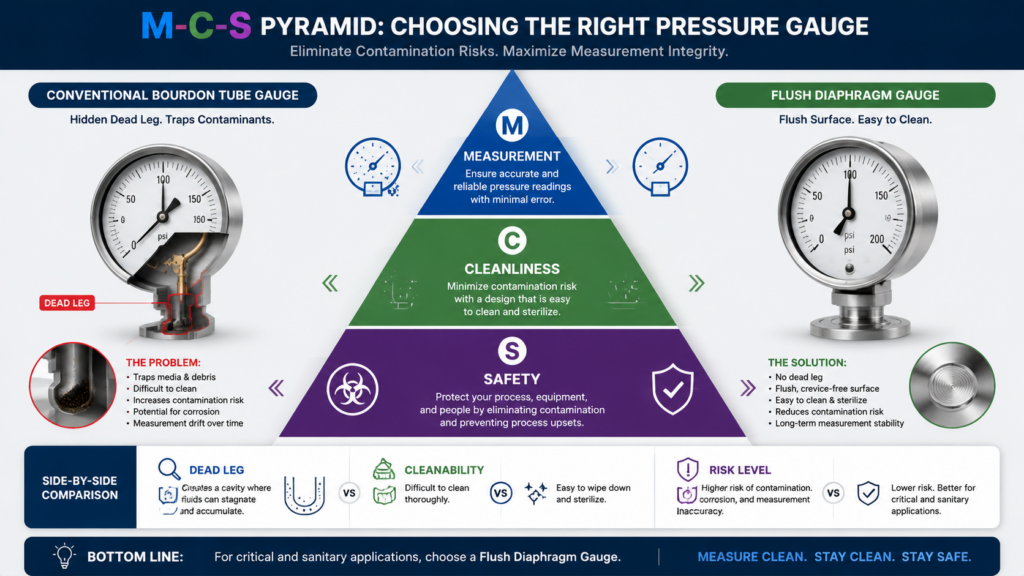
Top Level: Safety and Overpressure limits
System pressure spikes blow out gauges lacking mechanical stops. A Bourdon tube ruptures violently if exposed to severe overpressure (typically exceeding 130% of its scale), launching shrapnel and spraying hazardous fluid. A diaphragm gauge features an upper housing precisely machined to match the membrane’s contour. If pressure spikes to 400% of the maximum scale, the diaphragm simply flattens safely against the rigid upper housing, preventing a blowout.
Expert Pitfalls: Why Process Gauges Fail In The Field
Field failure data points directly to specific installation oversights. Instrument technicians repeatedly ignore thermodynamic and physical boundaries when mounting gauges to active pipes.
The Bourdon “Dead Leg” Freezing Trap
Outdoor water lines destroy Bourdon tubes every winter. The fluid trapped inside the C-tube acts as a stagnant dead leg. Even if the main pipeline flows continuously to prevent freezing, the water static inside the Bourdon tube will freeze, expand, and split the metal open. Engineers must install diaphragm gauges or use chemical seal assemblies filled with anti-freeze silicone oil to protect sensors in sub-zero outdoor environments.
The Capillary Fill-Fluid Expansion Error
Diaphragm gauges often use a sealed capillary fluid (like glycerin) to transfer the membrane’s deflection to the dial mechanism. Direct sunlight or extreme process heat forces this internal fill fluid to thermally expand. This expansion pushes against the internal gears, creating a false positive pressure reading (temperature drift). Technicians must specify temperature compensators or high-temperature fill fluids like Syltherm when installing diaphragm systems on hot steam lines or unshaded desert pipelines.
Industry Trends: Dual-Membrane IoT Diagnostics
Modern chemical processing demands predictive leak detection. Manufacturers now produce “smart” diaphragm gauges equipped with a dual-membrane system and a vacuum interstitial space. If the primary process-facing diaphragm suffers a micro-tear from abrasive slurry, the gauge does not leak chemical into the environment. Instead, an edge-computing pressure transmitter detects the vacuum drop between the two membranes and immediately sends an alert via WirelessHART to the control room, allowing operators to replace the gauge before a catastrophic breach occurs.
People Also Ask (FAQs)
Can a Bourdon tube gauge measure negative pressure (vacuum)?
Yes. When exposed to a vacuum, the C-shaped Bourdon tube contracts and curls inward tightly. The internal gearing reverses this movement to drive the needle counter-clockwise on a compound or vacuum dial.
Why are diaphragm gauges more expensive than Bourdon tube gauges?
Diaphragm gauges require complex machining for the corrugated membrane, upper and lower housings, and specialized welding for exotic metal coatings (like Hastelloy or PTFE). Bourdon tubes rely on simple, mass-produced extruded metal coils.
What is a flush diaphragm pressure gauge?
A flush diaphragm gauge eliminates the threaded entry port. The flexible membrane sits completely flush with the pipe wall or tank surface. Food, beverage, and pharmaceutical industries strictly use flush diaphragms to eliminate crevices where bacteria can grow.
How do you protect a Bourdon tube from steam?
You must install a pigtail siphon (a coiled pipe) between the steam line and the gauge. The coil traps condensed water. The high-temperature steam pushes against this water plug, isolating the delicate soldered joints inside the Bourdon tube from melting.
Does gauge orientation affect a diaphragm pressure gauge?
Yes, particularly if the diaphragm assembly involves a heavy fluid-filled capillary tube. Mounting the gauge dial significantly higher or lower than the diaphragm seal introduces a liquid column “head pressure” error, requiring a factory zero-adjustment to compensate for the fluid’s weight.
What causes a diaphragm pressure gauge to fail?
Punctures from sharp solid particulates, chemical incompatibility eating through the membrane foil, or severe temperature extremes degrading the internal fill fluid cause the majority of diaphragm gauge failures.