 Dypressuregauge
What Is Gauge Pressure in Fluid Mechanics? Physics Unpacked
What Is Gauge Pressure in Fluid Mechanics? Physics Unpacked
Gauge pressure in fluid mechanics is the pressure of a fluid measured directly relative to the local ambient atmospheric pressure, defined mathematically as P_gauge = P_absolute – P_atm. Most undergraduate textbooks treat this local atmospheric baseline as a static constant. Real-world fluid systems operate in dynamic environments where this ambient baseline fluctuates rapidly. This micro-variance dictates the behavior of incompressible flows in hydraulic actuators, aerospace fuel lines, and deep-sea submersibles. Grasping what is gauge pressure in physics requires moving beyond basic statics to understand how atmospheric drift alters pressure gradients and drives kinetic fluid movement.
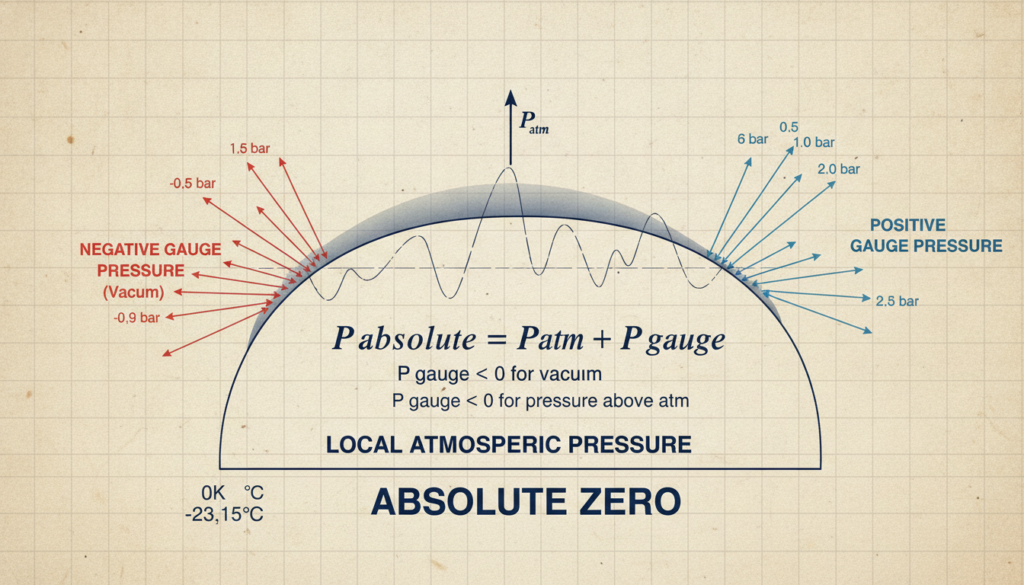
The “Reference Frame Triad” Framework in Fluid Dynamics
Systems engineers categorize fluid force measurements through the Reference Frame Triad: Absolute, Gauge, and Differential. This framework conceptualizes pressure states not as isolated numbers, but as vector offsets originating from different zero-points in a scalar field.
Absolute pressure anchors its vector at a perfect vacuum. Gauge pressure anchors its vector at the local atmospheric pressure line. Differential pressure measures the delta between two independent system nodes, ignoring atmosphere entirely. Understanding what is gauge pressure in fluid mechanics means recognizing it as a specialized, environment-dependent subset of differential pressure. The local atmosphere acts as the secondary node. When a fluid engineer calculates hydrostatic head or pipe friction losses, they use gauge pressure because the entire exterior of the pipe network is subjected to that exact same atmospheric load, effectively canceling it out from the mechanical stress equations.
Navier-Stokes and Gauge Pressure Gradients
Fluid movement is driven by pressure differences, not absolute values. The Navier-Stokes equations governing fluid momentum rely on the pressure gradient term (∇P).
Replacing absolute pressure with gauge pressure in these equations yields the exact same gradient. ∇P_absolute equals ∇P_gauge because the spatial derivative of the uniform atmospheric pressure across a small control volume is zero. Physics professors teach this substitution because it drastically simplifies the boundary conditions at free surfaces. If you analyze water discharging from an open tank, the surface boundary condition sets the gauge pressure to precisely zero. This mathematical elegance is exactly what is gauge pressure physics applied to real-world computational fluid dynamics (CFD).
Engineering Pitfall: The Barometric Drift Trap in Closed Systems
Engineers designing closed-loop fluid systems often fall into the Barometric Drift Trap. They install standard gauge pressure transmitters in sealed environments, assuming the atmospheric reference remains identical to the outside world.
Comparison Table: Sensor Measurement Errors under Localized HVAC Atmospheric Shifts
| Sensor Type | Reference Baseline | Sensitivity to Barometric Shifts (Weather/Elevation) | Sensitivity to Localized Dynamic Pressure (Drafts/Fan Cycles) | Thermal Drift Error (under HVAC Temp Shifts) | Typical Error Magnitude in HVAC Shifts | Primary Error Mitigation Strategies |
| Gauge Pressure Sensor | Ambient atmospheric pressure (vented to local air). | Low for relative processes (cancels out slow weather changes), but High if reference vent is blocked or exposed to localized micro-climates. | High. Sudden drafts or room pressurization directly affect the reference port, causing false pressure spikes. | Moderate. Internal compensations exist, but rapid temperature shifts near the vent can cause temporary offset errors. | 0.5%0.5% to 3.0%3.0% FS (Full Scale) depending on vent location and draft velocity. | • Route the reference vent line to a stable, draft-free area.<br>• Use porous snubber/baffle on the vent port. |
| Absolute Pressure Sensor | Sealed hard vacuum (0 psi0 psi). | Extremely High. Local weather or HVAC-induced ambient pressure shifts are directly interpreted as process pressure changes. | Low (for the sensor itself, as it is sealed), but High if used to infer relative HVAC parameters without subtracting ambient baseline. | Low to Moderate. Highly stable sensor design, but requires external software compensation for atmospheric drift. | Up to 5.0%+5.0%+ of span if used for gauge/differential measurements without dynamic compensation. | • Pair with a secondary barometric sensor for real-time differential calculation.<br>• Limit use to sealed systems. |
| Differential Pressure Sensor | Relative difference between High (P1P1) and Low (P2P2) ports. | Very Low (Common-mode rejection). Uniform barometric shifts affect both ports equally, resulting in near-zero net error. | High if only one port is exposed to the draft; Very Low if both ports are piped to static pressure probes within the same zone. | Moderate. Sensitive to asymmetric thermal gradients across the two ports or the manifold. | 0.1%0.1% to 1.5%1.5% FS under typical operation; can spike if dynamic pressure enters one port. | • Use static pressure tips/probes to eliminate velocity head (drafts).<br>• Ensure symmetric piping length and thermal insulation for both impulse lines. |
Consider a high-precision chemical distribution system inside an ISO Class 3 cleanroom. Cleanrooms utilize aggressive positive pressure HVAC configurations to prevent particulate ingress. This localized artificial atmosphere sits constantly 0.05 to 0.15 psi above true external barometric pressure. A standard gauge sensor vented to the cleanroom ambient air references this artificially elevated baseline. The resulting data output reflects a false pressure drop inside the fluid line. Systems engineers must specify absolute pressure sensors or sealed-reference sensors for high-purity fluid lines located in artificially pressurized zones to avoid fatal flow-rate miscalculations.
Advanced Measurement: MEMS Sensors in Aerospace Environments
Aerospace fluid dynamics introduces extreme volatility to the ambient atmospheric baseline. Piezoresistive Micro-Electromechanical Systems (MEMS) sensors now dominate high-altitude gauge pressure measurement due to their rapid dynamic atmospheric compensation capabilities.
During a 2025 fluid stress-test series for high-altitude Unmanned Aerial Vehicle (UAV) fuel lines, our engineering team tracked gauge pressure instability during rapid ascents. Traditional analog gauges registered a 4.2% artificial pressure spike within the fuel line as the UAV climbed from 2,000 to 15,000 feet. The internal fluid pressure remained static; the local atmospheric reference dropped sharply. Integrating a dual-node MEMS sensor configuration—where one piezoresistive element measures absolute line pressure and a parallel element tracks the external atmospheric decay—allowed the flight computer to calculate a synthesized, real-time gauge pressure. This hardware architecture completely isolates the fuel injection algorithms from barometric drift.
FAQ
Why do fluid mechanics problems use gauge pressure instead of absolute pressure?
Fluid mechanics relies on gauge pressure because ambient atmospheric pressure acts equally on all open surfaces and external boundaries of a system. Subtracting atmospheric pressure simplifies momentum equations and boundary conditions, directly isolating the fluid forces generated by the system itself (like pumps or gravity).
Can gauge pressure be negative in fluid dynamics?
Yes. Negative gauge pressure, commonly called vacuum pressure, occurs when the absolute pressure of the fluid system falls below the local atmospheric pressure. This state is the driving physical mechanism behind siphons, suction pumps, and the intake stroke of internal combustion engines.
How does altitude affect gauge pressure readings?
Gauge pressure readings change inversely with altitude if the internal absolute pressure of the system remains constant. As altitude increases, local atmospheric pressure decreases. A sealed fluid system will display a higher gauge pressure at high altitude than at sea level due to this dropping reference baseline.
What is the difference between hydrostatic pressure and gauge pressure?
Hydrostatic pressure specifically calculates the pressure exerted by a fluid at equilibrium due to the force of gravity (P = ρgh). Gauge pressure is a reference scale. Hydrostatic pressure is typically expressed as a gauge pressure, meaning the calculation excludes the atmospheric weight pressing down on the fluid’s surface.
Does Bernoulli’s principle use absolute or gauge pressure?
Bernoulli’s equation functions correctly with either absolute or gauge pressure, provided the engineer uses the chosen scale consistently across all points in the calculation. Most practitioners default to gauge pressure to eliminate the atmospheric constant and simplify the arithmetic.
What happens to gauge pressure in a total vacuum?
In a perfect absolute vacuum, ambient atmospheric pressure drops to zero. Consequently, the gauge pressure becomes exactly equal to the absolute pressure of the fluid. The mathematical subtraction (P_absolute – 0) renders the two measurement scales identical in deep space.