 Dypressuregauge
What Is Gauge Pressure? See What It Actually Measures
What is gauge pressure? See what it measures
The gauge pressure (Gauge pressure) measures the pressure of a closed system relative to the local ambient atmospheric pressure. If the gauge pressure reads zero, it means that the pressure inside the system is exactly the same as the air pressure outside. Just because they didn’t understand this simple baseline difference, many technicians bought the wrong meter. The next content will sort out for you: how the fluctuation of atmospheric pressure will affect the safety of the pipeline, and how to select the most matching equipment for your factory.
Core Definition: What Is Gauge Pressure Measuring?
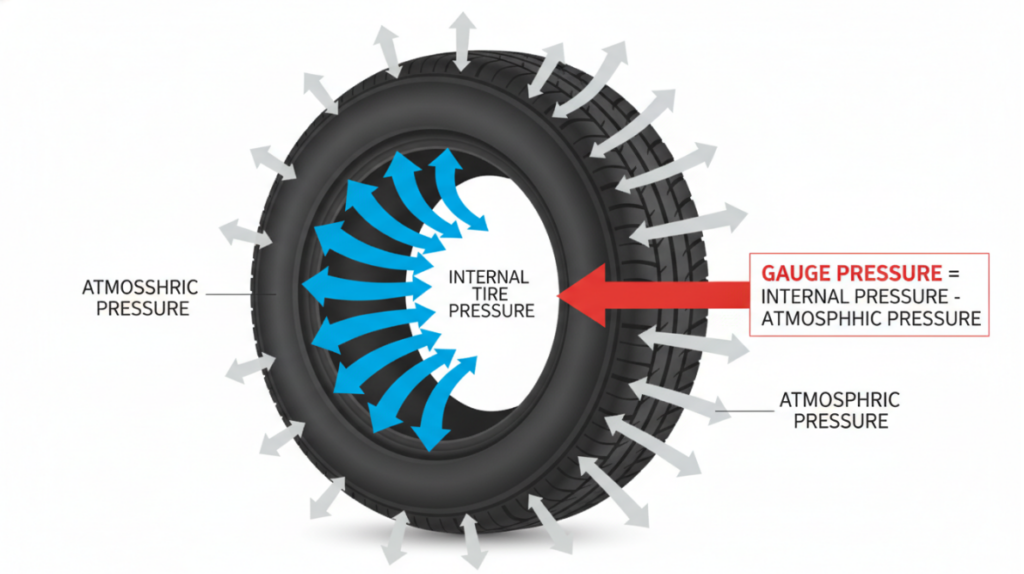
Simply put, the gauge pressure reflects the actual mechanical stress on the inner wall of the container, which completely eliminates the “bottom noise” of the weight of the earth’s atmosphere. When outside air acts directly on your process, you should look at this indicator. For example, if the tire pressure gauge of your tire shows 32 PSIG (pounds per square inch gauge pressure), it means that the force of the air in the tire is 32 PSI greater than the force of the air outside.
Engineers dealing with open tank level measurement, air compressor regulation, or daily hydraulic systems rely primarily on gauge pressure (usually with the letter “g”, such as psig or barg). The sensor subtracts the current absolute pressure from the total pressure in the container by mechanical or digital means, and the calculated pressure is the gauge pressure. With this data, we can prevent the process tank from being broken when delivering high-pressure fluid.
“Zero Reference Triangle” Thinking Model
The key to understanding the various pressure types is to find out where their exact “zero” is. You can sort them out using the “zero reference triangle” model:
Vacuum reference (absolute pressure-Absolute Pressure): The starting point for this measurement is complete vacuum (absolute zero). It is usually used for leak testing and scientific weather monitoring.
Weather reference (gauge pressure-Gauge Pressure): The zero point of this measurement is the current local atmospheric pressure. It is used in our daily industrial pipelines and automobile tires.
Process reference (differential pressure-Differential Pressure): The zero point of this pressure is established on the basis of another connected system. This is used, for example, when measuring the flow rate through a filter.
The purchasing manager can take this triangular model to avoid setting the wrong specifications. If your system is discharged into the open air, you need to choose the weather reference (gauge pressure); if the system is completely closed and isolated from the outside air, you have to choose the vacuum reference (absolute pressure). not affected by changes in the outside air, what you need is the vacuum reference (absolute pressure).
| Pressure Type | Zero Reference Point | Common Industrial Application |
| Absolute Pressure | Perfect vacuum (absolute zero pressure) | Barometric pressure monitoring, aeronautics, vacuum packaging, and scientific laboratory equipment. |
| Gauge Pressure | Local atmospheric pressure (ambient pressure) | Tire pressure measurement, HVAC systems, air compressors, and general pipe/tank pressure monitoring. |
| Differential Pressure | Another specific pressure point (difference between two points) | Flow rate measurement (e.g., across an orifice plate), filter health monitoring, and liquid level measurement in sealed tanks. |
| Vacuum Pressure | Local atmospheric pressure (measures pressure below atmosphere) | Vacuum distillation, freeze drying, leak testing, and vacuum suction/material handling systems. |
Absolute Pressure And Gauge Pressure: Calculate A Mathematical Account.
The conversion formula between these two indicators is fixed: gauge pressure = absolute pressure-atmospheric pressure. In other words, the total internal force, minus the downward pressure caused by the local weather, is the gauge pressure.
The standard atmospheric pressure at sea level is about 14.7 PSI(1 bar). If the absolute pressure of a system is maintained at 50 PSI, then at sea level, its gauge pressure reading is 35.3 PSIG. However, tianqi111 changes are changing this baseline every day. If 1 is a severe low-pressure storm that causes the local atmospheric pressure to plummet, even if the absolute pressure inside the device does not move, your gauge pressure reading will jump up 1 slightly.
Expert Procurement Guide: Avoiding The “Altitude Trap”
If you choose the wrong subdivision type, standard gauge pressure transmitters can easily fall off the chain at high altitudes. Purchasing teams often ignore the distinction between “vented gauge pressure” and “sealed gauge pressure”, 1 accidentally stepping into the “altitude trap”.
The ventilation and pressure gauge device has a small breathing tube that allows the diaphragm of the sensor to directly contact the real air around it. The sealed gauge pressure equipment is in the factory, directly behind the diaphragm sealed a small 1 of 14.7 PSI of air. Just imagine, if you take a sealed gauge pressure sensor made in Miami (sea level) factory and move it to a high-altitude factory in Denver (the ambient air pressure is only about 12.1 PSI), the measurement data will go wrong directly. As soon as the sensor is unpacked, there will be an error of about 2.6 PSI, because the mass of reference air sealed inside is not in line with the local environment. Therefore, be sure to check the altitude and specify the ventilation gauge pressure equipment when applying across the sea.
Measured Data: Simulated Bunden Tube VS Ventilation MEMS Sensor
Once the traditional analog Bourdon tube pressure gauge encounters mechanical vibration, the performance is extremely fast. Our engineering team conducted a 24-month pressure test on a pump pipeline with 60Hz vibration, and put a traditional analog meter and a digital ventilation micro-electromechanical system (MEMS) pressure transmitter together for real comparison.
The data prove that the simulation table really should be updated. Due to the mechanical fatigue of the metal, those simulated Bunden tubes drifted 12% at zero after 14 months of use. On the other hand, the vented MEMS sensor, relying on its own environmental compensation algorithm, has stabilized the benchmark accuracy at 99.8 percent for 24 months. For those pipes that have been vibrating with harmonics, factories really need to consider replacing old analog meters with digital MEMS devices.
Frequently Asked Questions (FAQ)
Can gauge pressure be negative?
Yes. A negative gauge pressure indicates a degree of vacuum within the system relative to the local atmosphere. If the air pressure inside the suction pump is lower than the air pressure in the room, the gauge pressure will show a negative value (for example, -5 PSIG).
What happens to gauge pressure in space?
The gauge pressure is based on the ambient air as a reference point. Space has zero ambient pressure (a complete vacuum). So in space, the values of gauge pressure and absolute pressure are exactly the same.
Why do we mainly use gauge pressure instead of absolute pressure?
Engineers prefer gauge pressure, mainly because most industrial vessels and pipes, including biological systems (such as human blood pressure), are in the earth’s atmosphere. How much stress the tank wall bears depends entirely on the difference between the force propped up inside and the force squeezed inside outside.
How to calibrate a gauge pressure sensor?
The calibration process is not complicated: the port of the sensor is completely exposed to the open room air. Without applying any process pressure, let it contact the natural environment, and then reset the reading of the equipment to zero at the mechanical or digital level.
What is the difference between PSIA and PSIG?
PSIA stands for “pounds per square inch absolute” (Absolute) and refers to absolute vacuum. PSIG stands for “pounds per square inch gauge” (Gauge) and refers to the local air pressure. When looking at the value, pay attention to the last letter so that you can know which baseline it uses.