 Dypressuregauge
What Is Bar in Pressure Gauge Readings? Pro Advice
The “bar” on the pressure gauge is the metric unit of pressure, which is exactly equal to 100,000 Pascals, which is roughly equivalent to the atmospheric pressure (14.5038 psi) at the earth’s sea level. When you look at the bar scale on the pressure gauge, what you see is the actual force exerted by the liquid or gas inside the system relative to the external environment. But to be honest, memorizing this textbook definition alone does not prevent you from buying the wrong instrument or even frying a hydraulic line on the first day of work.
The real difficulty lies in: how to distinguish between gauge pressure and absolute pressure? How to choose the right dial range to maximize mechanical life? And how to predict system failure by reading small numerical fluctuations? Today, let’s disassemble, in the end how to look at industrial applications, how to choose, how to optimize the bar as the unit of pressure gauge.
Core Definition: What Does The Bar On The Pressure Gauge Mean?
Outside of North America, bar is the internationally accepted standard for industrial fluid power and pneumatic systems. The reason why equipment manufacturers like to use bar is that it is very close to atmospheric pressure (1 atm = 1.01325 bar), which makes engineers very intuitive when doing mental calculations.
For example, a standard 10 bar air compressor, its working pressure is about 10 times the normal atmospheric pressure. Mechanical equipment in Europe and Asia usually defaults to metric threads (such as BSPP) and bar-based readings. These machines are equipped with pressure gauges with a bar scale to ensure a perfect match with the original factory instructions and safety valve settings. If you insist on manually converting psi into bar in the workshop, it is easy to accidentally trigger the safety pressure relief mechanism if you are not careful.
The Trap Of “Barg” And “Bara”: A Nightmare For The Procurement Staff
When buying a meter, the most expensive mistake is not figuring out whether you need a “Barg” or a “Bara”. Barg (gauge pressure, Bar Gauge) measures the pressure relative to the ambient atmospheric pressure; while Bara (absolute pressure, Bar Absolute) is the pressure relative to the absolute vacuum.
The vast majority of standard mechanical pressure gauges on the market display Barg. Suppose your factory is at sea level, and a Barg pressure gauge that has not been piped up reads 0 bar. However, in the case of an uninstalled Bara pressure gauge, the reading will be 1 bar. If you buy an absolute pressure sensor for a compressed air pipeline that needs to see the gauge pressure, your PLC (programmable logic controller) system will have a permanent error of 1 bar out of thin air. It is this kind of low-level mistake that will not only mess up the timing of the cylinder, but also directly turn the quality control compliance record into waste paper.
| Feature / Criteria | Barg (Bar Gauge) | Bara (Bar Absolute) |
| Full Name | Bar Gauge | Bar Absolute |
| Zero Reference Point | Ambient atmospheric pressure | A perfect vacuum |
| Reading when Uninstalled (at sea level) | 0 bar | 1 bar |
| Typical Applications | Air compressors, standard pneumatic cylinders, standard factory hydraulic systems | Vacuum pumps, atmospheric pressure monitoring, leak testing systems |
| Typical Procurement Mistake | Not applicable (usually the default standard) | Purchasing a Bara sensor for a system (like a compressed air line) that requires Barg parameters. |
| Consequence of Mistake | Not applicable | Introduces a permanent 1-bar offset into the PLC, which ruins pneumatic cylinder timing and invalidates quality control compliance records. |
P.A.R. Selection Matrix: How To Determine The Appropriate Bar Range
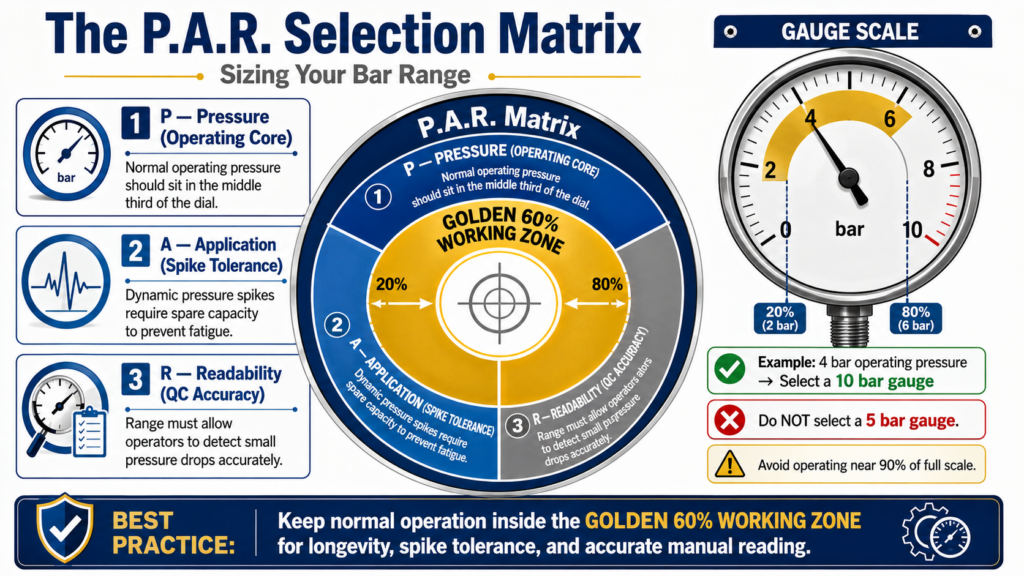
If you pick a pressure gauge whose maximum range is exactly equal to the working pressure of the system, it is almost a death sentence for premature mechanical failure of the instrument. Apply the P.A.R.(pressure-application-readability, Pressure-Application-Readability) matrix to find the most suitable range.
- Pressure (core working area): The daily working pressure of the system must fall firmly in the middle 1/3 area of the total scale of the dial. Assuming your pump is running at 4 bar, don’t buy a 5 bar watch, honestly buy a 10 bar watch.
- Application (Impact Margin): Dynamic systems like hydraulic presses often have water hammer effects. If a meter is working at 90% of the maximum rated pressure for a long time, the Borden tube inside will fatigue and damage within a few months. The “60% rule” is the secret to ensuring the life of the instrument.
- Readability (quality control accuracy control): there is a limit to the recognition ability of human eyes. if the scale is too dense and too fine, it cannot be seen at all. For example, if your quality control standard is to monitor the pressure drop of 0.2 bar, but the purchase has to be equipped with a 100 bar super-large range dial, the slight change is like a hair on the dial. After the visual space is extremely compressed, it is simply unrealistic for front-line workers to rely on the naked eye to accurately read meters.
Numbers And Indicators: The Significance Of Capturing Subtle Fluctuations
Now, the intelligent digital pressure gauge, which can keenly capture the tiny fluctuation of 0.01 bar, has long become the standard weapon for “predictive maintenance” in factories. Recall that before using the traditional mechanical pointer table, often have to wait until the equipment completely strike, resulting in serious failure, the dial will slowly show a large area of pressure loss.
Today’s digital pressure transmitters can continuously push real-time bar readings to the monitoring background. Take a closed hydraulic circuit as an example. If you find that the system has been dropping pressure inexplicably for 48 hours-even if it is only 0.05 bar-this often implies a hidden danger: either the O-ring inside has broken a microhole invisible to the naked eye, or the seal of the pump is aging.
Once this sign is noticed, the mechanic can arrange the shutdown and maintenance for the weekend and spend 20 to 3 yuan to buy a new sealing ring. This is better than delaying until the morning peak on Tuesday, watching the equipment suddenly crash and throwing it in for nothing. The loss of 20,000 US dollars is much better.
Actual Combat Case: The Yield Of Pneumatic System Is Increased By 15%, Which Depends On This Small Detail.
In fact, sometimes as long as the range of the instrument is reduced a little bit, the accuracy of quality control can be immediately raised to a higher level.
In 2024, when an engineer went to a secondary supplier of auto parts in Germany to do an on-site audit, he found a particularly typical old problem: the pneumatic clamp system in the workshop requires extremely high precision, and the actual working pressure is only 2.5 bar, but what the workers stare at every day is actually a “large range meter” of 0-16 bar “.
The fatal injury of the dial span is that even if the system leaks 0.3 bar of gas, the operator cannot see any movement of the pointer with the naked eye. This directly leads to insufficient clamping force of the fixture. Even if there is only a slight alignment deviation during CNC machining, the rejection rate cannot be reduced.
Later, the factory decided to dismantle all these old watches with too large span and replace them with 0-4 bar high-precision small watches. The effect of this 1 is immediate-as long as the pressure falls a little, the technician can see through it at a glance. The rejection rate of the workshop in the current quarter was directly cut by 15%.
By The Way, A Few Small Doubts (FAQ)
What is the difference between Bar and PSI on the pressure gauge?
Answer: Bar (bar) is the metric unit of pressure. It can be said to be the most popular “universal language” in the global industrial circle. The value is similar to a standard atmospheric pressure. PSI (pounds per square inch) is an imperial unit, which is basically used by the United States. If you have a number in mind, 1 bar is roughly equivalent to 14.5 PSI.
Is that 1 bar exactly equal to a standard atmospheric pressure?
Answer: If measured at sea level, the exact value of standard atmospheric pressure is 1.01325 bar. However, when we work in the workshop, we usually estimate that in order to save trouble, we directly use 1 bar as an atmospheric pressure, which is absolutely enough in the actual production site.
Why does my pressure gauge point to 0 when it is not connected to the tube?
Because the standard industrial pressure gauge measures “gauge pressure (Barg)”. When they are calibrated at the factory, they are set to ignore the 1 bar atmospheric pressure that presses on us every day. It measures only the part that comes out more than the current ambient pressure.
How do I pick the maximum range (Bar) for my device?
Multiply your system’s daily work pressure by 1.5 to 2. If the equipment runs steadily at 6 bar at ordinary times, install a meter with a maximum scale of 10 or 12 bar, which can protect the internal Bourdon tube from the impact of pressure spikes.
As long as the Bar number is right, can a water pressure meter be used to measure air pressure?
Absolutely not. Even if the value of bar is the same, the material of the parts contacting the medium inside the instrument can be different. Brass or specific alloys are often used to measure the inside and inside of the liquid, but if it encounters harsh gas or chemical pipelines, no matter how much pressure, stainless steel must be used to prevent corrosion.
What does it mean that the pressure gauge shows a negative number?
Negative bar means vacuum state. That is, the pressure inside the system is lower than the ambient atmospheric pressure outside the instrument. The usual reading range of the vacuum gauge is from 0 to -1 bar.