 Dypressuregauge
What Should The Water Pressure Gauge Read? Ideal Range
In general, a standard residential water pressure gauge should read between 40 and 60 PSI, with 50 PSI being ideal for most homes. It must be remembered that the piping specification is very strict, and the water pressure in the home must not exceed 80 PSI, otherwise there is a risk of pipe explosion at any time. On the contrary, if it is lower than 30 PSI, not only is bathing like dripping water, but also the wading appliances in the home will not move.
When you wonder whether your water pressure is normal, don’t think you can rest easy by measuring 50 PSI in the afternoon. This “one-off” test in broad daylight will often fool you. At 2 o’clock in the morning, everyone is sleeping, and the water consumption of the municipal pipe network plummets. At this time, there will be a hidden and fierce “water pressure peak”. This undercurrent will quietly destroy your water heater and pipe connections while you are asleep.
| Status | Pressure Reading | Symptoms & Consequences |
|---|---|---|
| Low Pressure | Under 40 PSI | Results in weak shower flow and dysfunctional household appliances. |
| Ideal Range | 40-60 PSI | The optimal baseline for most homes (50 PSI target). Ensures safe operation. |
| Danger Zone | 80+ PSI | Catastrophic pipe failures; silent overnight spikes destroy water heaters and pipe joints. |
The “Iron Triangle” Of Hydraulic Diagnosis: A 3-Step Test Method For Old Plumbers
To get the most accurate diagnostic results, you have to measure the water pressure of the pipeline system in three different states. Experienced plumbers usually use a set of “water pressure diagnostic iron triangles”: peak, static and dynamic tests. If you just stare at one of the data, you will definitely miss the faulty pressure reducing valve (PRV) or the expansion tank that has long been flooded and failed.
Static water pressure (basic value for backing)
This measures the pure pressure generated when the entire pipeline system is completely closed and the water flow is stationary. The test method is simple: screw the pressure gauge to the outdoor faucet or the water pipe connection of the washing machine, and make sure that there is no water in the house. If the pointer is steady and stops right in the middle of 40 to 60 PSI, then there is no problem. If the static reading is directly over 80 PSI, don’t hesitate, your pressure relief valve has been completely scrapped, quickly replace it.
Dynamic water pressure (flow state test)
Dynamic water pressure looks at the actual working force when the system is releasing water. Leave the plumbometer on the outdoor faucet and don’t move, then go inside and turn on the bathtub faucet or shower. At this time, the watch needle will definitely fall down. For a healthy plumbing system, the water pressure drops at most 5 to 10 PSI. However, if the sudden drop of 20 PSI or more, it means that the friction loss in the pipeline is extremely serious, either there is a hidden blockage inside, or the main water pipe is fouled too much, blocking the water flow.
Peak water pressure in the morning (“lazy needle” test method)
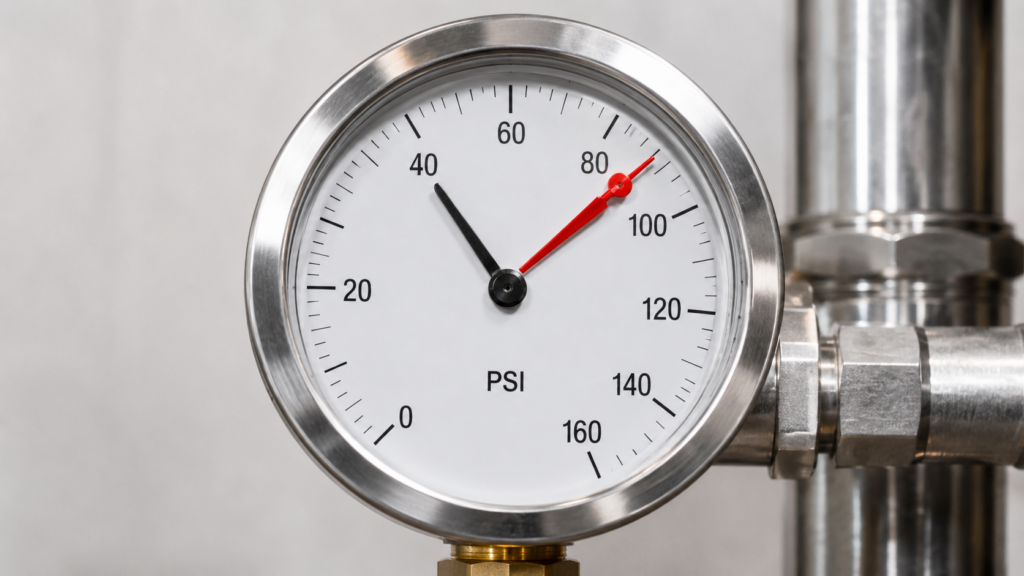
In the middle of the night, the entire community almost no water, municipal water pressure will soar. To catch these ghost-like fluctuations in water pressure, you have to buy a water pressure gauge with a red “lazy needle” (the highest pressure indicator needle). Connect it to the faucet, turn on the water, zero the red needle, and let it stay there overnight. You may still see a normal 55 PSI during the day, but the red needle often reveals the truth mercilessly the next morning: at 3 a.m., the water pressure rushed all the way to 105 PSI.
‘Thermal Expansion Trap’: Your Water Gauge May Be Lying
If you ‘ve just finished 1 a big hot bath, or run to check the water pressure just after using the dishwasher, the frighteningly high numbers on the watch are absolutely bluffing. When cold water flows into the water heater and is heated, it expands in volume. Because the current residential pipes are all “closed-loop” systems (equipped with one-way valves to prevent water from flowing back to the municipal pipe network), this part of the expanded hot water has nowhere to go. This physical reaction will temporarily push the pressure in the pipeline to 90 or even 100 PSI.
Many homeowners panicked 1 looking at this figure and foolishly spent money to replace the pressure relief valve that was actually intact. The correct approach is: after someone in the family has used up a lot of hot water, wait at least two hours before testing. Or, before measuring the static water pressure, open the cold water for 10 seconds to release the excess pressure in the pipeline, so that the interference of thermal expansion can be perfectly avoided.
Well Pumps VS Municipal Water: How To Look At Different Readings
The municipal pipe network gives constant water pressure, but the well pump system used for drilling wells is different. It is controlled by relay switches, and the water pressure circulates in bursts. If you use your own well and want to know how much water pressure is normal, you have to look at the specific “cut-in” and “cut-out” settings of your pressure switch.
When the water is released, the needle of the well water system will run back and forth between the two fixed numbers. Most domestic well pumps use a 40/60 cycle: when the pressure drops to 40 PSI, the pump starts; when the pressure reaches 60 PSI, the pump stops. Some older systems or shallow wells may use a 30/50 switch. As long as the needle slides smoothly between these two settings and there is no crazy jumping, your water pressure gauge will be fine. If the needle rebounds and jumps as fast as the exhaust (called “short cycle” in the industry), it proves that your pressure tank has leaked air and lost its pressure stabilizing effect.
How To Adjust The Pressure Reducing Valve (PRV) According To The Reading?
Adjusting the pressure reducing valve is a delicate job, which requires small adjustments, otherwise it is easy to explode the rubber diaphragm inside or burst the water pipe joint instantly. First find the bell-shaped brass valve where the main water pipe enters the house. Use a wrench to loosen the lock nut on the top of the valve. Connect the hydrometer to the faucet in the back and place it where you can see it, or find a helper to keep an eye on it.
Turn the adjusting bolt clockwise, the water pressure becomes larger; turn counterclockwise, the water pressure becomes smaller. Remember, only make a maximum of 1/4 turns (90 degrees) at a time. After each turn, turn on the faucet for five seconds to drain the water from the pipe, turn it off, and then see how much the static pressure on the meter has changed. When the needle reaches 55 PSI, lock the top nut again.
Intelligent Monitor VS Mechanical Watch: New Standard In The Industry
The mechanical water pressure gauge has a big flaw-you only know the data when you go to the yard to see it yourself. This results in your home being unprepared for abnormal water pressure 99% of the time. Smart plumbing monitoring systems like Moen Flo or Phyn Plus can now analyze water pressure, flow and water temperature in the home in real time at a frequency of 240 times per second.
These devices are installed directly on the main water pipe and send real-time PSI data to your mobile phone. Even if the water pipe in your wall breaks a hole as big as a needle, resulting in an extremely slight drop in water pressure, the smart valve can immediately detect it and automatically cut off the main water valve before the house is flooded. The old-fashioned manual water pressure gauge is still an artifact for plumbers to troubleshoot, but for modern families, the intelligent monitor installed in the pipeline is the real 24-hour patron saint.
FAQ
How high is the water pressure dangerous?
Any static water pressure over 80 PSI is a direct violation of plumbing codes and is a ticking time bomb for your house “. Under such high pressure for a long time, the hose of the washing machine will be damaged, the toilet inlet valve will fail, and the temperature and pressure release valve (T & P) of your water heater will not be able to carry it and will leak water all the time.
Why does the water pressure gauge drop to zero as soon as I turn on the tap?
1 the drain gauge needle will return to zero, indicating that there is a serious blockage in the main water pipe. The most common reasons include: the old galvanized water pipe is too thick to block the road, the main water valve is not fully opened, or the pressure reducing valve is completely broken, and the internal parts are stuck to block the water flow.
Water pressure gauge broken will lead to low water pressure at home?
No, it won’t. To put it bluntly, the water pressure gauge is a “ruler”. It has no ability to change the water flow or the water pressure. If you think the water flow is small, the problem lies in the pressure reducing valve, the bubbler is blocked, the hidden pipe is leaking or the municipal water supply pipe itself, which has nothing to do with the measurement table.
If there is no outdoor faucet at home, how to measure the water pressure?
The table can be connected to the threaded interface on the back of the washing machine. First, turn off the cold water valve at the back of the washing machine, unscrew the water inlet hose, screw the water pressure gauge directly onto the cold water faucet of the washing machine, and then open the valve to successfully measure the pressure inside the pipeline.
Why does the water pressure gauge of my well pump show 0 PSI, but the faucet still has water?
The high probability is that the small inlet hole at the bottom of the water pressure gauge is blocked by rust, sediment or scale. The pressure switch of the well pump is still working normally according to the real water pressure in the pipeline, supplying water to the home, but the water pressure gauge itself has been blocked and the data cannot be measured. Unscrew the watch, find a wire to poke the hole through, or simply spend some money on a new watch.