 Dypressuregauge
What Is Gauge Pressure? Starter’S Guide To Machine Operation
Gauge pressure is the measure of pressure relative to the local atmospheric pressure, meaning a standard gauge reads zero when open to the surrounding ambient air. Understanding this measurement prevents incorrect readings that can cause machinery damage, uneven espresso extraction, or air line leaks in workshop equipment. If you operate an air compressor, a commercial coffee brewer, or a hydraulic system, ignoring how surrounding air pressure alters your gauge readings will lead to system failures.
What is Gauge Pressure? The Direct Definition
Understanding Gauge Pressure in Simple Terms
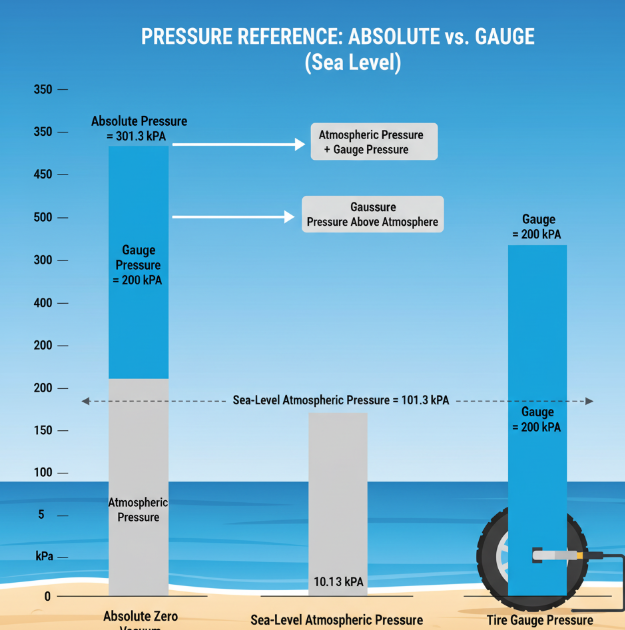
Gauge pressure measures the force exerted by a fluid or gas within a closed system, excluding the pressure of the atmosphere pressing down on the outside of that system. The ambient atmosphere exerts a constant force on everything around us, which is approximately 14.7 psi (1.013 bar) at sea level. Because a standard pressure gauge uses this ambient pressure as its reference baseline, it reads zero when it is disconnected and sitting on your workbench.
Gauge Pressure vs. Absolute Pressure: Key Distinctions
Absolute pressure accounts for both atmospheric pressure and the additional pressure inside your equipment. If you need to understand the true physical force inside a vacuum chamber, you must use absolute pressure, which measures from a reference of absolute zero (a perfect vacuum). Conversely, gauge pressure is the practical standard for most industrial machinery because devices like pipe networks and storage tanks only experience stress from the pressure difference between their internal fluids and the outside air.
Comparison table between Gauge Pressure
| Feature | Gauge Pressure (psig / barg) | Absolute Pressure (psia / bara) |
| Definition | Pressure relative to the ambient atmospheric pressure | Pressure relative to an absolute vacuum (zero pressure) |
| Reference Point | Atmospheric pressure (varies with location and weather) | Absolute vacuum |
| Units | psig (pounds per square inch gauge), barg (bar gauge), kPaG (kilopascal gauge) | psia (pounds per square inch absolute), bara (bar absolute), kPaA (kilopascal absolute) |
| Reading Range | Can be positive, negative, or zero | Always a positive value |
| Relation to Atmospheric Pressure | Gauge Pressure = Absolute Pressure – Atmospheric Pressure | Absolute Pressure = Gauge Pressure + Atmospheric Pressure |
| Common Applications | Tire pressure, tank pressure, pipeline pressure, general industrial measurements | Scientific research, vacuum systems, aerospace, meteorology |
| Influencing Factors | Affected by ambient atmospheric pressure; readings vary with altitude or weather | Not affected by ambient atmospheric pressure |
How to Find Gauge Pressure: The Mathematical Formula & Operational Steps
The Standard Equation Explained
Calculating gauge pressure requires subtracting local atmospheric pressure from the total absolute pressure of the system. The fundamental relationship is expressed through a straightforward linear formula:
Pg=Pabs−PatmPg=Pabs−PatmWhere:
PgPgis the gauge pressure (often expressed in psig or barg).PabsPabsis the absolute pressure (psia or bara).PatmPatmis the local ambient atmospheric pressure (typically 14.7 psi or 1.013 bar at sea level).
Step-by-Step Calculation Guide for Operators
Determining gauge pressure in a field environment involves finding your local atmospheric pressure and reading your absolute pressure sensor. Follow this three-step protocol to calculate the exact gauge pressure in your system:
- Identify the Local Atmospheric Pressure (
PatmPatm): Use a barometer to measure the local ambient air pressure, or assume standard sea-level pressure (14.7 psi / 1.013 bar) if you are operating at sea level. - Read the Absolute Pressure (
PabsPabs): Obtain the absolute pressure value from your system’s digital absolute transducer. - Subtract the Ambient Pressure from the Absolute Pressure: Apply the formula to find your final gauge pressure reading.
For example, if an industrial gas tank sensor registers an absolute pressure of 50 psia at sea level, your gauge pressure is:
Why Your Pressure Gauge Might Lie: The Altitude and Temperature Trap
How Altitude Alters Your Gauge Readings
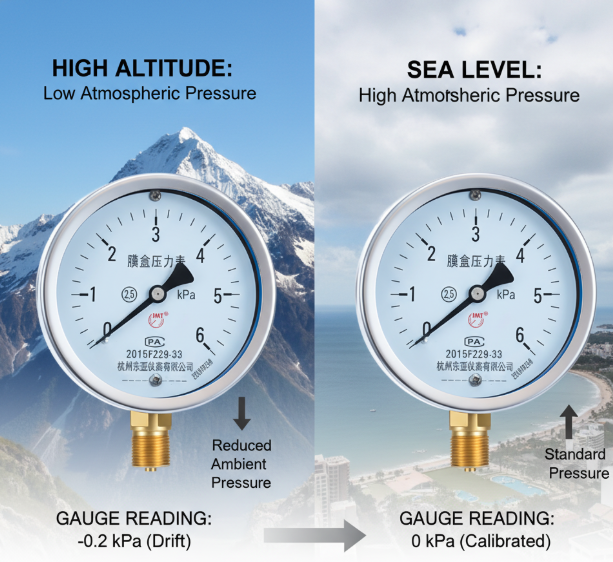
Higher elevations naturally decrease the weight of the atmosphere, which directly shifts standard mechanical pressure gauge readings. When you transport an uncalibrated pressure gauge from a coastal city at sea level to a high-altitude facility, the gauge will read higher than zero even when completely vented to the atmosphere. This happens because the lower outside air pressure exerts less force on the internal mechanical elements, distorting the relative measurement.
The Bourdon Tube Hysteresis (Why Gauges Fail to Zero)
Mechanical dial gauges rely on an internal, curved brass or stainless steel tube called a Bourdon tube that flexes as internal pressure changes. Exceeding the maximum pressure limit of your gauge even once can permanently stretch this internal metal tube beyond its elastic limit. This mechanical deformation, known as hysteresis, prevents the needle from returning to zero, rendering all future pressure readings highly inaccurate.
Industry-Specific Applications: Gauge Pressure in Daily Machinery
HVAC and Refrigeration Systems
Refrigeration systems rely on gauge pressure measurements to monitor phase changes within closed loop copper lines. Technicians connect manifold gauges to determine if refrigerant gases are properly compressed or if a leak has introduced atmospheric air into the lines. Because refrigeration cycle calculations depend on relative pressure differentials to drive the expansion valves, gauge pressure is the primary metric used during daily maintenance.
Commercial Espresso Machines (The 9-Bar Extraction Rule)
Espresso machines require a precise gauge pressure of 9 bar (approximately 130 psi) to force hot water evenly through finely ground coffee. If the extraction pressure gauge drops below 8 bar, the water will channel through the coffee grounds too quickly, resulting in a weak, sour shot. Operators must monitor the brew pressure gauge during active extraction to ensure the rotary pump is maintaining consistent mechanical force.
“ShiPing ChaRu” (Insert Video: How to adjust the rotary pump pressure on a commercial espresso machine)
Workshop Air Compressors
Air compressors utilize automatic pressure switches tied to a tank’s gauge pressure to determine when to cycle the motor on and off. A standard workshop compressor might be set to cut in when the gauge drops to 90 psig and cut out when it reaches 120 psig. If the pressure gauge fails or drifts, the motor may run continuously, causing the safety relief valve to open or risking catastrophic tank failure.
Diagnostic Checklist: How to Calibrate and Troubleshoot a Pressure Gauge
Maintaining accurate equipment requires systematic testing and calibration of your analog pressure indicators. Use this operational checklist when you suspect your gauge readings are drifted or incorrect
Frequently Asked Questions (FAQ)
Is gauge pressure always positive?
No, gauge pressure can be negative when the pressure inside a system is lower than the surrounding atmosphere. This negative reading represents a vacuum, where the internal force is pulling inward relative to the outside environment.
What is the difference between gauge pressure and absolute pressure?
The fundamental difference lies in their reference points. Gauge pressure uses local atmospheric pressure as zero, whereas absolute pressure uses a perfect vacuum (absolute zero) as its starting reference.
What does a pressure gauge read at standard atmospheric pressure?
A standard pressure gauge reads exactly zero when exposed to open atmospheric air. This occurs because the pressure on the inside of the gauge mechanism is equal to the atmospheric pressure pushing on the outside of the gauge.
Why does altitude affect gauge pressure?
Altitude changes the density and weight of the ambient air, which reduces atmospheric pressure at higher elevations. Because a gauge compares internal system pressure to this ambient air, a lower atmospheric pressure causes the gauge to read higher than it would at sea level.
Can you convert gauge pressure to absolute pressure without a barometer?
You can approximate the conversion by using the standard atmospheric pressure value of 14.7 psi (1.013 bar). However, this approximation will introduce errors if your equipment is operating at high elevations or during extreme weather systems.
The prev: Manómetro de BourdonThe next: What Does A Supply Pressure Gauge Do & Show? [2026 Guide]