 Dypressuregauge
What Does A Supply Pressure Gauge Do & Show? [2026 Guide]
Published on: May 24, 2026
A supply pressure gauge measures and displays the raw, unregulated fluid pressure entering a gas regulator directly from the storage source, such as a high-pressure cylinder or bulk manifold system [1.1]. Mistaking this inlet reading for your downstream process pressure—or failing to anticipate the rising outlet pressure spike as this gauge drops—leads directly to compromised gas purity, ruined experimental runs, or hazardous overpressurization. Understanding the exact readings of this gauge prevents process interruptions and ensures early detection of regulator failure before a safety incident occurs.
](https://www.dypressuregauge.com/wp-content/uploads/2026/05/pasted-image-20260524-031652-743-1024x562.png)
What is a Supply Pressure Gauge and What Does It Do?
Defining the Supply Pressure Gauge vs. the Delivery Pressure Gauge
A supply pressure gauge is an instrument mounted directly on the high-pressure inlet side of a gas regulator [1.1]. Industrial regulators typically feature two distinct gauges to manage flow safely. The supply pressure gauge monitors the source pressure entering the regulator, whereas the delivery pressure gauge measures the lower, controlled pressure discharged downstream to the process application.
| Feature | Supply Pressure Gauge (Inlet) | Delivery Pressure Gauge (Outlet) |
| Location | High-pressure inlet side (before regulation) [1.1] | Low-pressure outlet side (after regulation) |
| Primary Source | Gas cylinder, bulk tank, or main pipeline | Downstream process equipment or distribution line |
| Pressure Range | High scale (e.g., 0–3,000 PSI / 0–200 Bar) | Low scale (e.g., 0–100 PSI / 0–7 Bar) |
| Main Function | Monitors remaining source volume and inlet safety | Monitors delivery pressure to the process |
The Primary Functional Roles in Gas Control Systems
Technicians rely on the supply pressure gauge to determine when to schedule source bottle changeouts without halting active operations. A steady decline on this dial signals that the supply cylinder is depleting. Beyond inventory tracking, this gauge alerts safety inspectors to upstream piping blockages, leaking manifold connections, or cylinder valve malfunctions before gas flows reach the regulator seat.
What Does a Supply Pressure Gauge Show and How to Read It?
Understanding High-Pressure Scale Interpretations (PSI, Bar, MPa)
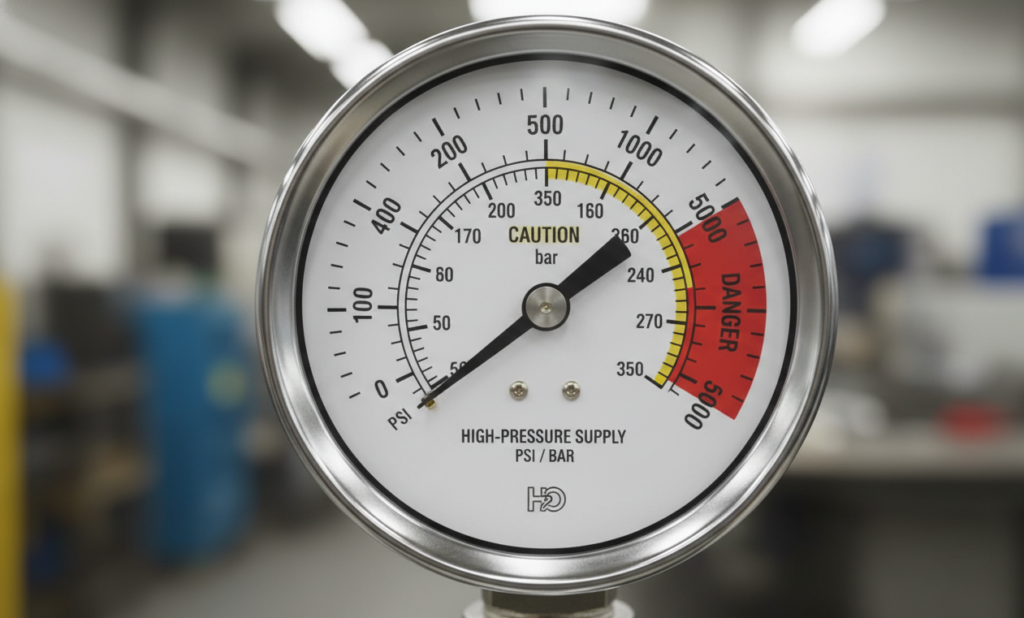
A supply pressure gauge shows the current hydrostatic or pneumatic pressure of your stored media, typically indicated on dual-scale dials displaying pounds per square inch (PSI) and metric Bar (or Megapascals, MPa). Technicians read the inner or outer scale depending on their localized piping standards. A full nitrogen or oxygen cylinder at room temperature typically registers between 2,000 and 2,640 PSI (137 to 182 Bar) on this dial.
Static Bottle Pressure vs. Dynamic Flowing Pressure
Technicians interpret the gauge dial differently based on whether gas is static or flowing through the system. Static pressure readings reflect the stable chemical equilibrium pressure of the source vessel. Dynamic pressure readings, observed when downstream flow valves are open, may drop slightly due to pipe friction and thermal expansion; a massive drop during flow suggests a major upstream restriction.
The “S.A.F.E.” Diagnostic Framework for Pressure Analysis
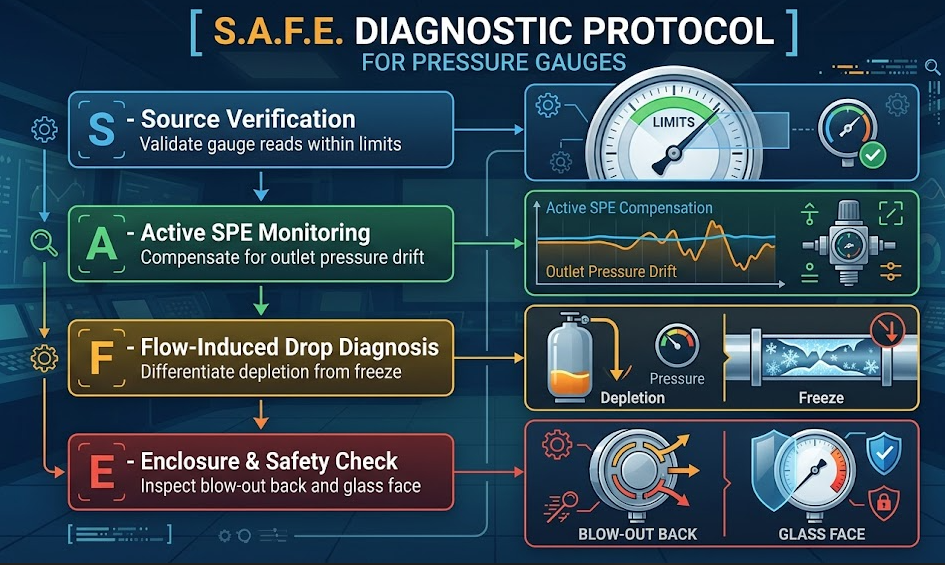
The S.A.F.E. protocol provides a structured diagnostic framework to verify supply gauge readings and maintain system safety. Industrial inspectors use these four sequential steps to evaluate system health.
Source Verification (S)
Source verification requires matching the supply gauge reading with the certified pressure rating of the connected gas bottle or supply manifold. Safety inspectors check if the dial reading aligns with the expected filled pressure listed on the gas vendor’s certificate. Any reading significantly lower than the specification on a fresh tank indicates a slow leak or a faulty fill.
Active SPE Monitoring (A)
Active monitoring of the Supply Pressure Effect (SPE) prevents downstream overpressurization when source cylinders run low. In single-stage regulators, downstream delivery pressure rises unexpectedly as the inlet supply pressure drops. Technicians use the supply pressure gauge to anticipate this shift, making manual dial adjustments to protect sensitive downstream equipment from pressure spikes.
Flow-Induced Drop Diagnosis (F)
Measuring supply pressure under dynamic flow conditions helps isolate pipeline flow restrictions from actual source depletion. A rapid plunge in supply pressure when a valve opens—followed by a slow recovery when closed—points to a restricted inlet filter or a crimped pigtail hose. Real-time diagnosis prevents technicians from prematurely replacing half-full gas cylinders.
Enclosure & Safety Check (E)
Inspecting the structural safety elements of the pressure gauge protects operators in the event of an internal Bourdon tube rupture. Inspectors must verify that the gauge’s rear blow-out plug is intact and unobstructed. If a high-pressure leak occurs inside the gauge housing, this safety feature directs the explosive pressure outward through the back of the casing rather than shattering the front glass into the operator’s face.
Three Critical Pitfalls Industrial Inspectors and Technicians Must Avoid
Pitfall 1: Ignoring Zero-Shift Calibration Drift
Operating with a supply gauge experiencing zero-shift calibration drift risks undetected overpressure or premature cylinder swap-outs. Over time, high-pressure surges stretch the internal Bourdon tube, causing the pointer to rest above zero even when completely depressurized. Inspectors detect this failure during maintenance shutdowns; a gauge showing residual pressure in an open-to-atmosphere system must be decommissioned immediately.
Pitfall 2: Overlooking the Supply Pressure Effect (SPE) Spike
Failing to compensate for the Supply Pressure Effect (SPE) causes catastrophic damage to low-pressure downstream components. When supply pressure drops by 1,000 PSI, a typical single-stage regulator’s outlet pressure can spike by as much as 10 to 20 PSI due to unbalanced forces on the internal valve seat. Technicians prevent this downstream pressure creep by installing dual-stage regulators or manually dialing down the regulator adjustment knob as the supply gauge declines.
Pitfall 3: Dismissing Freeze-Induced Pressure Drops (Joule-Thomson Effect)
Rapid pressure drops across the regulator inlet cause extreme cooling that freezes regulator internals and distorts gauge accuracy. High-flow carbon dioxide or nitrous oxide systems are highly susceptible to this thermodynamic cooling. A sudden drop in the supply gauge reading, accompanied by frost forming on the regulator body, indicates localized freezing rather than tank depletion, requiring the installation of inline gas heaters.
Step-by-Step Supply Pressure Gauge Inspection Checklist
Safety inspectors must execute these validation steps during scheduled monthly facility walk-throughs to ensure pressure integrity.
| Step | Inspection Target | Verification Criteria | Corrective Action |
| 1 | Dial Face & Lens | No cracks, condensation, or yellowed plastic. | Replace lens or entire gauge if visibility is compromised. |
| 2 | Pointer Alignment | Pointer rests exactly on the zero mark when system is depressurized. | Calibrate or replace gauge if zero-shift is observed. |
| 3 | Blow-Out Back | Elastic safety plug in the rear of the casing is present, pliable, and unpainted. | Replace missing or painted plugs to restore safety venting. |
| 4 | Connection Integrity | Threaded joints are free from corrosion and pass a liquid leak-detector test. | Depressurize system, clean threads, and re-seal with PTFE tape or thread sealant. |
| 5 | Steady Pointer Action | Pointer rises smoothly without fluttering or jumping under flow conditions. | Install a snubber or liquid-filled gauge to dampen system vibration. |
Frequently Asked Questions (PAA Style)
What is the difference between a supply gauge and a delivery gauge?
The supply gauge measures the raw, high pressure coming directly from the gas source (such as a 2,000 PSI cylinder) before it undergoes regulation [1.1]. The delivery gauge measures the lower, controlled pressure (usually between 0 and 100 PSI) exiting the regulator to feed downstream process lines.
Why does my supply pressure gauge drop suddenly when gas starts flowing?
A sudden drop in the supply gauge during active flow indicates a flow restriction upstream of the gauge or a severely depleted gas supply. Friction losses from clogged inlet filters, narrow-diameter pigtails, or partially opened cylinder valves restrict gas volume, causing the dynamic pressure reading to plummet.
Can a supply pressure gauge be repaired if the pointer does not return to zero?
A pressure gauge showing zero-shift calibration drift cannot be safely repaired in the field and must be replaced. This drift indicates that the internal brass or stainless steel Bourdon tube has suffered permanent plastic deformation from pressure spikes or physical shocks, rendering its entire scale inaccurate.
Why does delivery pressure rise when the supply pressure gauge reading drops?
This counter-intuitive behavior is caused by the Supply Pressure Effect (SPE), which is typical in single-stage gas regulators. As the inlet pressure drops, there is less force pushing against the regulator’s valve seat, allowing the internal spring to open the valve wider and increase downstream delivery pressure.
What is the safest way to depressurize a supply pressure gauge before removal?
To safely depressurize the gauge, close the main supply cylinder valve completely, then open a downstream vent valve to discharge the trapped gas. Verify that both the supply and delivery gauge pointers have returned fully to zero before attempting to loosen any threaded fittings.
How do I know if my high-pressure supply gauge is safe for oxygen service?
Gauges certified for oxygen service must feature a “Cleaned for Oxygen Service” label or a “Use No Oil” warning printed on the dial face. Hydrocarbon oils or greases inside a high-pressure oxygen environment will spontaneously ignite, making specialized cleaning protocols mandatory.